




Text Message Marketing Compliance: Understanding SMS Regulations for the United States and Europe


Legalese surrounding text message marketing compliance can seem endless. Like it or not, there are rules for all types of marketing, and breaking them can cost you money and customers.
Did you hear about the $250 million class-action lawsuit against Papa John’s Pizza in 2012? Customers reported receiving 500,000 text messages offering pizza discounts, with some getting 15 or 16 texts in a row, even at odd hours.
So, which rules of SMS marketing did Papa John’s violate? According to the Telephone Consumer Protection Act of 1991, businesses cannot send text message advertisements to customers without their permission. The plaintiff said that they never gave their consent to receive pizza ads.
Well, you can’t be mad at them for suing Papa John’s. Promotional messages can be annoying in many ways, and as a marketer, you don’t want to get in trouble with your customers or the law. So, how do you maintain compliance? When should SMS consent be obtained? What compliance regulations must you follow?
BSG will answer these questions. You will also learn how SMS marketing is regulated in the United States and Europe. Compliance with these regulations protects your brand’s reputation and assists you in avoiding costly marketing mistakes.
Why Complying with SMS Marketing Rules is Crucial
SMS marketing is more than just putting out campaigns and hoping people like them. Marketers frequently feel that following so many SMS rules can be a pain. But it might help to know why this is so important.
User Data Protection
One of the biggest sides of gaining customers is first gaining their trust. But imagine a case where they are lied to, tricked, or misled by businesses. Compliance laws are in place to stop these kinds of bad marketing practices. They protect customers’ privacy rights and allow them to choose the information that brands can access.
Branding
Dear marketers! Your brand is everything; your branding can make or break the deal. So, protect it at all costs, even if that means following endless text marketing rules. According to statistics , people are more likely to buy from you and share information with you if they trust you.
But when your brand gets a bad name, it’s hard to get rid of all the baggage that comes with it. SMS compliance is critical for businesses that want to keep their reputation intact and retain customer loyalty.
Financial Costs
You’re most likely concerned about the financial implications of breaking SMS rules. At the very least, you are now aware of Papa John’s scandal, which resulted in a $250 million fine. A compliance breach can have far-reaching consequences from which some businesses never fully recover. Not only will consumer distrust cost you revenue, but settling a regulatory audit can be prohibitively expensive and stifle business growth.
Which Bodies Regulate Text Marketing Compliance?
Separate organizations are in charge of making sure that SMS compliance laws are followed. From those working in the US to those in charge of things in Europe, here are the bodies that control SMS marketing.
| SMS Regulator | Meaning | Operating Region | Purpose |
|---|---|---|---|
| CTIA | Cellular Telecommunications Industry Association | USA | The CTIA is an organization that regulates wireless providers and related businesses. |
| TCPA | Telephone Consumer Protection Act | USA | The TCPA is federal legislation drafted in 1991 and regulates telemarketing and text messaging. |
| FCC | Federal Communications Commission | USA | The FCC regulates commercial text messages sent to mobile devices under the CAN-SPAM Act. |
| MMA | Mobile Marketing Association | USA | The MMA establishes guidelines to assist members in maintaining compliance with text message marketing. |
| Protecting Children With COPPA | The Children’s Online Privacy Protection Act | USA | COPPA is a federal law that regulates how website owners collect and use children’s data. |
| GDPR | General Data Protection Regulation | Europe | The GDPR governs the protection of consumer and personal information used by businesses operating in Europe. |
Comparing SMS Marketing Regulations: US vs. Europe

What laws govern text message compliance in the United States and Europe?
SMS Marketing Rules in the US
Here’s what marketers in the United States should know about text message regulations in their country.
TCPA SMS Requirements
According to the TCPA , it is against the law to send promotional text messages without the recipient’s prior express written consent. Failure to comply can result in massive class-action lawsuits and fines of up to $500 per text message.
CTIA SMS Requirements
The CTIA maintains the Short Code Monitoring Handbook , which lays out additional guidelines for SMS marketing. The CTIA’s guidelines align with TCPA laws to protect people from unwanted text messages but extend further to help marketers create a better consumer experience.
FCC SMS Requirements
The CAN-SPAM Act is the primary anti-spam legislation in the United States that mirrors the TCPA. Such annoying messages are known colloquially as robotexts. According to the FCC, companies must make it easy for customers to opt out of receiving text messages. In addition, the recipient must immediately identify the message as an advertisement. The CAN-SPAM Act covers only promotional text messages, not to ones that are transactional or informative.
COPPA Text Message Requirements
Before collecting or using personal information from children under 13, SMS marketers are required by the Children’s Online Privacy Protection Act (COPPA) to acquire “verifiable parental consent.” The FTC asserts that the COPPA Rule applies to most websites that target children under 13. However, operate a site for a general audience or a service used by sites intended for children, such as an ad network, plug-in, or another third-party service. You may also be responsible for COPPA compliance.
SMS Marketing Rules in Europe
In addition to the US regulations that apply globally, European regions have some text messaging compliance rules.
GDPR SMS Regulations
The General Data Protection Regulation (GDPR) establishes minimum mandatory requirements for collecting, storing, and disclosing personal data from EU citizens by any organization handling such data. Among the essential GDPR are the following:
- Obtaining consent before collecting user information.
- Protecting collected data by anonymizing their storage.
- Notifying users of any compromised data.
- Transferring data internationally in a secure manner.
When Should SMS Consent Be Obtained?
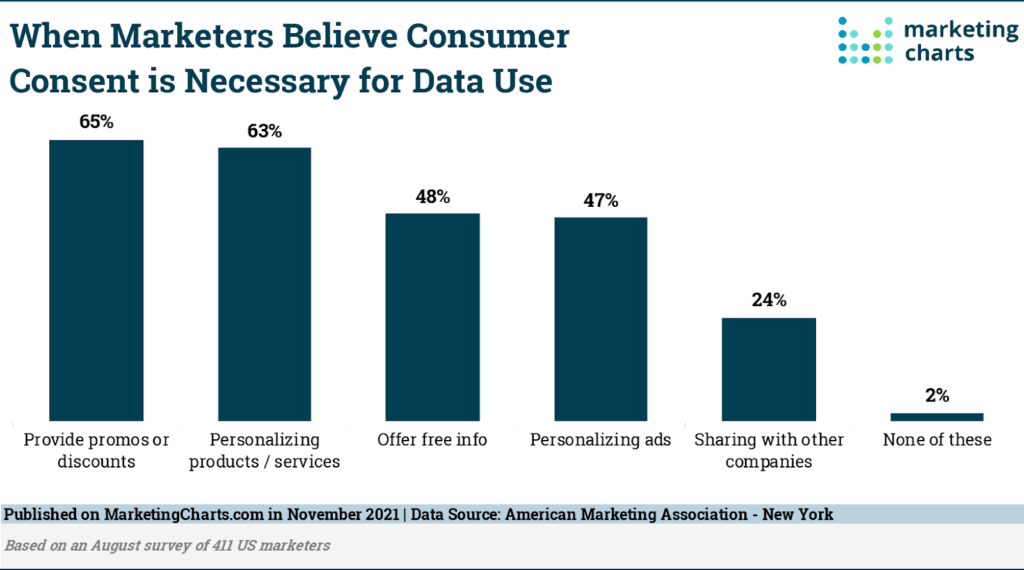
According to Marketing Charts , there are six classic situations in which marketers think that permission should be asked. The percentage of marketing professionals who hold each opinion is depicted in the image below.

But when we get down to SMS, text message campaigns can be conversational, informative, or promotional. While all types are subject to regulations, text messages that promote a business, service, or product are the most heavily regulated.
So, when is consent mandatory?
Conversations
Conversational texting or 2-way SMS is a way for businesses and customers to engage through text messages. Most of the time, the customer starts a conversation and wants a response from the brand. So, we call this kind of opting-in “implied consent.” This means that you don’t explicitly ask the user to opt-in. Instead, their actions should show that they want to interact with the brand.
Information
Informational messages are texts that convey important updates to users. Even though informational texts don’t try to sell something, you should still get the user’s permission to send them. Often, promotional messages are mistaken for those that provide useful information. When marketers need help determining what kind of permission to get, they must ask for express written consent. Users could permit by replying to the message, filling out a form, or agreeing to t alk to the brand over the phone .
Promotions
It would help if you got clear, written permission for any SMS advertising campaigns you run. Because promotional SMS is more intrusive than other types, marketers need to ensure they have enough proof that users gave their permission in case they face a lawsuit.
You cannot sneak permission to send marketing texts into fine print or a privacy statement when soliciting someone’s express consent for SMS marketing. You also can’t use default checked boxes to force people to opt in.
When Can Consent be Exempt?
- Exemptions from the TCPA’s text message prohibitions include having an existing relationship with the recipient, operating as a non-profit organization that does not engage in commercial activities, or sending business information on behalf of a person covered by a particular healthcare plan. The TCPA’s consent requirement does not also apply to automated text messages sent for emergencies.
- Under COPPA’s rules, parents’ permission isn’t always needed to get a child’s personal information. Such instances include getting a child’s consent to protect them, or fulfilling a one-time request, as long as the personal information is deleted right after usage.
How to Ensure You’re Compliant
Maintaining compliance is not exactly a feat of genius, but neither is it particularly difficult. Below are crucial guidelines to keep in mind.
Obtain permission from clients
Before sending your first marketing text message, you must obtain permission from your intended recipients. This authorization must be in writing.
Avoid Ambiguity
If you want people to opt-in to your bulk SMS campaigns , you must inform them of what it entails. And before consumers consent, they should be briefed on vital details such as the company, the campaign’s purpose, the number of messages they will receive, and more.
Send Acceptance Confirmation
Send a confirmation message to subscribers who have opted into receiving your promotional emails. If they conclude their initial choice was erroneous, they can leave the area more quickly. If you make it simple for subscribers to unsubscribe from your SMS, they will be less likely to report it as spam.
Avoid Offensive Expressions
For example, the acronym SHAFT comprises sex, hate, alcohol, firearms, and tobacco. This is an absolute never when it comes to marketing. If you avoid this, you won’t have to deal with the legal drama that may result from it.
Stay Current on SMS Rules
Keeping up-to-date with the latest SMS marketing regulations is an ongoing process. Since the rules constantly change, you must monitor the trends and ensure that your SMS marketing adheres to the most recent norms.
Work with Only Vetted and Approved SMS Operators
Be wary of unlicensed operators who take advantage of SmartHub’s gray areas and offer foreign service providers access to their connections without granting them direct access. Of course, such collaborations raise the risk of text message compliance violations.
BSG is an authorized A2P SMS partner for the largest SMS Hubs, OTTs, and mobile operators in the world. Promotional A2P messages are frequently subject to local country regulations, so we ensure that not only are our products compliant with local regulations, but also with international standards.
One such product is our
SMS platform for rent
, which allows small scale operators and wholesalers to start their SMS business at a low cost and in accordance with text messaging regulations. If you are still unsure whether your campaigns meet the guidelines established by authorities, we will be happy to assist you.
Get in touch with our experts
for more advice.


Interested in a special offer?
Ready to reach further?
Let’s talk


Related articles

Why reseller solutions in SMS industry? What do SMS resellers or other intermediaries do in the distribution

For those who yet do not know what inbound marketing is, this is a kind
Today, brands are reaching us out via emails and SMS inboxes more frequently than our