




WhatsApp Business multiple users: app vs Platform for eCommerce

An eCommerce operator in Lagos opens WhatsApp at 9am and finds forty-seven unread conversations from the night before. More than half are pre-purchase questions - sizing, stock, delivery timing, payment confirmation. By 11am, three agents are replying from the same phone. Two open the same thread a minute apart and send conflicting answers about delivery time. The customer goes quiet. That cart is gone, and nobody on the team can tell who dropped it.
This is what WhatsApp Business multiple users actually looks like in practice - not a settings question, but an operational one. In markets where WhatsApp is the primary sales channel, how your team shares that inbox decides how many carts you recover and how many orders you lose. Getting the multi-user setup right is the difference between a support team that scales with revenue and one that caps it.
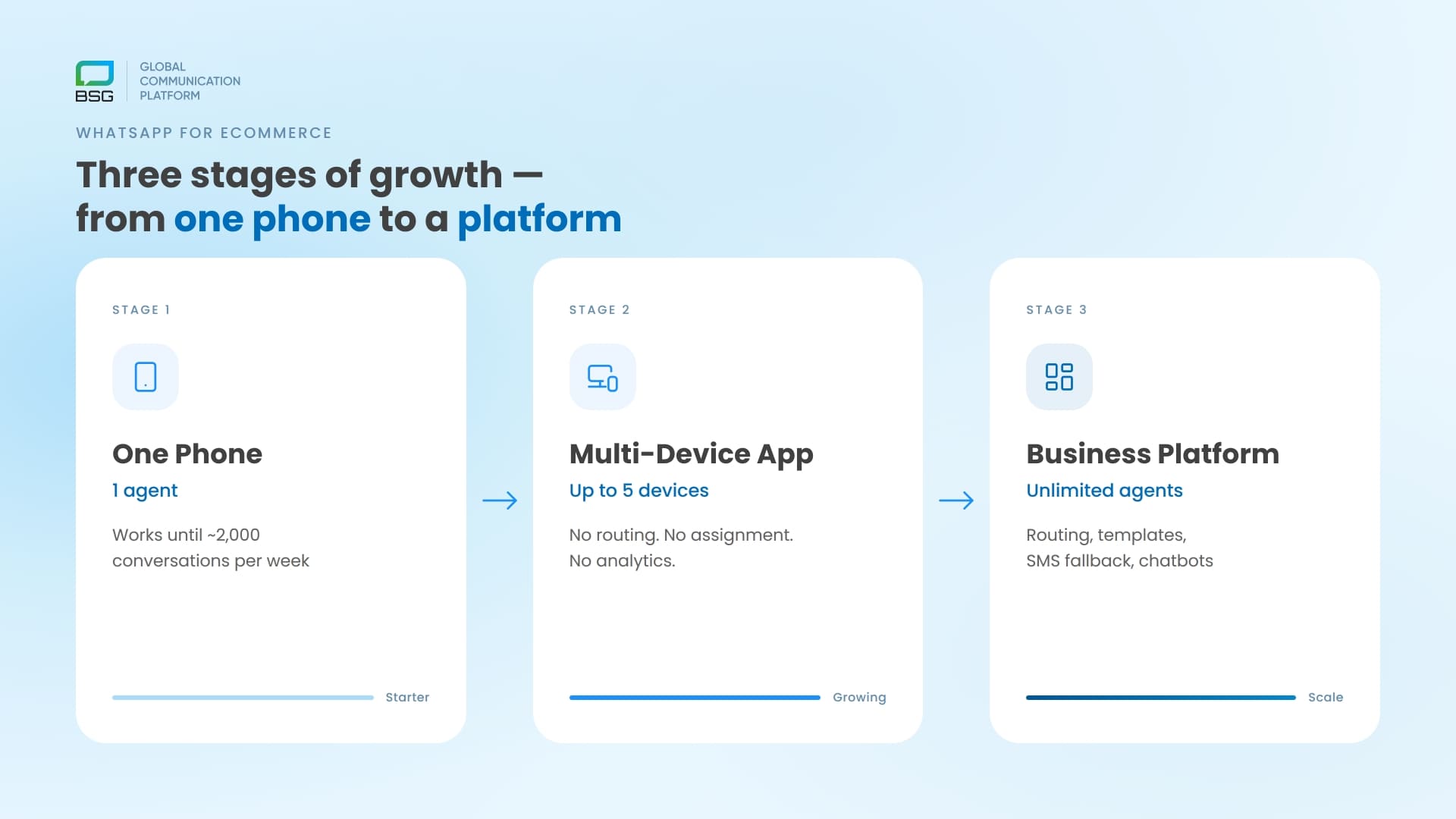
The one-phone problem for eCommerce teams
When a small online retailer starts using WhatsApp for sales, one phone is fine. One person handles conversations, answers what they can, and passes the rest to a team chat. It works until it doesn't.
The tipping point usually arrives before operators notice it. Message volume rises with every promo, every Instagram campaign, every payday. In Nairobi and Lagos, eCommerce teams running paid ads commonly cross 2,000-4,000 WhatsApp conversations per week within a few months of treating WhatsApp as a primary channel. At that volume, the person holding the phone stops being a support agent and becomes a bottleneck.
What breaks first is speed. Customers in WhatsApp-first markets expect replies during business hours in minutes, not hours. The second break is visibility - nobody outside the person with the phone can see what was said, what was promised, what was missed. The third is ownership. When everyone has access to the same device, nobody owns a thread, and threads without an owner go cold.
At BSG, we've seen that teams hit this wall earlier than they expect. In the campaigns we support across Kenya, Nigeria, and the Philippines, operators usually reach the one-phone ceiling somewhere between month three and month six of treating WhatsApp as a primary sales channel - often during a promotion when volume doubles overnight.
What the WhatsApp Business app offers for multiple users
The WhatsApp Business app includes a multi-device feature. One primary phone anchors the account, and up to four additional devices - laptops, desktops, tablets, or extra phones - can link to it. All five can see the same inbox, the same threads, and reply from the same business number.
For a team of two to five people, this solves the access problem. Everyone works from their own screen. Nobody waits for the phone. That is the strength of the app, and also its limit - it solves access, not coordination.
There is no agent assignment, no routing logic, no analytics showing who replied or how fast. Two agents can reply to the same customer at the same time and the app will not flag it. There is no integration with an order management system, so an agent answering a cart question has to check order status in a second tool. For very small teams with predictable volume, this is a reasonable starting point. For most eCommerce teams, it is a ceiling pretending to be a platform.
How to add devices to the WhatsApp Business app
The steps are short. Open the WhatsApp Business app on the primary phone, tap the three-dot menu, select Linked Devices, tap Link a Device, then scan the QR code on the secondary device. Repeat for each additional laptop, tablet, or phone up to the four-device cap.
One detail worth remembering: the primary phone must remain signed in and online at least once every 14 days. If the primary device goes offline longer, the linked sessions expire and the team is locked out. In teams that share a dedicated company phone, this detail slips through regularly - especially over holidays.
Where multi-device stops being enough
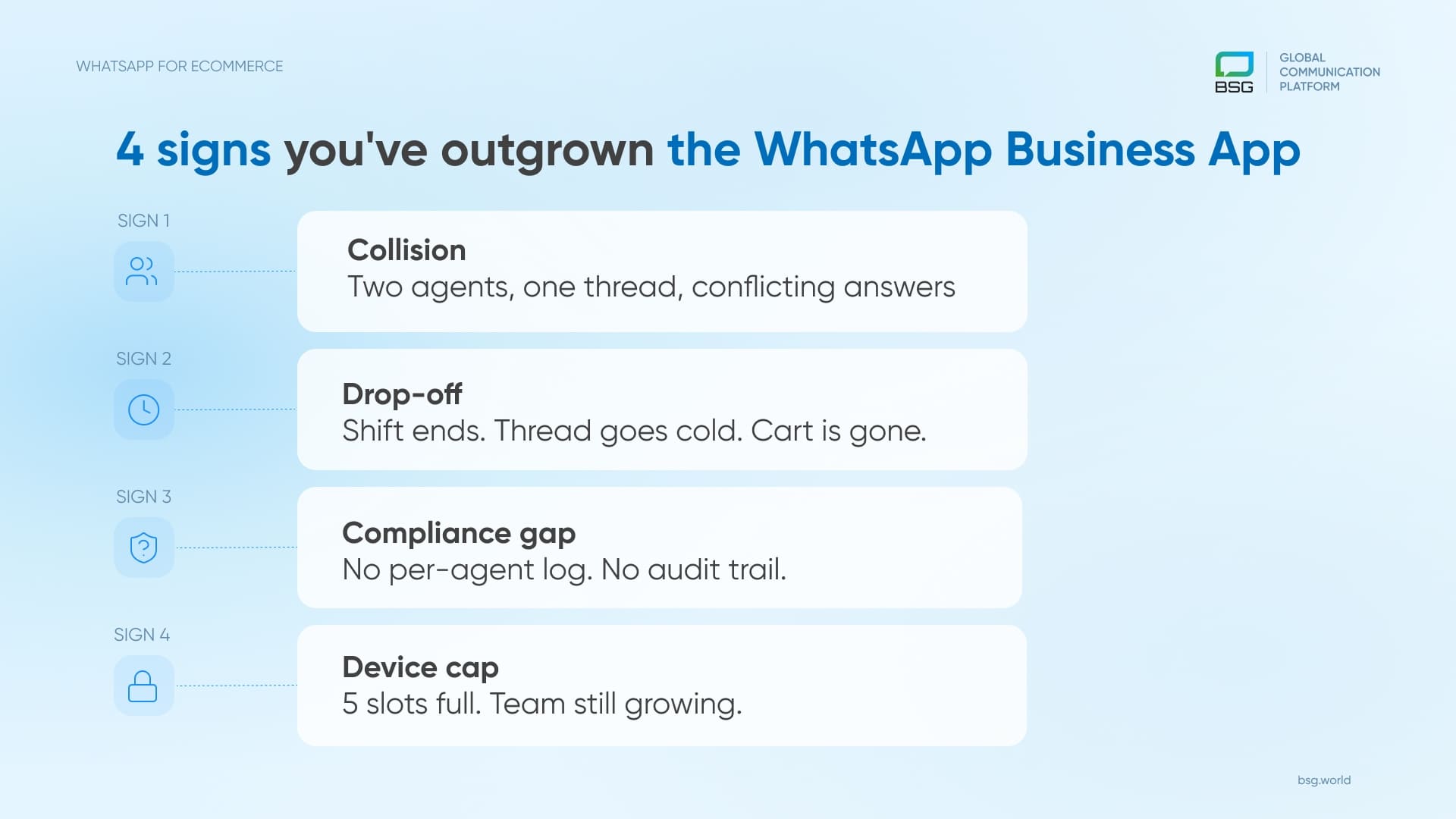
Multi-device linking is a ceiling, not a platform. The signs that a team has hit the ceiling are predictable, and each costs money directly.
Collision is the most visible one. Two agents in the same conversation at the same time, typing past each other. The customer now has two different answers to the same question - usually about the delivery window. Trust dips. The sale stalls. Based on what we observe across the campaigns we support, a team of five or more on the app alone generates collision incidents at least weekly, and the customer almost always feels it.
The second sign is drop-off. Without ownership, a thread started at 3pm can sit unattended overnight because the agent who opened it finished their shift and nobody else picked it up. By the morning, the buyer has forgotten the question or moved to a competitor. Average cart abandonment across eCommerce already sits around 70% (Baymard Institute, 2024) - unattended WhatsApp threads push that number higher in channels where customers expect fast replies.
The third symptom is compliance exposure. Nigeria's NDPR and South Africa's POPIA require a clear audit trail of customer communications, including who responded and when. A shared phone with no per-agent login leaves that audit trail blurred. The Philippines' Data Privacy Act applies a similar standard. The fourth symptom is the simplest - you run out of device slots, and the team keeps growing.
Moving to the WhatsApp Business Platform for eCommerce teams
The WhatsApp Business Platform - the API layer - is the upgrade path. It is not a new app to install. It is a change in how the WhatsApp number is connected: instead of being tied to a phone, it sits on a business platform accessed through a verified Business Solution Provider.
What this changes for an eCommerce team is direct. Unlimited agents work from a shared inbox on a desktop or browser. Conversations are assigned by rule or by hand. Pre-approved message templates for order confirmations, delivery updates, and abandoned-cart nudges can be sent at scale. Chatbots handle the repetitive pre-purchase questions - stock checks, size guides, payment instructions - so agents focus only on threads that need a human.
SMS fallback is the piece that matters most in emerging markets. Parts of Kenya, Nigeria, South Africa, and the Philippines see regular connectivity drops mid-conversation. A WhatsApp message that does not deliver within a defined window can be re-sent over Bulk SMS so the customer still receives the order confirmation or OTP. This kind of conditional routing is not possible on the Business app - it requires platform-level control. For the eCommerce businesses we work with in target markets, pairing WhatsApp with SMS fallback on transactional messages is consistently one of the highest-impact operational changes teams make after moving to the Platform.
Two adoption paths exist. A custom API build gives developers direct control and deep customisation, which suits teams with in-house engineering. A turnkey platform from a BSP covers the same functionality through a dashboard - faster to launch, no code required, and usually the right fit for SMB and mid-size eCommerce teams. Our solutions for eCommerce and retail are built around the turnkey route for exactly this reason.
Choosing between the app and the Business Platform
The decision is not philosophical. It is operational, and it usually comes down to three questions.
How many people need to reply to customers? Under five agents, the app can hold - if the device cap suits the team's shift pattern. Above five, the Platform is the only real option. What is the weekly message volume, and is it stable? If conversations are few and predictable, the app is fine. If volume spikes on paydays, promos, or after paid-media pushes, routing becomes necessary. How long can a customer wait for a reply without the cart going cold? For most eCommerce teams in Lagos, Nairobi, Johannesburg, or Manila, the honest answer is "not long" - and coordination matters more than access once that is true.
For the businesses we work with in these markets, the clearest signal that it's time to move off the app is a combination of two things at once: the team is at five people and growing, and the operator is losing visibility into which customer questions got answered and which did not. When both are true, the app is no longer neutral - it is actively costing revenue.
FAQ
Can you have multiple users on WhatsApp Business for free?
Yes - the WhatsApp Business app supports up to five devices on one account at no cost. Beyond that, the WhatsApp Business Platform charges per-conversation fees set by WhatsApp, with additional platform or BSP fees depending on the provider and the channels enabled.
How many users can WhatsApp Business API support?
The WhatsApp Business API does not cap the number of agents. Teams of ten, fifty, or several hundred agents can all share the same inbox and business number, with routing, assignment, and analytics managed at the platform level.
Do I need a BSP to use the WhatsApp Business API?
Yes. WhatsApp requires that access to the Business API runs through a verified Business Solution Provider. The BSP handles number onboarding, template approvals, and compliance layers - and is also the source of support when something breaks in production.
If your team is past five agents on WhatsApp
If you're seeing missed threads and duplicate replies on a weekly basis, the next step is a short conversation about what a multi-agent setup would look like for your specific volume and markets. We can walk through the onboarding timeline, the SMS fallback configuration, and the integration options with your order system. Talk to our team when you're ready.


Interested in a special offer?
Ready to reach further?
Let’s talk


Related articles

There have been changes to customer preferences in their interaction with brands in recent years.

With over 13 years of experience in sales, I’ve navigated my way from a Senior
Why Should Ecommerce Stores Use SMS Marketing? Did you know that up to 5 billion