




RCS vs WhatsApp for eCommerce: Which Channel Actually Reaches Your Customers

An eCommerce manager in Lagos, Nairobi, or Manila rarely has the budget to run three messaging channels in parallel just to see which one works. The decision carries revenue weight immediately. A cart recovery flow that reaches the wrong audience, a checkout OTP that times out at the critical moment, or a promotional campaign that opens at two percent instead of forty percent — each of these chips away at conversion and lifetime value before anyone notices the trend in the dashboard.
Two channels dominate the conversation about RCS vs WhatsApp for eCommerce today. WhatsApp Business API has mass reach in Africa and Southeast Asia and a mature automation ecosystem. RCS for Business is newer in these regions, carrier-dependent, and increasingly visible since Apple added iOS 18 support. Both promise open rates far above email. Both cost real money at volume.
The question is not which channel is "better." The question is which one reaches your specific customer base reliably, at what cost, for what job — and whether both together do the work better than either one alone.
The revenue cost of choosing the wrong messaging channel
A single missed OTP at checkout is often a lost sale. A WhatsApp promotion that reaches only half your audience because the other half never opened the app that week is a 50 percent campaign, not a 100 percent one. An RCS campaign that assumes broad carrier support in a market where one major operator has not yet enabled RCS reaches whatever share of your audience happens to be on the supported networks.
At BSG, we've seen that eCommerce teams who treat channel selection as a marketing decision — rather than an operational one tied to delivery confirmation — tend to overspend on the primary send and underspend on the fallback logic that determines actual reach. The cost of that mistake shows up in the cost-per-recovered-cart number, not in the campaign open rate.
For the businesses we work with in Nigeria and Kenya, the pattern is consistent: WhatsApp handles the bulk of conversational and promotional traffic, SMS carries the guaranteed-reach floor for verification and urgent alerts, and RCS fits specific campaigns where carrier and device alignment are known in advance.
How RCS and WhatsApp reach customers differently
WhatsApp is an application. A customer installs it, registers with a phone number, and receives messages whenever their device has a data connection. With around three billion monthly active users globally as of mid-2024 (Statista / Mobilesquared, 2024), the install base in Kenya, Nigeria, South Africa, and the Philippines is close to total among smartphone owners. A message sent from a WhatsApp Business API account lands in the same inbox as messages from family, which is both the channel's strength and the reason opt-in hygiene matters so much.
RCS for Business is not an app. It is a messaging protocol that upgrades the native SMS inbox on supported devices into an interactive, branded experience — carousels, buttons, read receipts, verified sender profiles, and rich media, all inside the phone's default messaging app. On Android the inbox is usually Google Messages. On iPhone, RCS arrived with iOS 18 and is rolling out market by market.
The practical difference matters for an eCommerce operator. WhatsApp delivery depends only on whether the recipient has the app and a data connection. RCS delivery depends on three conditions aligning at once: a capable device, a supported OS version, and carrier support on that customer's network. In BSG's experience, RCS availability across the operators our clients serve in Africa and Southeast Asia varies meaningfully from one country to the next, and from one quarter to the next as carrier rollouts progress.
RCS vs WhatsApp for eCommerce: the feature comparison that matters
The trade-offs come into focus once the two channels are placed side by side on the dimensions an eCommerce team actually budgets against — install base, fallback behavior, pricing, ecosystem maturity, sender identity, and rich media.
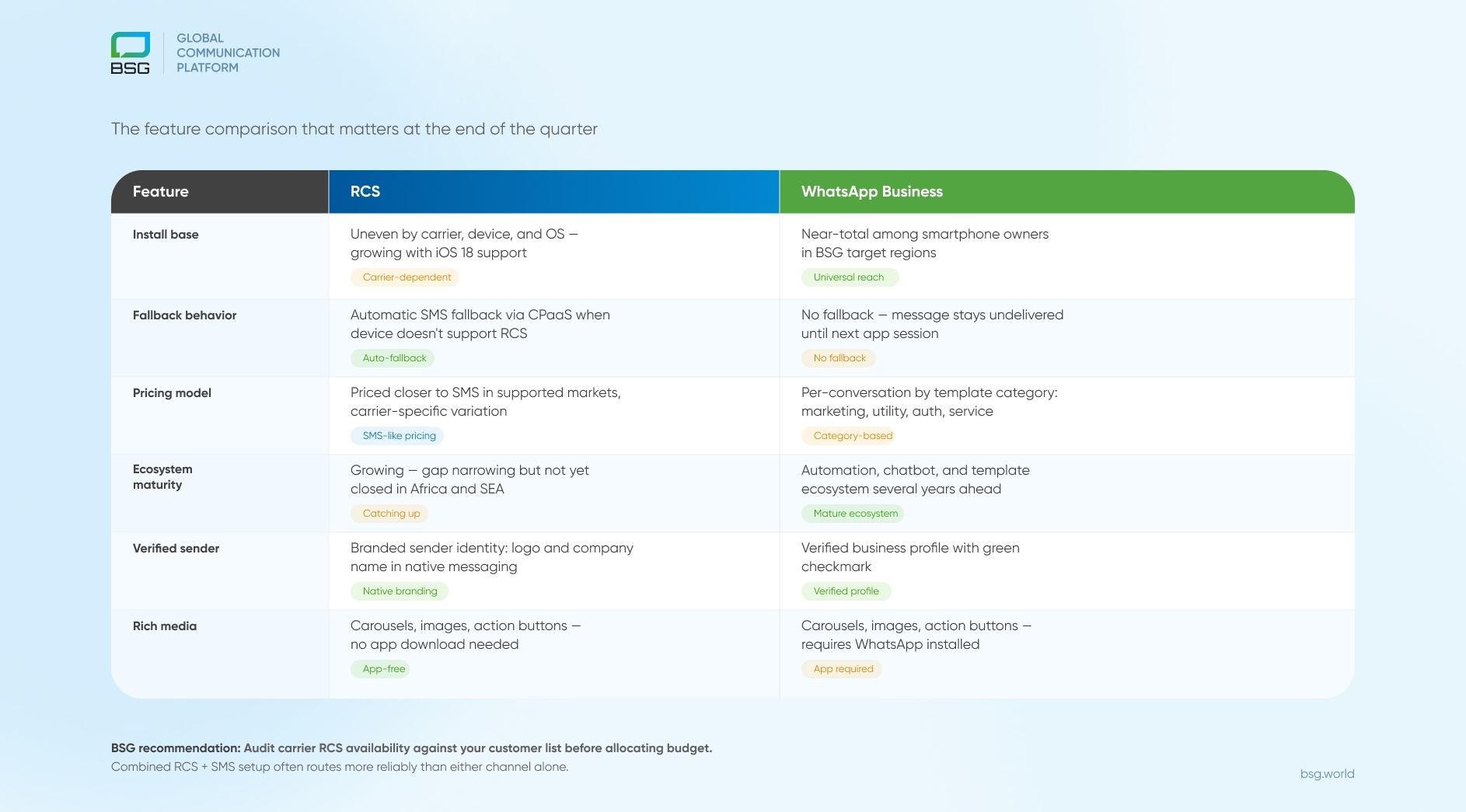
Two takeaways drive the rest of the decision. RCS wins on automatic SMS fallback and native-inbox placement, while WhatsApp wins on universal install base and ecosystem maturity. In most BSG markets, the strongest setup is not one channel beating the other — it is a combined RCS + WhatsApp + SMS routing that pulls each one's strength forward.
Matching RCS or WhatsApp to the eCommerce job
No single comparison table replaces the decision of which channel for which message. The same eCommerce brand may reasonably use WhatsApp for one-to-one support, RCS for a seasonal promotion in a market with strong carrier coverage, and SMS as the default floor underneath both.
Cart recovery leans toward WhatsApp in BSG's markets because reach among shoppers is near-universal and the conversational format invites a reply instead of just a click. This is especially true where M-Pesa in Kenya and GCash in the Philippines have already conditioned shoppers to complete transactions inside a chat-style interface. A well-built WhatsApp cart recovery flow recovers a meaningful share of abandoned carts in a 72-hour window — but only if the customer opted in at checkout and the device has recent data activity.
Promotional campaigns are where RCS earns its place in markets with solid carrier coverage. The native-inbox placement competes with fewer conversations than a WhatsApp campaign buried under family chats.
Order updates and service messages work well on either channel. The choice often depends on what the customer opted in for and which channel your support team is already operating.
OTP and checkout verification is the use case where teams most often default to whichever channel they already run, and that default is usually wrong by itself — a topic worth its own section below.
Is RCS better than WhatsApp for OTPs?
Neither channel is universally better for one-time passwords. RCS OTP from a verified sender reaches a broad Android base in markets with strong carrier support, while WhatsApp OTP performs well where the customer already has the app open daily. The reliable pattern is to lead with the channel your customer already uses and fall back to SMS through a 2FA setup when delivery confirmation does not arrive within a short window. What our clients have found is that the difference between a 92 percent checkout completion rate and a 97 percent one is almost entirely in how fast the fallback triggers when the primary channel does not confirm delivery.
The fallback question most teams skip
The single decision that most separates a reliable eCommerce messaging stack from an unreliable one is not the primary channel choice. It is the fallback logic underneath.
A WhatsApp-only cart recovery flow misses every customer whose phone is not currently pulling data. An RCS-only campaign misses anyone on a carrier that has not enabled RCS or a device that has not updated its messaging app. SMS, the least glamorous channel in this comparison, is still the only one that reaches almost any mobile phone, on any network, in any state — which is exactly why it belongs in the architecture even when it is not the primary send.
In the eCommerce campaigns we support, the typical production pattern is a primary channel matched to customer segment, a secondary channel triggered by delivery failure within a defined window, and SMS as the guaranteed-reach floor for time-sensitive messages like OTPs and order confirmations. The routing logic runs per message, not per campaign. A customer on a newer Android device in South Africa may receive RCS; the same campaign sends WhatsApp to a Philippines customer who opens the app daily; and both fall back to SMS when the primary does not confirm.
Can I use RCS and WhatsApp together for eCommerce messaging?
Yes, and in most cases that is the strongest setup. A routing layer sends the message on the primary channel your customer prefers, monitors delivery confirmation, and falls back to the next channel automatically when delivery does not confirm. In our experience working with eCommerce clients in emerging markets, a production setup that combines WhatsApp, RCS, and SMS under a single routing logic delivers higher overall reach than any single-channel strategy, especially on transactional messages where delivery is not optional.
Is RCS available in Kenya, Nigeria, South Africa, and the Philippines?
RCS availability in these markets is real but uneven. Support varies by mobile operator, by device model, and by the messaging app version on the customer's phone. Before committing budget to an RCS campaign in any of these markets, audit the carrier support on the specific operators where your customer base concentrates. A vendor's global availability claim is not the same thing as delivered coverage on your customer list.
How do RCS and WhatsApp compare on cost for eCommerce campaigns?
WhatsApp prices per conversation by template category, with marketing, utility, authentication, and service windows each carrying distinct rates. RCS in markets where it is available is often closer to SMS pricing, with operator-specific variation. The meaningful cost comparison for eCommerce is not per message but per outcome — per recovered cart, per authenticated checkout, per opened promotion — and that math depends on your specific audience's channel reach.
What to check before you commit
Before running a full campaign on either channel, eCommerce teams should audit three things.
- Carrier RCS availability: the actual support on the carriers their customer base uses — not the global availability claim from a vendor deck.
- Device and OS mix: the actual breakdown inside their own customer database, not regional averages.
- Cost model at realistic volume: including the fallback route and what each delivery confirmation actually costs.
That audit takes less than a week and prevents the expensive decision of committing six months of budget to a channel that reaches sixty percent of the intended audience.
If you are weighing RCS, WhatsApp, and SMS for an eCommerce operation in Kenya, Nigeria, South Africa, or the Philippines, the decision gets easier once you have clear delivery data on your own customer base rather than on global averages. Our team has helped eCommerce clients in these markets audit channel reach, build routing logic that combines RCS, WhatsApp, and SMS, and tune the fallback windows that decide whether a cart recovery or an OTP actually lands. Talk to the BSG team if you want a practical read on what will work for your customer base before you commit a budget.


Interested in a special offer?
Ready to reach further?
Let’s talk


Related articles
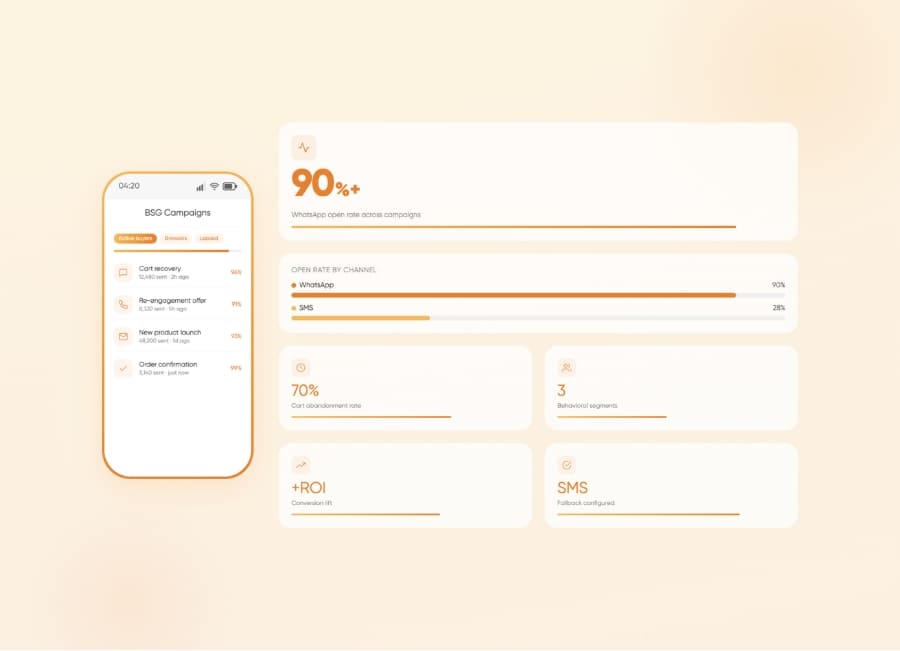
Your WhatsApp broadcasts get read — but orders aren't following. Five execution decisions that close the gap.
Have you ever wondered why service providers gather your personal information, such as your date
Creating conversational bulk SMS messages can be a tall order for businesses, especially when there’s