






Quality customer service lies at the core of any prosperous business, and voice bots are revolutionizing solutions that can bring a new experience to your customers. They provide a hands-free approach, increase the speed of processes, and save the company’s budget.. According to recent Gartner research , conversational AI is predicted to reduce contact center agent labor costs by $80 billion by 2026.
Voice bots are a win-win decision for both the company in terms of time and cost savings, and for the customers in terms of usability. However, the technology has more development complications and requires training AI voice bots to make them function properly. Continue reading this article to learn about the process of training these bots, the difficulties you may encounter, and the best practices to train voice bots.
How Do Virtual Assistants Work and What is Voice Bot Training?
As conversational technologies are still maturing, they already have a lot to offer. As an experienced provider of voice chatbots , the BSG has defined technologies and voice bot development phases like these:
Technologies that Lie at the Core of How Voice Bot Works
The voice bot AI can be provided with an extensive landscape of capabilities, which depends on the needs of customers:
- Speech Recognition . Voice bots comprehend and transcribe spoken language. A large amount of audio data is required to train the bot to recognize words, phrases, accents, and speech patterns.
- Natural Language Processing . Using NLP, voice bots can interpret spoken language, which allows the bot to recognize user intents, collect relevant information, and reply properly.
- Intent Recognition . To comprehend human inquiries and instructions, voice bots learn to understand human queries and commands.
- Customization . Users may personalize their voice bot experiences and the bot may be educated using user-specific data such as previous interactions, preferences, and personal information.
- Language adaptiveness . Voice bots may learn to speak in a variety of accents and languages through multilingual training data.
- Emotional Intelligence . This feature of voice bots enables for detecting and responding to user emotions to provide appropriate replies or assistance.
While delivering coherent and brought customer experience, both Voice Bot or Chatbot comprehensive training to operate properly.
8 Steps to Train your Voice Bot
The phases you will need to undergo while creating a voice bot on your own or with a vendor include:
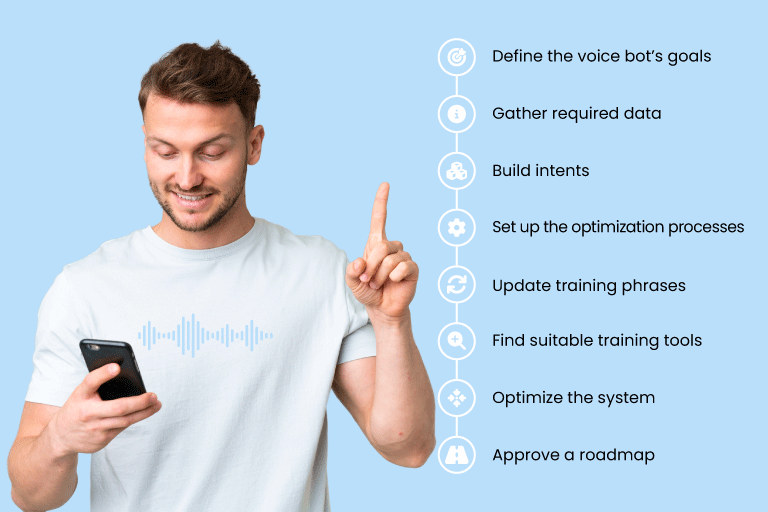
- Define the voice bot’s goals . Spot the specific information and interactions the voice bot should obtain.
- Gather required data . Collect a diverse set of training data for a voice chatbot, including audio recordings, transcripts, conversations, and relevant online content.
- Build intents . Create intents that describe different user intentions. Each intent should include training phrases (sample questions) and one or more responses.
- Set up the optimization processes . Start monitoring conversation progress between the bot and trainers, evaluating if the bot correctly matches intents with the tasks given.
- Update training phrases . Train your voicebot adding the new question to the intent’s list of training vocabulary. In case a mismatch occurs, feel free to choose the correct intent and add the new question to training phrases.
- Find suitable training tools . Utilize a chatbot training tool that provides an interface to display conversation history and user’s intents and can help to correct voice bot’s decisions.
- Optimize the system . Long-term improvements include switching channels, adopting conversation scripts, or adding new languages or voice chatbot technologies.
- Approve a roadmap . Create a strategy to outline conversational AI paths. Make sure to include proof of concept, adding complexity, and scaling.
Besides following these steps, it is important to keep in mind that training voice bot technology requires regular updates to ensure proper understanding of users.
How Does a Voice Bot Assist Businesses and Customer Service?
The innovative solution of using voice bot technology has gained momentum after the Covid-19 pandemic, as businesses had to turn to improved remote customer service to survive. The demand for voice bot experiences has witnessed a significant boom across all industries, creating a need for effective tools to fill the gap in customer assistant positions. Implementing AI-powered solution has resulted in the following benefits:
BSG has defined three major benefits of AI-powered assistants:
- High efficiency
Contact center interactions with customers can be completely automated with conversational AI. AI voice bots may automate up to 30% of the work normally done by a human, including gathering basic client information like name, policy number, and reason for call.
- High usability
Conversational AI can enhance the user experience by responding to customers more quickly and accurately, nearly minimizing the risk of human factor mistakes.
- Lower operational costs
Voice bots automate customer chats, reducing the need for additional customer support and consulting positions. This allows contact center agents to focus on more complex customer issues, relieving them from repetitive support inquiries.
- High customer retention
Voice bots ensure high-quality customer experiences by addressing their needs instantly and reducing human errors. Satisfied customers are more likely to remain loyal to your brand.
- Reduced marketing costs
AI-powered voice bots gather valuable data to create comprehensive client profiles and integrated into existing customer data platforms. Organizations can leverage this information to tailor their marketing strategies to their target demographic.
- Scalable business processes
While a human can only handle a conversation with a limited number of people, automated voice calling system has limitless capabilities, allowing businesses to cater to a larger customer base efficiently.
It comes as no surprise that voice bot solutions have become one of the most sophisticated tools in customer support, providing numerous improvements for businesses across all industries, including financial one.
What are The Challenges in Training a Voice Bot?
Working on a voice bot is a complementary and complex task that requires constant improvement. However, there are several complications that may arise during the training process. Here are some of them:
- Robotic-sounding conversations
AI phone calls can often sound impersonal and cold, which can be off-putting to users. To avoid robot AI voice, it is important to work closely on the tone of voice of your AI assistant. Greet customers in a friendly manner, keep the conversation light and interactive, prepare backup answers for when the bot doesn’t understand a question, and incorporate real voice elements into the bot.
- Lack of knowledge in Machine Learning and Natural Language Processing (NLP)
Some chatbots may offer only a single NLP option that may not cover all user requests. If you want to develop your NLP capabilities and improve your chatbot’s performance using machine learning, you need to choose a suitable model. Consider a range of models, from generative to retrieval-based, to build an intelligent chatbot.
- Data security issues
Integrating a chatbot or voice bot into your website can bring potential data security problems with APIs. Ensure that you use the ‘http’ protocol for your chatbot, avoid including any confidential data in the bots, and conduct thorough beta-testing of all security protocols to prevent any mistakes.
- Lack of expertise in the training team
It is a common mistake to launch a voice bot without sufficient training. To ensure the chatbot is well-prepared to answer queries, involve a diverse team that can ask questions in various formats. This team can also rigorously test the bot before its official launch.
- Misalignment of chatbot with business capabilities
If your chatbot does not capture your business’s unique selling proposition (USP), adding excessive data or advanced technology will not yield meaningful results. It is crucial for your chatbot to not only possess relevant data but also communicate effectively with your target audience by reflecting your brand identity and promoting brand awareness.
By considering factors mentioned above, businesses can train AI-driven conversational systems that are engaging, effective, and aligned with their goals.
How to Train Your Voice Bot to Understand Customer Intent
Here is a comprehensive step-by-step guide on how to train a voice bot to understand your customer intents by BSG, a company with years of experience in conversational AI solutions:
- Recognize the significance of intent and emotions: Emotions play a crucial role in conveying meaning and understanding in interpersonal communication, which includes the expression of intent.
- Analyze the emotional content of client statements : It is possible to evaluate both the content and prosodic or cepstral features of the voice. Machine learning can reliably classify speech features that indicate emotions.
- Consider contextual cues: Take into account the broader context of the conversation, including global knowledge, the specific situation, and nonverbal cues. Understand how the emotional context influences the interpretation of words and adapt the bot’s responses accordingly.
- Train the bot based on real-life interactions: Analyze conversations between customers and agents to train the bot. Study specific speech patterns and emotional cues displayed by buyers to recognize motivations and emotions in various contexts.
- Define “intent”: Intent is an emotional value in human-robot interactions. Teach the bot to identify and respond to emotive language to provide a better customer experience.
- Utilize deep learning: Deep learning techniques learn everything from data based on human dialogue, and they are crucial for improving the bot’s understanding of user intent and emotions. Feedback can be used to enhance language processing.
- Connect intent and emotion recognition: Find solutions to recognition errors caused by emotions, which can impact the bot’s understanding of customer utterances to enhance the accuracy of intent identification. Work on improving the examination of how customer service and recommender systems recognize automated intent.
- Implement emotional attitudes to enhance comprehension: Incorporate emotional attitudes into the bot’s phrase processing, both in literal and nonliteral contexts, to improve comprehension and customer service. To educate a speech bot to better understand user intent, consider emotions, contextual signals, continuous learning, and adaptation.
Working with artificial intelligence can be a difficult task, keep following these steps to enhance the adaptation process of your voice bot and create a more intuitive and empathetic customer experience.
Example of Voice Bot Training to Improve the Customer Experience
One of the brightest cases BSG has worked on is FrameHome Construction Voice Bot implementation. The primary objective was to ensure customers progressed through the sales funnel stages, achieving a minimum 40% conversion rate from the “waiting” stage to the “appointment” stage.
BSG Voice Bot provided timely responses to maintain customer interest and analyzed conversation patterns to determine clients’ purchase intentions. Voice Bot proved to be a powerful solution, qualifying leads by asking relevant questions and collecting essential information about clients’ needs. FrameHome Construction achieved significant business value, including a remarkable 45% increase in intention-to-visit conversions, a reduced workload for customer managers, and an expanded client database.
Final Take
Voice bots can yield several benefits. These include enhancing user satisfaction, reducing operational costs, and fostering customer loyalty toward your brand. Although training a voice bot may seem like quite a challenge, partnering with a reputable conversational AI provider and following fundamental training techniques can empower your business to reach new levels of success with this innovative and unique solution. Are you considering implementing an AI-powered solution for your business? BSG — global communication platform is an experienced partner ready to provide you with chat and voice bots, 2FA systems, and other effective communication solutions!


Interested in a special offer?
Ready to reach further?
Let’s talk


Related articles
Marketing is a nuanced endeavor that requires diverse strategies to attract and retain customers. The

With over 13 years of experience in sales, I’ve navigated my way from a Senior
Businesses use text message campaigns in different ways, but first and foremost ― to advertise and sell goods and services. SMS marketing is inexpensive and has a stunning 98% open rate promising retailers a great return for money.