





Mobile Number Portability: All You Should Know
To stay in play in the liberalized telecom market, mobile service providers are bound to offer better service conditions to attract new subscribers. They improve network coverage and offer appealing cost-effective tariff packages and other benefits. At the same time, businesses are sending more SMS to customers than ever before. The larger your contact base, the less you can be sure of the numbers’ validity. As SMS comes to be a primary B2C channel, it is essential that they reach their destination accurately.
MNP Abbreviation Definition
Mobile number portability means the possibility for individuals to keep their existing phone number when switching to another network provider. It simply removes a bar to switch.
What Does Porting a Phone Number Mean?
The key reason for porting cell numbers is the growing competition among telecom providers. It is great for consumers, enabling them to change a carrier taking their numbers with them. Business subscribers, in particular, are reluctant to change their number due to the equity it carries. For ordinary people, MNP means no inconvenience of updating their friends and family and all their accounts authenticated via 2FA SMS with a new number.
Generally, upon MNP implementation within a country, the churn increases, but it subsides soon. MNP allows new telecom market players to compete with established incumbents. It streamlines the switching experience, but challenges businesses to keep track as the clients move between networks.
Background of Mobile Number Portability
The service was launched in Singapore in 1997, and today 108 countries support number portability at the legislative level. In some of them, over 40% of the numbers have been ported.
In the EU, people have been given the right to keep their mobile telephone number when changing service providers since 2003. The provision of MNP there is cost-oriented, and charges may not prevent people from porting a mobile number.
Every time a number is ported, its mobile MNP status is updated in the MNP database to let other networks know where it is being used. The key impact of MNP for the callers is the loss of tariff transparency. They can’t distinguish between networks by the number prefix. Since prices differ across providers, they are no more aware of the charges for placing their calls.

What Is the Process and Cost of Porting a Mobile Number?
In various parts of the world, MNP steps differ slightly. The process of porting a number takes from 20 minutes in Canada to 28 days in Lithuania. In the EU it is typically 1 business day.
In the USA, the subscriber contacts the desired new operator, who, in turn, communicates with their current. FCC rules oblige carriers to port a number upon a valid request, but the subscriber remains legally bound by existing service agreements and should know their early termination fees. The transfer is handled within a few hours.
In India, users keep their numbers despite changing states across the country since 2015, with no roaming charges. They send a message to a short number and go through complicated formalities . They also must use the old operator’s service for at least 90 days before porting. The new carrier uses the porting code to verify that the subscriber’s old account is paid in full. Once done, they inform the subscriber when the porting will take place.
Typically, the MNP service is free or for a token payment. However, in Austria and Japan, the price reaches around €20. The cost consists of
- Initial system setup costs: for portability system development, network management, operator services, billing information, and maintenance. Operators bear those costs on their own.
- Customer transfer costs. The donor operator bears the cost of closing down an old account, while the recipient bears the cost of opening up a new account.
- Call Routing Costs. MNP requires a dedicated database storing the records of the ported numbers. Operators build, maintain, and regularly update such local bases for accurate routing.
SMS mass texting suppliers face difficulties from MNP. Failure to find the actual belonging of the transferred number causes routing errors. Termination fees incur a surcharge if the received traffic is routed to the wrong provider. Messages even can be dropped.
Technical Background of MNP Status Check
To ensure timely delivery and optimized margins, A2P SMS aggregators check the portability status right before attempting message delivery. As a business that sends marketing bulk SMS or an SMS OTP, you should leave it to your communication provider to take care of. This essential information will cut your hidden expenses and boost revenue allowing you to choose optimal routes.
How Does It Work?
You never know when your customer wants to switch to a more attractive mobile operator, keeping the old number. That’s why you need MNP Lookup ― to check the portability of a mobile number in real time before launching a campaign.
Communication providers who route messages to MNP-enabled countries might use Number Verifier queries to determine the actual subscriber’s network. In fact, the MNP query is part of the Number Verifier query . On contrary, BSG works only with MNP queries, applying a single protocol for all “ported” countries. We provide wide MNP coverage and fast response time.
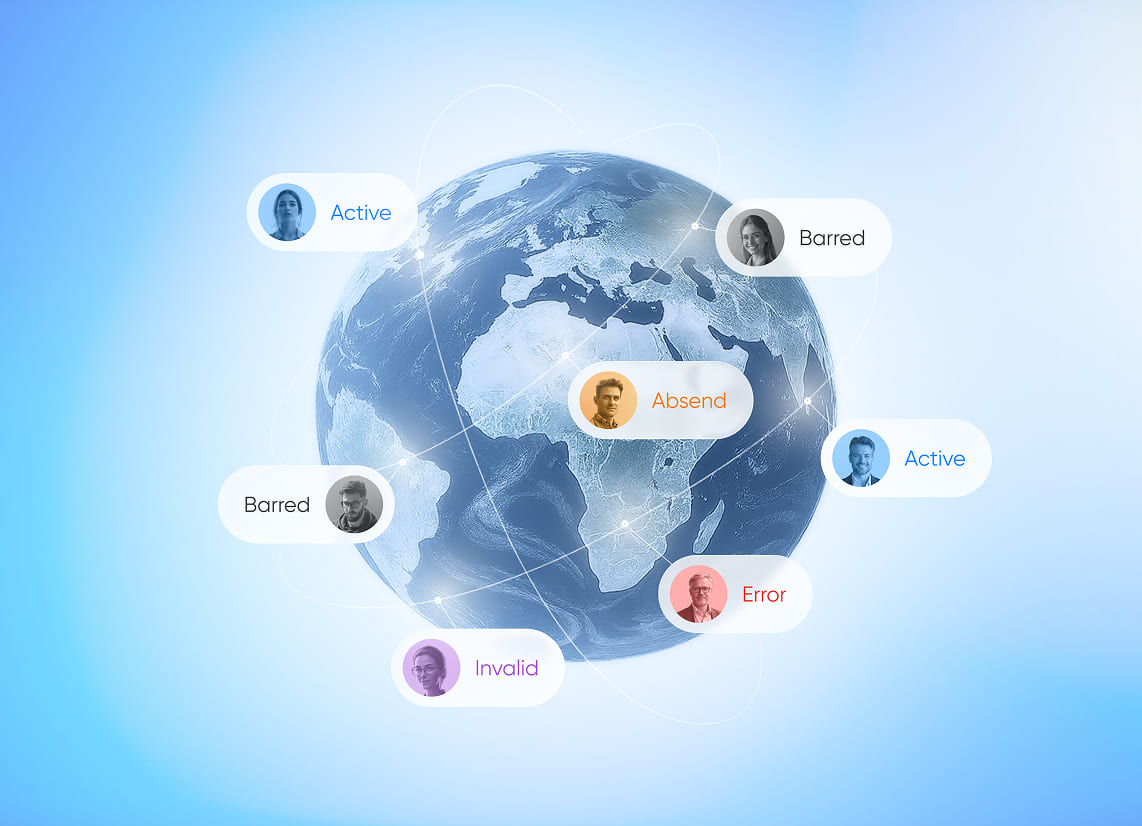
Our service takes an MSISDN, i. e. a phone number in an international format, as a query input, and returns the subscriber’s current serving operator. In a nutshell, before launching the SMS campaign, our system queries the external database provided by the Number Verifier via API, and returns the following information:
- who issued the user’s SIM card: the legal entity or the region the provider belongs to;
- whether the number is currently active;
- whether the number was transferred to another provider and what was the previous one.
- the country code, the mobile network of the provider, and the network to which the subscriber is currently belonging.
From this information, the system determines the best route.
Data comes directly from genuine portability database holders or their direct partners on the market. Our MNP Lookup service is accessible at the BSG Hosted Messaging Platform in synchronous or asynchronous request mode.
Synchronous mode request is performed over HTTP API where a client sends either as a single request or a multiple number lookup query. Asynchronous number lookup is done over a dedicated notify URL which is set by a client to work differently, and it is possible to send as many requests as you can without waiting for them to be completed. Remember that you will get a notification with a URL. Depending on the operator, you can receive the entire bulk list at once, but it is also possible to check every single number. Very convenient if you have multiple databases.
Within a short time, the traffic will be redirected to a necessary network. Due to API, a significant number of requests can be processed per second. You’ll promptly receive notifications about changes in network operators of every client, and they won’t miss any forthcoming SMS campaigns.
Moreover, we have recently implemented the ENUM ― the advanced industry standard. This set of protocols is used for mapping the phone number as an IP address into the Domain Name System (DNS). Together, they make data exchange several times faster. That provides significantly higher throughput when processing bulk requests.
Summing Up
Mobile Number Portability is a pivotal service playing an important role in the mobile ecosystem. It represents a revenue-generating opportunity for mobile operators. For enterprises and service providers, using the mobile number as a personal client identifier regardless of its operator prefix is essential to deliver mission-critical messages. Therefore, determining the host carrier of a ported number is critical as never before.


Interested in a special offer?
Ready to reach further?
Let’s talk


Related articles
30% of SMS fail — not because of content, but numbers. Verify before you send.
SMS marketing is indispensable in today’s retail landscape for its direct and immediate communication. With

Do you know the tool that can instantly reach any of your customers, no matter