





For eCommerce managers in Nigeria, Kenya, South Africa, and the Philippines, this gap is one of the most expensive problems a marketing team can carry without fully understanding the cost. WhatsApp is not a supplementary channel in these markets — it is the primary customer touchpoint. WhatsApp messages achieve open rates above 90% (Meta Business, 2024). The platform delivers attention. But attention and conversion are two different outcomes, and most WhatsApp marketing strategies are only built to achieve the first.
A strategy built on generic broadcasts isn't just underperforming. It's actively degrading the most valuable marketing asset you have: a list of customers who chose to receive your messages. What follows are five execution decisions that determine whether your WhatsApp marketing strategy produces revenue — or burns the list it took months to build.
Behavioral Personalization: The Gap Between a Conversion and an Opt-Out
Adding a customer's first name to a message template is formatting, not personalization. Real personalization in WhatsApp marketing means a message reaches someone because of a specific action they took — not because they exist on a list.
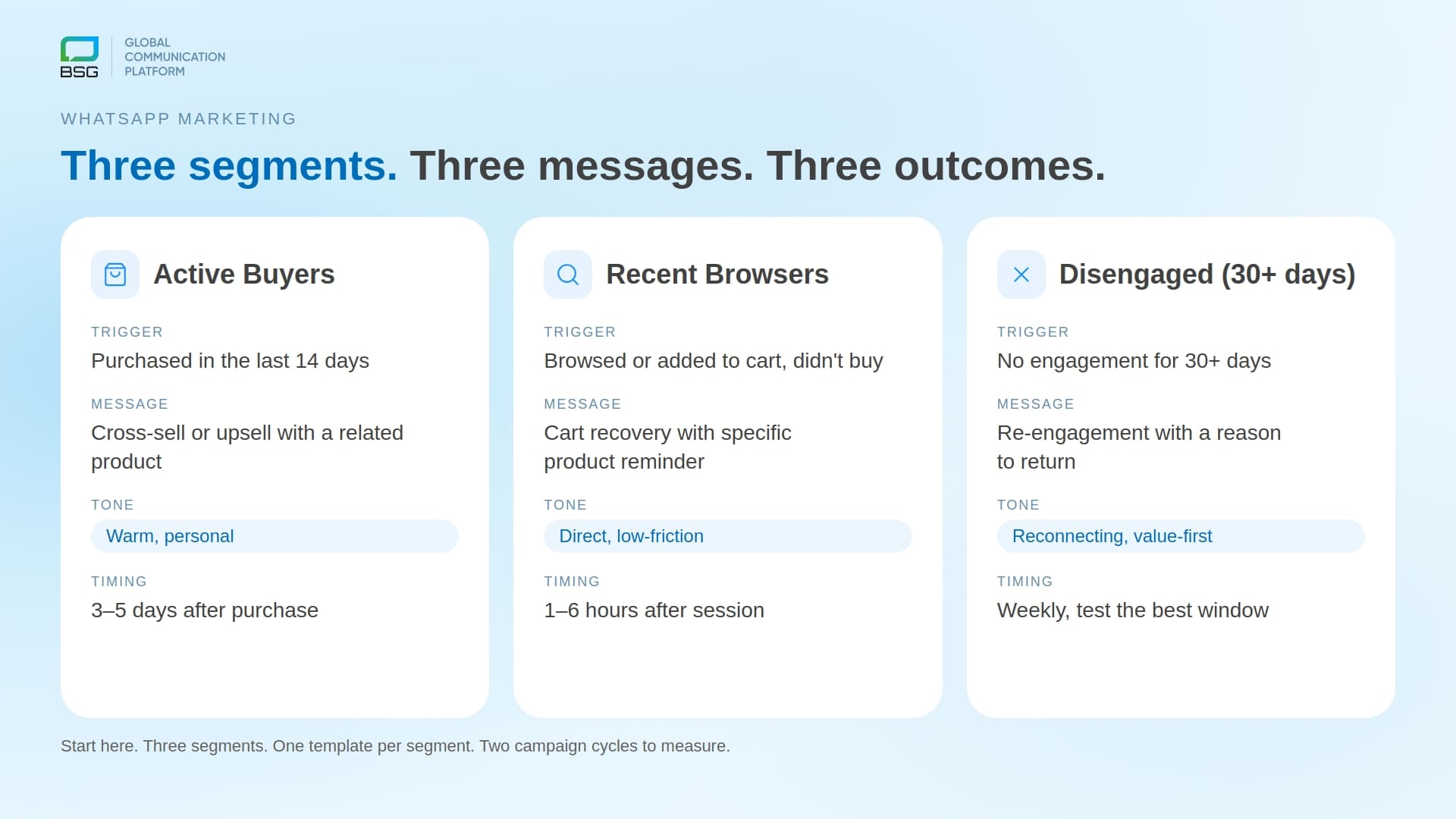
A customer who added a product to their cart and left is in a completely different conversion state from someone who last purchased 45 days ago and hasn't engaged in three weeks. The first needs a direct, low-friction recovery message. The second needs re-engagement that reconnects them to why they bought before. Sending both the same promotional message isn't neutral — it's a list-erosion event.
In markets where WhatsApp sits on the same device a customer checks before getting out of bed, an irrelevant message doesn't get ignored. It gets opted out. Permanently. There's no re-subscription flow, no win-back email, no second chance in the same channel.
At BSG, we've seen that eCommerce clients who move from full-list broadcast campaigns to three behavioral segments — active buyers, recent browsers, and disengaged customers — consistently see a measurable lift in conversion within the first two campaign cycles. The shift isn't marginal. Targeting precision is what the channel rewards, because customers opted in expecting relevance, not volume.
How do I personalize WhatsApp campaigns beyond the customer's name?
Start with three segments: customers who purchased in the last 14 days, customers who browsed without buying, and customers who haven't engaged in 30 days or more. Build one message template per segment that references a specific product, category, or action they took. Tone and send timing should differ across all three. Run each for two full campaign cycles before adding more variables — isolate the personalization impact before layering additional complexity on top.
Media Format Is a Revenue Decision, Not a Design Choice
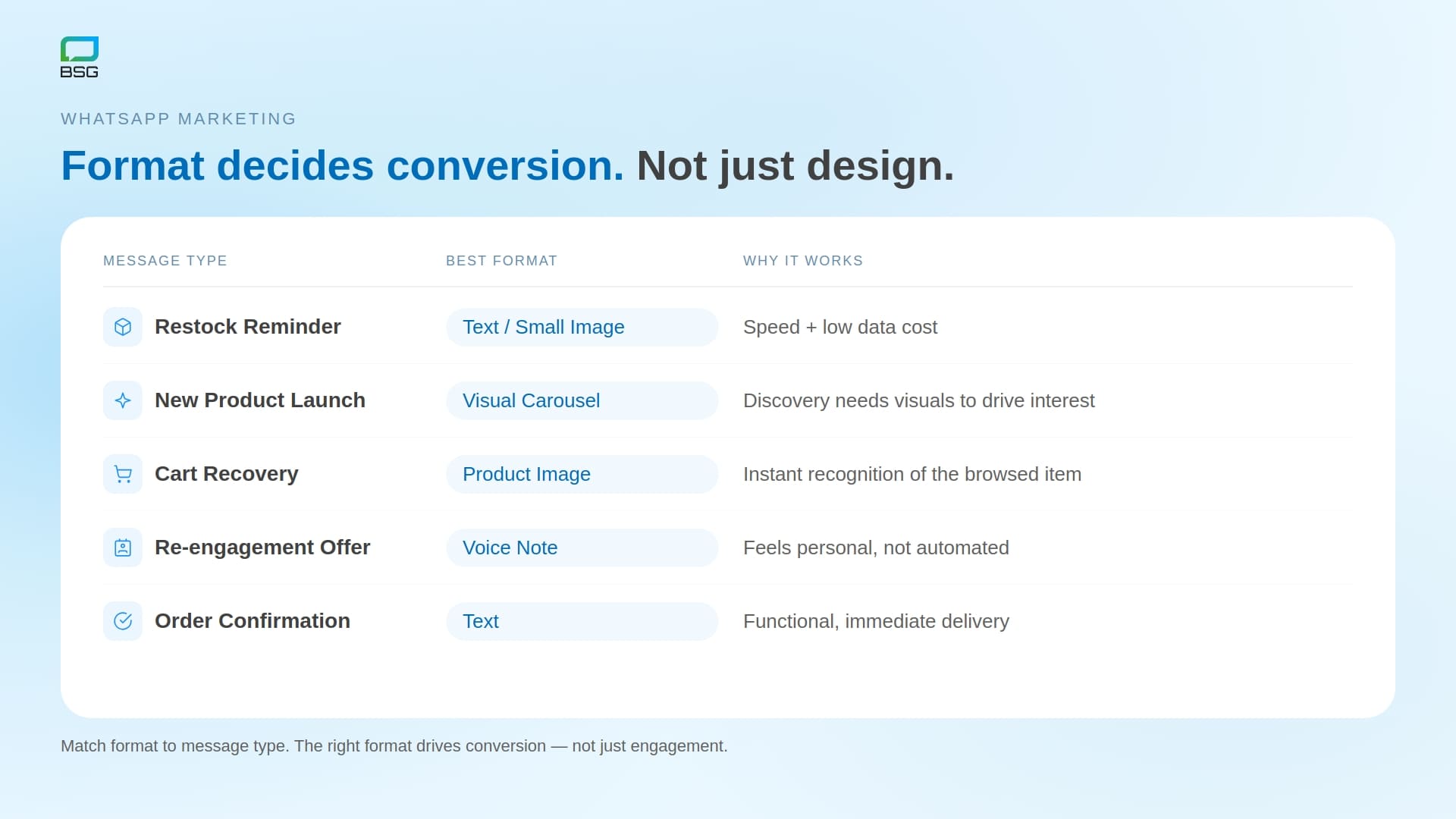
Choosing between text, image, video, and voice note is a channel strategy decision with a direct effect on CTR and conversion. A product image tied to recent browse history outperforms a generic promotional banner because it creates immediate recognition. A voice note reduces friction on high-consideration purchases because it doesn't feel automated. A short video works for product demonstrations — when it actually loads.
That condition matters significantly in Nigeria and Kenya, where mobile data costs and variable network connectivity are real delivery factors. Cart abandonment already averages around 70% across eCommerce globally (Baymard Institute, 2024) — a video asset that fails to load on a slow connection at the moment you're trying to recover that cart doesn't just underperform. It creates a negative experience precisely when you needed a positive one.
Based on what we observe across the campaigns we support in West Africa, teams that optimize media assets for low-bandwidth delivery — compressed file sizes, audio-first formats where video isn't essential, smaller product images — consistently achieve better delivery rates than those sending assets sized for high-bandwidth markets. Delivery rate and engagement rate are two separate metrics. Both matter to campaign ROI, and teams that only track the second are missing a real cost hiding in the first.
How Timing and Sequence Work Together
Most eCommerce teams configure a WhatsApp send schedule once — usually based on generic industry benchmarks — and never test whether it fits their actual audience. This is a consistent, low-visibility conversion loss that costs nothing to fix and that most teams never identify because the counterfactual is invisible.
Standard timing benchmarks were written for Western markets: predictable commute windows, desktop-primary browsing, and a standard 9-to-5 structure. That model doesn't transfer to Lagos, Nairobi, or Manila. Daily rhythms in these markets are shaped by mobile-first behavior, informal working schedules, and economic patterns that run outside the nine-to-five frame entirely. The send window that performs in Berlin at 10 AM may land completely differently in the Philippines at the same local hour — not because your message is wrong, but because your audience's attention is somewhere else.
The practical approach is to divide your active list into matched segments and stagger sends across three windows — one anchored in the early morning, one at midday, one post-evening. Run each window for a minimum of two weeks, not to confirm a hypothesis, but to let behavioral data override it. The window that generates the highest read rate and click-through rate sets your working baseline. In our experience with eCommerce clients in the Philippines and West Africa, the winning windows frequently contradict generic benchmarks. Early morning outperforms midday in some markets. Post-dinner windows consistently beat the widely cited mid-morning slot in others. The difference isn't noise — it reflects real variance in how daily economic life is structured in these markets. Treat the result as provisional: revisit the test quarterly as your list composition shifts.
Frequency follows the same logic. Starting at once per week and adjusting based on opt-out movement is a safer default than launching aggressive. An opt-out removes a customer from a channel with no recovery path. That loss compounds across every future campaign.
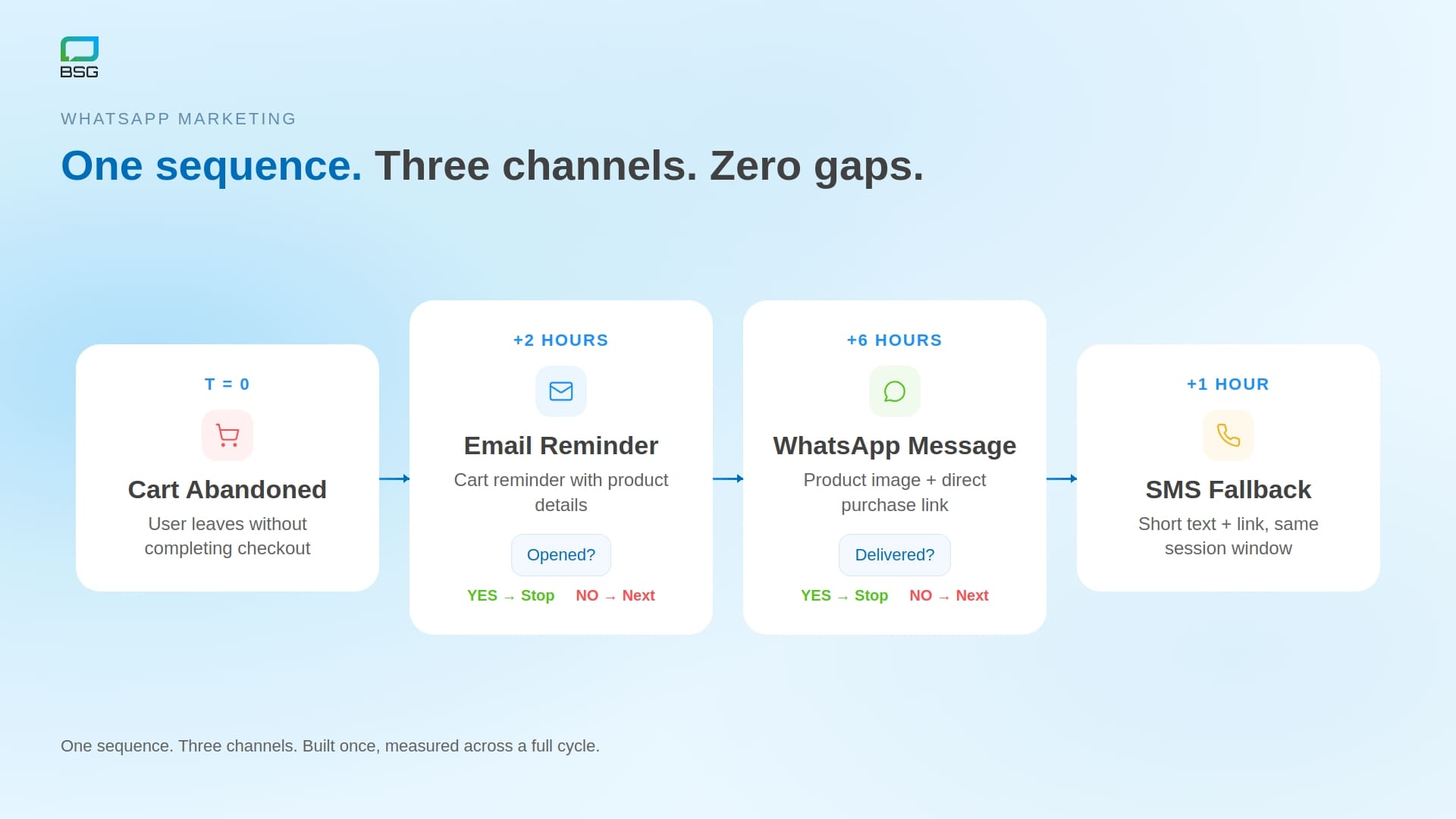
For eCommerce teams building their first automation layer, cart abandonment is the highest-value starting point because the intent signal is explicit and the revenue per recovered order justifies the setup time. The approach that consistently outperforms is a single, well-instrumented sequence — built once, run against a defined segment, and measured across a full campaign cycle before parallel flows are added. In markets where WhatsApp is the primary revenue channel, one focused and properly measured sequence produces cleaner data and stronger results than five half-built ones running simultaneously. Build for measurability first. Scale when the data supports it.
What is the best time to send WhatsApp marketing messages?
There is no universal answer — and that is precisely the point. The correct send window depends on your audience's actual daily behavior, not benchmarks written for markets with different economic patterns and device habits. Test three time windows, measure read rate and CTR per window, and treat the winning result as your working baseline. Revisit the test quarterly as list composition shifts.
Why SMS Fallback Is Non-Negotiable in Low-Connectivity Markets
In markets where email open rates run significantly lower than WhatsApp engagement, the sequence logic often needs to be restructured — WhatsApp first, SMS as fallback when WhatsApp delivery fails, email as a supporting long-form touchpoint later in the cycle. This isn't a backup configuration. It's the operational baseline for markets where network conditions determine whether a message is received at all.
Nigeria and Kenya present specific delivery challenges that most Western campaign infrastructure is not built to handle. Connectivity gaps are real, and they don't follow predictable patterns. A WhatsApp message that goes undelivered during a low-connectivity window doesn't generate a read, a click, or a recovery — it disappears from the cycle entirely. The cart abandonment window that triggered it won't reopen. The customer's intent won't stay at the same temperature until your next scheduled send.
Configuring SMS fallback for undelivered WhatsApp messages means that a message blocked by connectivity on one channel reaches the customer through another within the same session window. The fallback isn't a secondary option for customers who don't use WhatsApp. It's a delivery assurance mechanism for customers who do — but whose connection at that specific moment couldn't complete the delivery. In West Africa, this distinction matters operationally. Teams that run WhatsApp-only sequences without fallback are not just accepting delivery risk. They are building campaigns on infrastructure that cannot reliably cover the market they're operating in.
What this requires at the platform level: SMS fallback routing configured through the same Business Solution Provider as your WhatsApp API, delivery-rate tracking separated from read-rate tracking so you can identify channel-specific drop-off, and audience segmentation that can handle multi-channel sequencing without duplicating sends. This is not complex to configure, but it needs to be built into your campaign infrastructure from the start — not added as a fix after a campaign cycle reveals the delivery gap.
Platform Infrastructure Determines Your Campaign Ceiling
The free WhatsApp Business app is built for individual operators. It is not a campaign tool. A 256-contact broadcast limit, no automation, no segmentation, no analytics, and no integration with your eCommerce stack means every campaign is manual, untrackable, and capped before it reaches meaningful scale.
At the point where you're sending more than a few hundred messages per campaign cycle, you need the WhatsApp Business API through a verified Business Solution Provider. This isn't only an operational decision — it's a compliance requirement in the markets where most growth-focused eCommerce teams operate.
Nigeria's NDPR, South Africa's POPIA, and the Philippines' Data Privacy Act each require documented opt-in consent and specific data handling standards for marketing communications. Tools that operate outside the official API expose your account to suspension and your business to regulatory risk. Neither resolves quickly. Both can take down an active campaign mid-cycle with no path to recover the list you spent months building.
We've worked with teams who started on the free WhatsApp Business app, hit the contact ceiling partway through a campaign, and lost two to three weeks rebuilding on the API while that campaign cycle's revenue window closed. Moving to API infrastructure isn't a milestone to plan for at some future scale. It's the operational baseline for running WhatsApp marketing campaigns that can actually be measured, grown, and kept compliant.
What the platform needs to support: verified API access, behavioral trigger and segmentation capability, analytics that separate delivery rate from read rate from conversion rate, SMS fallback configuration for low-connectivity markets, and integration with your order management or CRM system. For teams comparing channel options, the tradeoffs between WhatsApp, SMS, and other channels are worth reviewing before committing to a single-channel setup — see SMS vs Viber vs WhatsApp for a practical breakdown.
Take the Next Step With BSG
If your WhatsApp marketing strategy is generating opens but not orders, the gap is almost always in execution — and it's usually fixable without rebuilding from scratch. BSG works with eCommerce teams across Africa and Southeast Asia to build WhatsApp campaigns on verified API infrastructure, with behavioral segmentation, SMS fallback, and the compliance framework each market requires.
The starting point is typically a review of what your current campaigns are actually measuring, where conversion drops off, and which segment is worth targeting first with a structured sequence. From there, the approach is data-led — scale what performs, cut what doesn't. If you want to walk through what that looks like for your team and market, get in touch with BSG and we'll review your current setup together.
FAQ
How do WhatsApp marketing strategies differ from SMS campaigns?
WhatsApp supports rich media, two-way conversation, delivery and read receipts, and behavioral automation in ways SMS doesn't match. In markets like Nigeria and the Philippines, WhatsApp also carries a higher degree of personal trust — customers associate it with direct communication, which makes the opt-in more valuable and the opt-out more consequential than in SMS.
Can a small eCommerce team run effective WhatsApp marketing campaigns without a developer?
Yes, but only with the right platform in place. Accessing the WhatsApp Business API through a verified provider gives a small team segmentation, automation, and analytics without custom development. The setup effort is front-loaded — once behavioral triggers and message templates are built, campaigns run without manual intervention per send.
How do I know if my WhatsApp marketing strategy is actually working?
Track delivery rate, read rate, CTR, and conversion rate separately by segment — not aggregated across the full list. A high read rate with low conversion points to a message relevance problem. A low delivery rate points to a media format or connectivity issue. Opt-out rate trend over time is the health metric that matters most for long-term list sustainability.
What compliance requirements apply to WhatsApp marketing in Africa and Southeast Asia?
Nigeria's NDPR, South Africa's POPIA, and the Philippines' Data Privacy Act each require documented consent before sending marketing messages, along with defined data handling and storage standards. Running campaigns through the official WhatsApp Business API via a verified provider is the baseline for meeting these requirements — unofficial tools do not offer the compliance framework or audit trail these regulations expect.


Interested in a special offer?
Ready to reach further?
Let’s talk


Related articles

Want to keep your customers' info super-secure? Try SMS One-Time Passcodes! It's like a secret code that verifies your customers' identity each time they log in or access protected data. No more worries about hackers or privacy breaches. Keep your peeps safe with SMS OTP.

Want to keep up with the latest and greatest in SMS marketing? Get in the know with key insights and trends shaping the industry and stay ahead of the trajectory.

Are you a fan of online gaming and betting or do you have an iGaming