





Your phone line is quietly leaking customers. A caller with a billing question hits a menu, presses 2, then 4, then 0, waits, gets transferred, and repeats their account number to a live agent — hanging up more annoyed than when they dialed. Multiply that across a few thousand calls a month and you have a support channel that burns budget and erodes trust at the same time.
That gap is exactly what an AI voice agent is built to close. Instead of forcing callers through a fixed keypad tree, it lets them say what they need in plain language, works out the intent, pulls the relevant record, and resolves or routes the call — often without a human touching it. For contact-center and CX teams weighing an upgrade, the real question isn't whether IVR still works. It's where classic IVR quietly caps your containment, your CSAT, and your cost per call — and what changes when conversational voice takes its place.
This is a practical comparison, not a pitch. We'll cover where “Press 1” breaks, what conversational voice actually does differently, a side-by-side on the metrics that matter, and — honestly — where a plain IVR is still the right call.
Classic IVR — Why “Press 1” Frustrates
Interactive Voice Response has run phone support for three decades, and the mechanics haven't changed much: a caller hears a recorded menu and presses keypad digits — DTMF tones — to navigate. That works when the caller's need maps neatly onto a menu option. It falls apart the moment it doesn't.
The core problem is that a menu forces the customer to translate their problem into your org chart. Someone calling about a double charge doesn't think “billing, sub-menu three.” They think “you took my money twice.” When none of the five options fit, they mash zero, and the whole self-service layer collapses into an expensive transfer.
The data backs up the frustration. In one survey, 88% of consumers said they'd rather speak to a person than work through an automated phone menu (Clutch via Hammer, 2022). And legacy menus contain far fewer calls than teams assume: seven in ten companies report an IVR containment rate of 30% or less (McKinsey via Assembled, 2025) — meaning most calls escape the system and land on a paid agent anyway.
At BSG, we've seen that the deeper you nest an IVR to cover more cases, the worse it performs. Every extra layer adds drop-off, because callers lose patience before they reach the option they need. Teams end up maintaining a sprawling menu that almost no one finishes — and still routing the hard calls to humans.
A logistics client we worked with had built an eight-branch menu to handle delivery queries, and it was quietly doing the opposite of what they intended. Callers who couldn't find “reschedule a delivery” in the first two levels simply pressed zero, so the menu that was meant to deflect calls was funnelling almost all of them straight to agents — after making the customer wait through the prompts first. The menu wasn't saving work; it was adding a frustrating step in front of it.
AI Voice Agent — Natural Language, Context, Action
An AI voice agent replaces the menu with a conversation. It uses automatic speech recognition to turn speech into text and natural language understanding to work out what the caller actually wants — even when they phrase it in a way no menu ever anticipated. “I got charged twice for my order last Tuesday” is read as a billing dispute, not a keypad miss.
Three things separate it from a scripted menu. It handles natural language, so callers state intent in one sentence instead of drilling through options. It carries context, so it can look up the order, the account, or the last interaction and skip the “enter your 16-digit number” ritual. And it takes action — checking an order status, rescheduling a delivery, sending a payment link — rather than only routing. That's the shift from a call router to what the industry now calls an intelligent virtual agent: software that resolves, not just redirects.
You'll also see this described as conversational IVR — the same telephony entry point, but driven by language understanding instead of a digit tree. BSG's Conversational AI Voice runs on this model: it handles inbound and outbound calls, speaks 150+ languages, detects emotional tone, and escalates to a human the moment a call turns sensitive.
The same engine works outbound, too. Instead of a robocall reading a script, the agent can call to confirm an appointment, chase an overdue payment, or run a short survey — and actually respond to what the person says back. Emotional-tone detection matters here: when a caller sounds angry or confused, a well-built agent escalates or softens its approach instead of ploughing through a fixed flow, which is precisely where scripted systems lose people.
The business case isn't subtle. Gartner projects that conversational AI in contact centers will cut agent labor costs by $80 billion by 2026, in an industry where labor can account for up to 95% of contact-center costs (Gartner, 2022). What our clients find is that the biggest gains come not from replacing agents, but from letting the AI absorb the repetitive volume — order status, balance checks, appointment changes — so agents keep the calls that genuinely need a human.
AI Voice Agent vs IVR: Side-by-Side
Here's how the two compare on the four metrics contact-center teams are actually measured on.
| Metric | Classic IVR | AI Voice Agent |
|---|---|---|
| Containment rate (calls resolved without an agent) | Often 30% or less at 7 in 10 companies | 50%+ in well-configured deployments across finance, travel, hospitality |
| CSAT | Low — 88% of callers prefer a human to a menu | Higher on resolved calls; natural dialogue removes menu friction |
| Call drop-off | High — menu fatigue, “press 0” loops, dead ends | Lower — intent captured in one turn, fewer forced transfers |
| Cost per interaction | Menu is cheap, but uncontained calls fall to agents — the costliest channel | More per contained call than a menu, far less than a live agent |
The cost gap is the part that gets budget approved. Automated self-service averages roughly $1.84 per contained contact versus about $13.50 for an agent-assisted one (Gartner benchmark via Lorikeet, 2026). When containment climbs from 30% to 50%+, that spread compounds across every thousand calls. Containment and CSAT move together, too: fewer forced transfers mean fewer callers reaching the point where satisfaction craters.
When IVR Is Still Enough (Honestly)
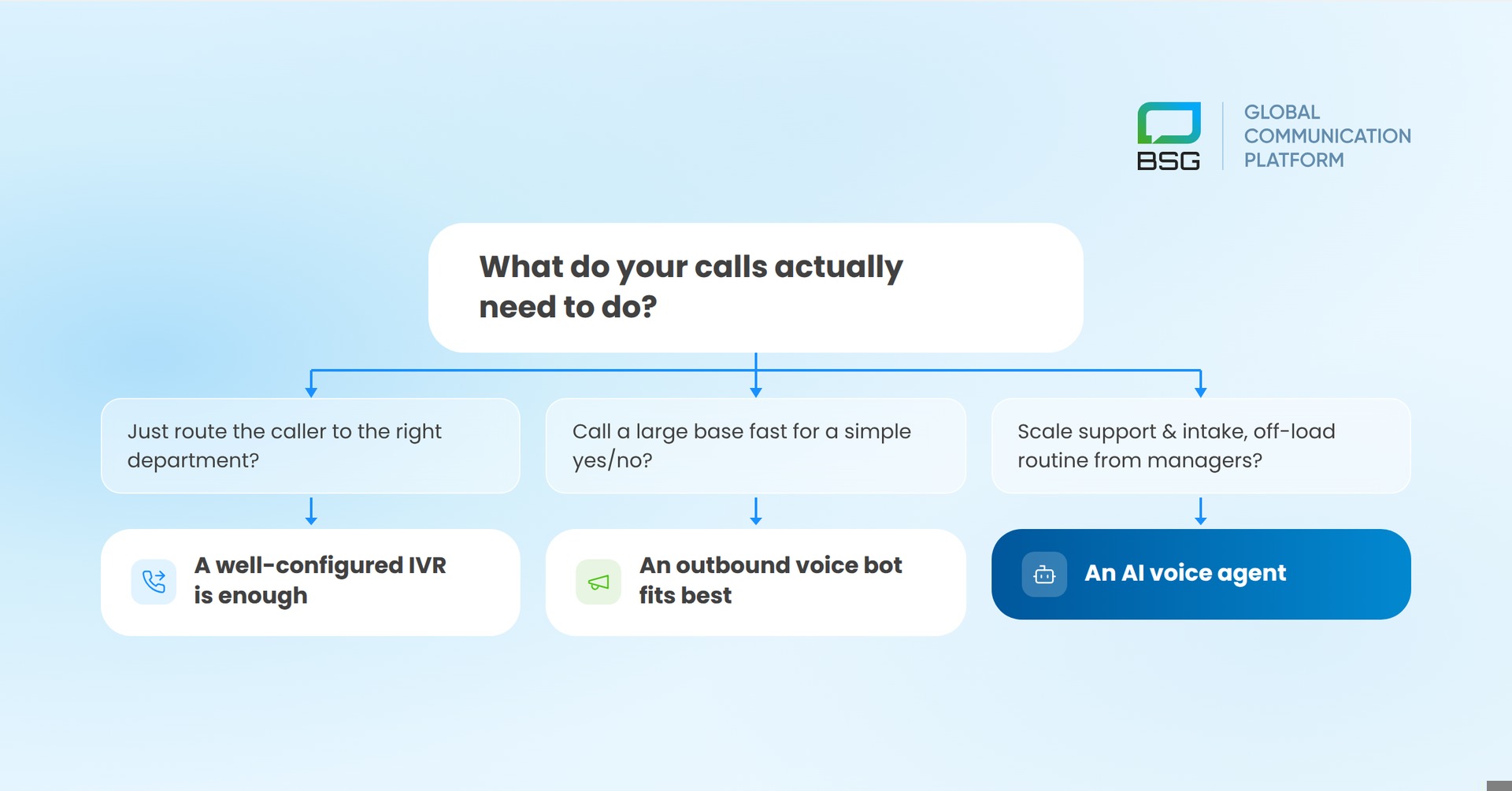
A voice agent isn't the right answer for every line. There's no universal solution — the right tool depends on what your calls actually need to do. Being honest about that is how you avoid paying for capability you won't use.
If your only goal is to point a caller to the right department, a well-configured IVR is enough. A clinic with three options — appointments, billing, everything else — doesn't need language understanding; a short, clean menu resolves it faster than a conversation would.
If you need to reach a large base quickly or collect a simple “yes/no” from thousands of contacts, an outbound voice bot is the better fit. Confirming appointments, running a quick survey, or verifying interest at volume is a structured task, and a voice bot handles it at a lower cost than a full conversational agent.
If your goal is to scale support and intake — taking the routine load off your managers so they only handle what needs judgment — that's where a voice agent earns its place. It absorbs the repetitive calls a menu can't contain and a person shouldn't have to.
In our experience working with contact-center teams, the mistake is rarely “IVR or AI.” It's forcing one tool to do a job the other is built for. Map the tool to the call type and the cost math takes care of itself — which is why high-volume customer care lines tend to show the clearest return.
Migration Path: From IVR to a BSG AI Voice Agent
Replacing an IVR doesn't mean ripping out your phone system over a weekend. The teams that migrate cleanly do it in stages, and they start where the volume — not the complexity — is highest.
Step one is the call log. Find the three or four intents that make up the bulk of your volume: order status, balance, appointment changes, “where's my delivery.” Those are the calls a menu handles badly and a voice agent handles well. Move those first and leave the long tail on the existing flow.
Step two is context. A voice agent is only as good as the data it can reach, so connect it to your CRM and order systems through the API — then it looks up a record instead of asking the caller to read it out. This single step is the biggest driver of both containment and CSAT.
Step three is the handoff. Decide the escalation triggers — repeated failure, detected frustration, a sensitive topic — and make sure the agent passes full context to the human so the caller never repeats themselves. BSG's AI Support Assistant is built around exactly this: automate the routine, escalate cleanly, keep the transcript.
At BSG, we've seen that a phased rollout beats a big-bang cutover every time. One client had the voice agent handling a large share of repeat requests within the first week, precisely because they started with a narrow set of high-volume intents instead of trying to automate everything at once. Before you commit, model your expected containment against your current agent minutes — our AI Voice Bot pricing page shows how the per-minute economics shift once the AI absorbs the repetitive load.
See Conversational Voice on Your Own Calls
If you're weighing a voice agent against the IVR you already run, the fastest way to judge fit is to watch one handle your actual call types. BSG's Conversational AI Voice takes inbound and outbound calls in 150+ languages, connects to your CRM, and escalates to a human when a call needs one. Book a 15-minute demo and we'll walk through where conversational voice would lift your containment — and where your current IVR is still the right tool. We've run this migration with contact-center teams before, so we can tell you honestly which calls to automate first.
FAQ
Is a voice agent the same as conversational IVR?
Mostly, yes. “Conversational IVR” describes a phone entry point where callers speak naturally instead of pressing keys, while “AI voice agent” stresses that the system also resolves and takes action, not just routes. In practice the terms overlap — the difference that matters is whether the system understands intent and completes tasks.
Will an AI voice agent replace my human agents?
No — it changes what they spend time on. The AI absorbs high-volume repetitive calls (status checks, confirmations, simple changes) and escalates anything complex or sensitive to a person with full context. Human agents move to the judgment-heavy calls where they add the most value.
How long does it take to move from IVR to a voice agent?
It depends on how many intents you automate and how deep the integrations go, but a focused rollout targeting your top three or four call reasons can go live in days, not months. Starting narrow and expanding beats trying to automate every call flow at once.
What does an AI voice agent cost compared to IVR?
An IVR is cheap to run but expensive in hidden transfers — low containment pushes most calls to agents, the costliest channel. A voice agent costs more per contained call than a raw menu but far less than a live agent, so the economics improve steadily as containment climbs above IVR's typical 30% ceiling.


Interested in a special offer?
Ready to reach further?
Let’s talk


Related articles

Security is the backbone of any enterprise requiring customers to input personal information. Weak infrastructure,
In light of businesses looking for fresh and catchy ways to communicate with clients, the
Up to 10% of your SMS budget dies on dead numbers. Verify the list first, then send.