





You're great at acquiring subscribers. Now — stop losing them
Every subscriber lost to an undelivered renewal reminder, a billing failure on a "dead" MSISDN or silence after the first month is ARPU, multiplied by the months that will never come. Your BSG stack already knows how to close these leaks — the only question is whether these tools are switched on.
For existing clients · HLR scan of a sample base + retention-flow review in 48 hours
Where exactly subscribers leak — and what closes it
Renewal reminder didn't land
The subscriber learns about the charge after the fact → complaint or cancellation. Single-channel SMS is exactly where these messages get lost.
An SMS + Viber cascade: the reminder lands, the charge is expected, complaints don't climb.
Billing hits "dead" MSISDNs
The number is inactive or has left the network — billing failures wreck your metrics, and you pay for attempts and messages going nowhere.
HLR scan of your base: dormant numbers go to quarantine, billing only against live subscribers.
Quiet churn after month 1
The subscriber isn't engaging with the content and cancels at the first mention of money. A plain SMS won't win attention back.
RCS/Viber digests with rich content previews: the service reminds subscribers of its value before renewal, not at the moment of the charge.
Cancelled — and gone for good
With no win-back flow, a lapsed subscriber is gone for good — even though the reason for cancelling is often situational (balance, forgot, changed their mind).
A win-back campaign at 14–30 days: HLR check + a personal offer via Viber/SMS. Winning them back is cheaper than acquiring new.
Calculate what your churn costs — and how much of it can be saved
-
Every subscriber saved is ARPU × months
Churn driven by delivery and billing failures comes back cheaper than new acquisition costs.
-
HLR strips "dead" numbers out of billing
Billing attempts against inactive MSISDNs wreck your metrics and burn budget — a filter before billing closes that off.
-
This is already in your integration
A renewal-reminder cascade and Lookup are a config on the BSG side, not a new project for your engineers.
What your churn costs
*subscribers saved × ARPU × an average 3-month lifespan. “Avoidable” churn is the kind driven by delivery and billing failures, not by content.
Five touchpoints that keep a subscriber in the base
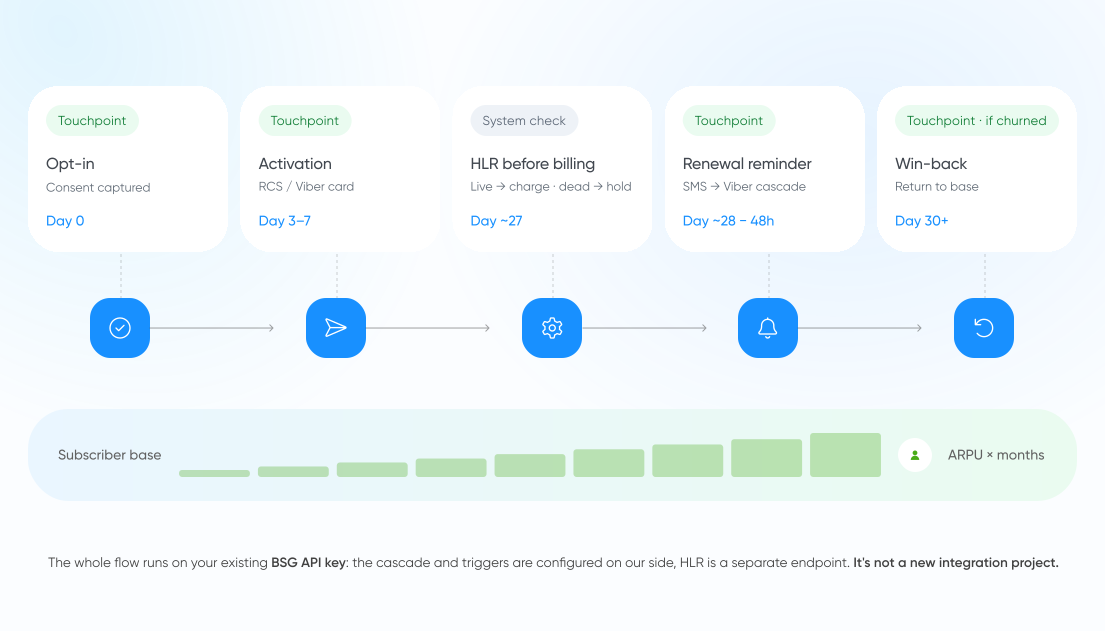
Proof-based double opt-in — a clean base from day one (and an MNO audit holds no fear)
A rich content digest in RCS/Viber — subscribers see what they're paying for
HLR check: number live → billing; dormant → quarantine instead of a failure
A cascade of reminders — the charge is expected, no complaints
A win-back offer to live numbers — winning back beats acquisition
Your growth — our retention strategy
Delivery Review
Delivery by operator, complaint trends against MNO thresholds, the state of your consent logs — on your data.
Complaint alerts
Complaints are nearing the operator's threshold — we flag it first, before the letter from the MNO's fraud team.
Rate review
More subscribers — better terms. A rate review against your actual volume, without waiting for the contract to end.
Launch support
Entering a new market — BSG coverage is already there: MNO consent requirements, routes and cost by country, before you launch.
The gist, in brief
Our churn is about content, not delivery. Why check it?
That's the most common assumption — and the check is exactly what tests it. If the HLR scan shows your base is clean, reminders are landing and the flow is complete, then it really is content, and you'll know for sure. But in bases that haven't been cleaned in a while, "dead" MSISDNs and undelivered renewals typically account for a real slice of churn that gets blamed on content.
Won't win-back sends anger the operators?
Done right — no: win-back goes only to those who opted in, with clean opt-out and frequency caps, after an HLR check. It's a one-time personal offer, not a spam wave. We'll factor each MNO's specific re-engagement rules into the campaign setup.
Is an HLR scan of the base safe from a data standpoint?
An HLR query works with the MSISDN alone — no names, no personal attributes — and sends the subscriber nothing; it's a network status lookup. A sample is enough; transfer is under NDA, and the sample data is deleted after the scan.
How much of this is config, and how much is development on our side?
A cascade for renewal reminders and triggered sends is a config on the BSG side, layered over your existing sends. An HLR filter before billing is a single REST call in your billing flow (typically a day of engineering). RCS/Viber digests need sender registration — a process we run for you.
We want to launch a new market. Does that fit here too?
Yes — tick "Launch a new market" on the form. Before launch you'll get a country breakdown: operator consent-flow requirements, expected delivery by channel and cost. Entering a market with a retention flow already in place is cheaper than bolting one on after the first complaints.


Your base is already leaking. Find out where
HLR scan of a sample + a leak map across the subscriber lifecycle.
Most recommendations switch on via config on the BSG side.
A 20-minute slot — let's talk through your retention flow and markets.

For existing BSG clients. Not a client yet? Start with an opt-in flow check.
Useful Materials
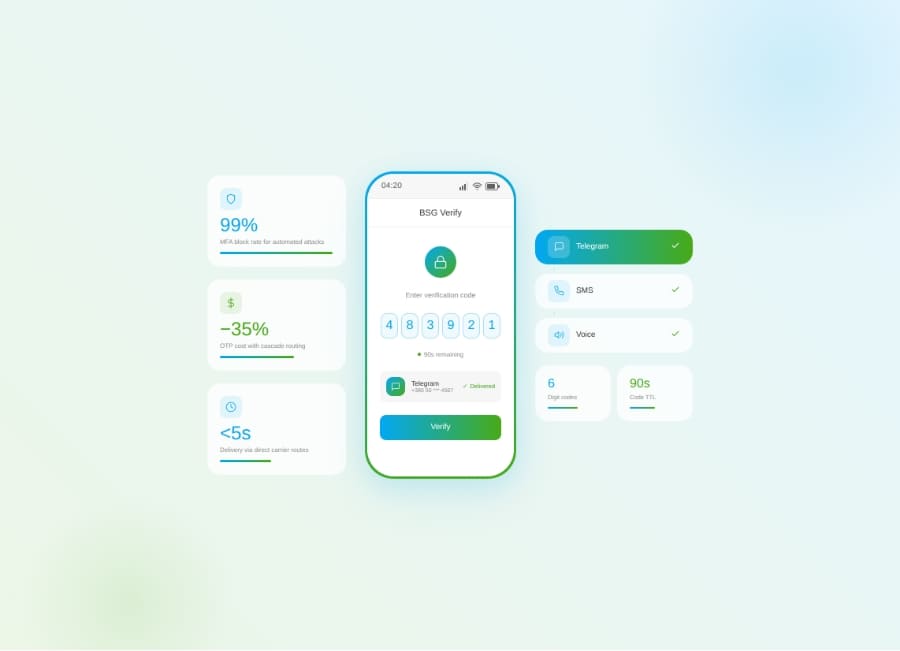
OTP means one-time password — see how it works, compare delivery channels, and cut verification costs with cascade routing.

Are you a fan of online gaming and betting or do you have an iGaming
Fraud and data theft continue troubling online services, costing them huge losses. The estimated cybercrimes