





Every product manager has seen it happen: a user signs up, enters a password, and within weeks that same password shows up in a breach database. Static credentials are the weakest link in any authentication flow. Account takeover attacks surged 24% year-over-year in 2024, and the average corporate breach tied to stolen credentials now costs $5 million per incident. The fix that has become standard across fintech, eCommerce, and SaaS is the OTP — a one-time password that expires after a single use.
This article breaks down what OTP means, how different OTP types compare, which delivery channels actually perform, and how to implement OTP verification without overspending on every code you send.
OTP Explained — Definition and How It Works
OTP stands for one-time password — a dynamically generated code valid for a single authentication session or transaction. Unlike static passwords that stay the same until the user changes them, an OTP code becomes useless the moment it is verified or its time window expires.
The mechanism is straightforward. When a user triggers an action that requires verification — logging in, confirming a payment, resetting a password — the server generates a unique code (typically 4–8 digits), sends it to the user through a pre-registered channel, and waits for the user to enter it. If the code matches and the time window has not elapsed, the action is approved.
At BSG, we've seen that the critical variable in this flow is not the code itself — it is the delivery channel. A perfectly generated OTP that arrives 45 seconds late or lands in a spam folder is functionally identical to no OTP at all. That is why the infrastructure behind OTP delivery matters as much as the algorithm that generates the code.
The core value of OTP is simple: even if someone intercepts the code, they cannot reuse it. This single property eliminates the most common attack vector — credential replay — where stolen passwords are tested across thousands of services simultaneously.
Types of OTP — TOTP vs HOTP vs SMS OTP
Not all one-time passwords work the same way. The three main types differ in how the code is generated and what triggers its expiration.
SMS OTP (server-generated, channel-delivered). The server creates a random code and pushes it to the user via SMS, email, WhatsApp, Telegram, or voice call. The code expires after a fixed time window (usually 60–180 seconds). This is the most widely deployed method because it requires zero setup on the user's side — no app installation, no token device.
TOTP (Time-Based One-Time Password). The code is generated locally on the user's device using a shared secret and the current Unix timestamp. Authenticator apps like Google Authenticator or Authy use this method. Codes refresh every 30 seconds. TOTP is more resistant to interception than SMS OTP because the code never travels over a network — but it requires the user to install and configure an app.
HOTP (HMAC-Based One-Time Password). Similar to TOTP, but instead of time, a counter triggers new code generation. Each time the user authenticates, the counter increments. HOTP codes do not expire automatically, which makes them simpler for hardware tokens but slightly less secure — an unused HOTP code remains valid until the next successful authentication.
For most consumer-facing applications — eCommerce checkouts, fintech onboarding, gaming account verification — SMS OTP remains the practical choice. In our experience working with fintech and eCommerce clients, fewer than 12% of end users have an authenticator app installed at the point of onboarding. Requiring TOTP at that stage creates friction that kills conversion. The realistic approach: use SMS OTP for initial verification, then offer TOTP as an optional upgrade for security-conscious users.
OTP Delivery Channels Compared
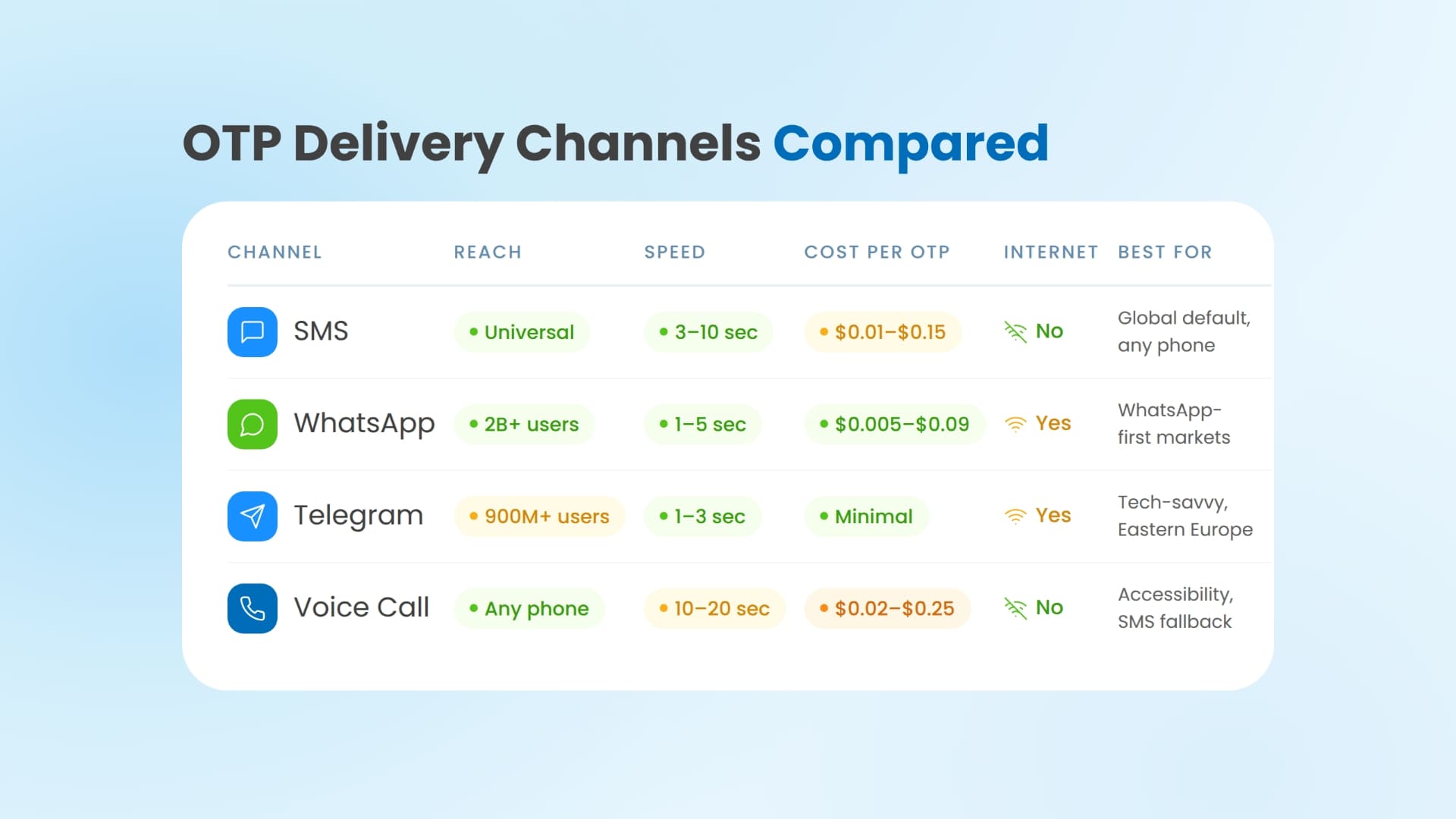
The channel you choose for OTP verification determines three things: delivery speed, cost per code, and reach across your user base. Here is how the main channels perform in practice.
SMS OTP — Pros and Cons
SMS is the default OTP channel for a reason. It reaches any mobile phone with a SIM card — no app required, no internet connection needed. SMS open rates exceed 90%, and most messages are read within three minutes of delivery (Validity, 2024).
The trade-off is cost. SMS pricing varies dramatically by destination — from $0.01 per message on competitive European routes to $0.10+ in markets with carrier surcharges. At scale, a fintech sending 5 million OTPs per month will notice every cent.
Security-wise, SMS OTP is vulnerable to SIM-swap attacks and SS7 protocol exploits. These are real risks, but they are also targeted attacks — not automated at scale. For the vast majority of consumer applications, SMS OTP provides a strong cost-to-security balance.
Based on what we observe across the campaigns we support, direct carrier connections reduce SMS OTP delivery time to under 5 seconds in most European and African markets. When messages pass through multiple intermediary aggregators, that same delivery can take 15–30 seconds — long enough for a user to abandon checkout.
WhatsApp OTP — Growing Trend
WhatsApp has become a viable OTP channel, particularly in markets where the app dominates daily communication — Africa, Latin America, Southeast Asia, and parts of Europe. WhatsApp OTP messages benefit from high visibility (users check WhatsApp far more frequently than SMS) and lower cost in many regions.
The limitation: WhatsApp requires the user to have the app installed and an active data connection. In low-connectivity environments, this creates a reliability gap.
Telegram OTP — BSG Unique Offering
Telegram OTP delivery is a channel that BSG supports natively through its Telegram API integration. For tech-savvy audiences and markets where Telegram has strong adoption (Eastern Europe, parts of Central Asia, Iran), it offers fast delivery at minimal cost.
The constraint is audience reach. Telegram penetration is uneven globally, so it works best as a secondary channel in a cascade, not a standalone OTP path.
Voice OTP — Accessibility
Voice OTP delivers the code through an automated phone call — the user hears the digits read aloud. This channel solves a specific problem: reaching users who cannot receive or read SMS. That includes users with feature phones that have full inboxes, users in areas with poor SMS delivery infrastructure, and users with accessibility needs.
Voice OTP is typically the most expensive channel per transaction, but it serves as an essential fallback when other channels fail.
OTP in 2FA — Why It Matters for Security
OTP is the mechanism; two-factor authentication (2FA) is the framework. When a platform requires both a password (something the user knows) and an OTP delivered to their phone (something the user has), it implements 2FA. This combination blocks the most common attack patterns.
The numbers make the case clearly. Account takeover fraud generated $16 billion in losses in 2024 (Javelin Strategy & Research, 2025). Meanwhile, organizations that enforce multi-factor authentication reduce account compromise risk by over 99% for automated attacks (Microsoft, 2023).
For the businesses we work with in fintech and eCommerce, the calculation is not whether to implement 2FA — it is how to implement it without degrading the user experience. A poorly designed OTP flow (slow delivery, unclear UI, no fallback when SMS fails) creates more cart abandonment than it prevents fraud.
What our clients have found is that the sweet spot is a tiered approach: require OTP for high-risk actions (login from new device, password reset, large transactions) and use risk scoring to skip OTP for low-risk sessions (returning user, trusted device, familiar location).
How to Implement OTP with BSG API
BSG provides OTP delivery through a single API endpoint that supports multiple channels — SMS, Telegram, voice, and email — with built-in cascade logic.
AI Verification Cascade (Cheapest Channel First)
The most expensive OTP is the one that fails to deliver and forces a retry on a costlier channel. BSG's cascade routing solves this by automatically attempting delivery through the lowest-cost channel first, then falling back to alternatives if the primary channel fails.
A typical cascade for a global fintech might look like this: Telegram first (lowest cost, fast delivery for users who have it), then SMS (universal reach), then voice call (guaranteed delivery for edge cases). Each step triggers only if the previous one fails or times out.
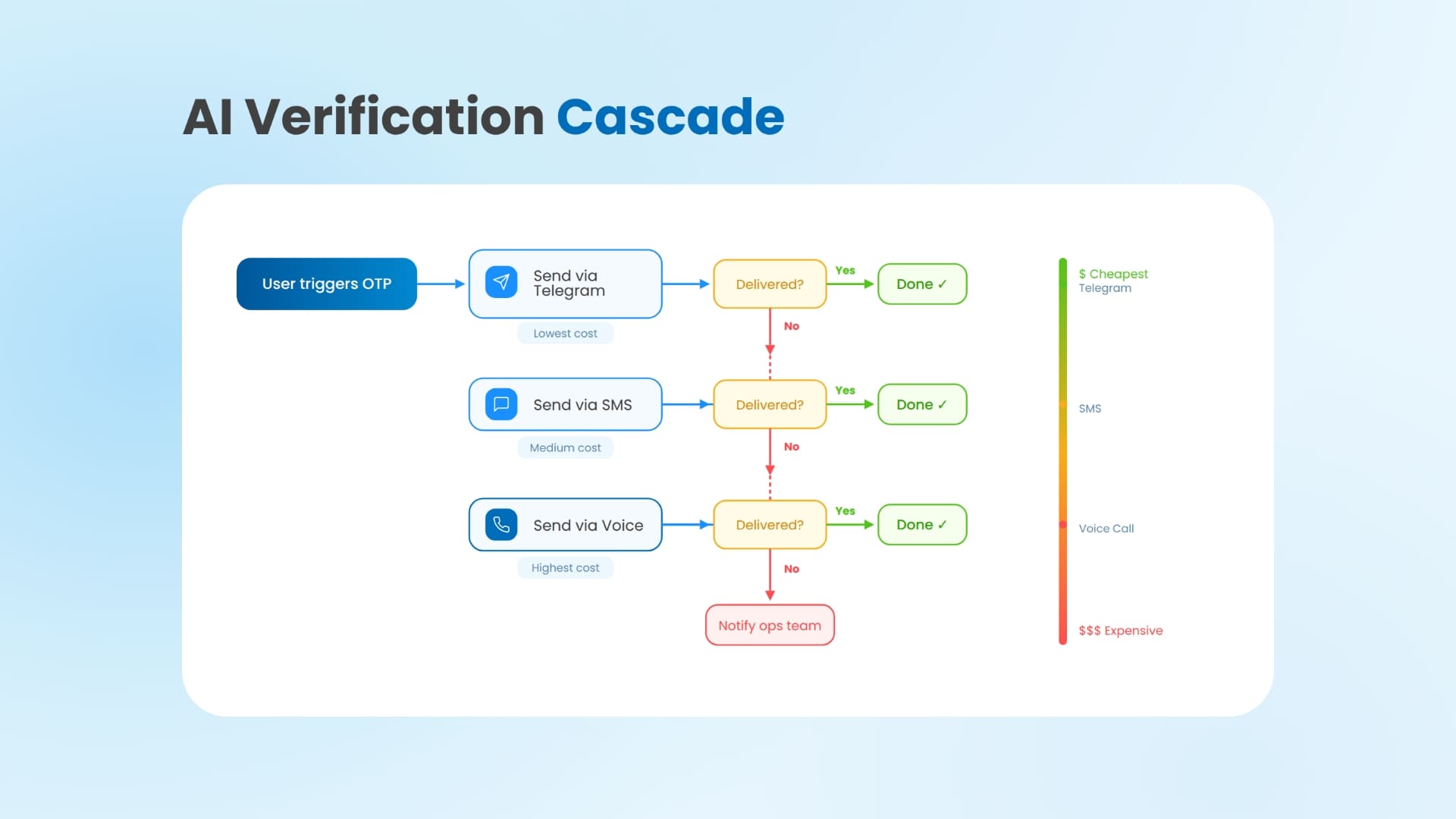
In our experience, cascade routing reduces OTP delivery cost by 20–35% compared to SMS-only flows — without sacrificing delivery rates. The exact savings depend on your user base composition: the higher the share of Telegram or WhatsApp users, the greater the cost reduction.
Code Example
A simplified API call to BSG's OTP endpoint:
POST https://api.bsg.world/v1/otp/send
{
  "phone_number": "+380501234567",
  "channel_priority": ["telegram", "sms", "voice"],
  "code_length": 6,
  "code_ttl": 120,
  "sender_id": "MyApp"
}
The response returns a request ID for status tracking. When the user enters the code, your backend verifies it through:
POST https://api.bsg.world/v1/otp/verify
{
  "request_id": "abc-123-def",
  "code": "483921"
}
Full API documentation is available at the BSG Developer Portal.
OTP Best Practices
Implementing OTP verification is not just about sending a code. The details of how you generate, deliver, and validate that code determine both security and user experience.
Set a tight expiration window. 60–120 seconds is enough for most flows. Longer windows increase the risk of code interception. Shorter windows frustrate users on slow connections. We've worked with teams who tried 300-second windows and found that fraud attempts concentrated in the 120–300 second range — tightening to 90 seconds eliminated those attempts without affecting legitimate completion rates.
Rate-limit OTP requests. Without rate limiting, attackers can trigger thousands of OTP requests to drain your messaging budget and harass your users (an attack pattern called OTP bombing). Limit to 3–5 attempts per phone number per 10-minute window.
Use 6-digit codes minimum. Four-digit codes have a 1-in-10,000 chance of being guessed. Six digits reduce that to 1-in-1,000,000. The marginal user effort of typing two extra digits is negligible.
Always configure a fallback channel. A single-channel OTP strategy works until it does not. Carrier outages, network congestion, and regional SMS filtering can spike failure rates without warning. Cascade routing through BSG's multi-channel API ensures that when one channel fails, another picks up within seconds.
Log and monitor delivery metrics. Track delivery rate, time-to-deliver, and verification success rate by channel and by country. A sudden drop in SMS delivery rate in a specific market often signals a carrier-level issue that cascade routing can route around automatically.
Ready to Reduce OTP Costs Without Losing Delivery?
If your team is spending more on OTP verification than it should — or losing users to slow, unreliable code delivery — BSG's cascade verification API is designed for exactly this problem. It routes each OTP through the most cost-effective channel first, with automatic fallback to SMS and voice. The integration takes hours, not weeks. Talk to BSG's team about your verification flow — we can map your traffic and estimate savings before you write a single line of code.
FAQ
What does OTP mean in authentication?
OTP stands for one-time password — a single-use code generated for a specific authentication session. It expires after one use or after a set time window (typically 60–120 seconds). OTP is the most common mechanism for implementing two-factor authentication (2FA) in web and mobile applications.
Is SMS OTP still secure in 2025?
SMS OTP has known vulnerabilities, including SIM-swap attacks and SS7 network exploits. However, these are targeted attacks that require significant effort. For most consumer applications, SMS OTP remains a practical and effective verification method — especially when combined with cascade routing that adds voice or messaging app fallback channels.
What is the difference between OTP and 2FA?
OTP is a type of verification code; 2FA is a security framework. Two-factor authentication requires two different proof types — typically a password plus an OTP. You can implement 2FA using OTP, but OTP can also be used independently for single-factor verification (for example, passwordless login via OTP only).
How does cascade routing reduce OTP costs?
Cascade routing sends the OTP through the cheapest available channel first (such as Telegram), then falls back to SMS, then to voice if previous channels fail. Because messaging app delivery costs are often lower than SMS, and voice is used only as a last resort, the blended cost per verified OTP drops significantly — typically by 20–35% compared to SMS-only delivery.


Interested in a special offer?
Ready to reach further?
Let’s talk


Related articles
What Is Two-Way Sms Text Messaging? Two-way messaging is done using short codes or virtual

Want to make sure your text message marketing campaigns are on the right side of law? It's all about understanding the rules! Stay informed about the SMS regulations in the US and Europe, and avoid any legal trouble.

The banking, financial services and insurance industry has experienced an unprecedented number of changes and