




AI Voice for Customer Retention: How to Reduce Churn with Conversational AI

A subscription business spends months acquiring a customer, runs three onboarding emails, and watches the account go silent after ninety days. The CX team catches the churn signal too late — the customer already switched. This is the pattern that costs SaaS, fintech, and eCommerce companies between five and twenty-five times more than what it would take to retain that same account (Invesp, 2024). The question is not whether retention matters — it is how to act on churn signals before the customer leaves.
An ai voice bot for business changes the timing of that intervention. Instead of waiting for a cancellation request, a voice assistant calls at-risk customers proactively — detects frustration in tone, adapts the conversation in real time, and either resolves the issue or routes to a live agent who already has context. Voice works where text often fails: it carries emotional weight, demands attention, and creates a dialogue that feels personal rather than transactional.
This article breaks down exactly how conversational AI voice bots power three specific retention flows — churn prevention, win-back, and CSAT measurement — with benchmarks, scenarios, and integration logic you can apply today.
Why Voice Beats Text for Retention
Text-based retention — emails, push notifications, in-app banners — works well for low-stakes nudges. But when a customer is genuinely considering leaving, text often gets ignored. Cart-abandonment emails see open rates around 40–45%, yet recovery rates rarely exceed 5–10%. The reason is simple: text is easy to dismiss. A phone call is not.
Research consistently shows that phone interactions drive stronger customer commitment. Callers demonstrate 28% higher retention rates compared to customers who interact only through digital channels (Adobe / Marchex, 2024). The act of speaking with someone — even an AI that sounds human — creates a cognitive commitment that reading a message does not.
At BSG, we have seen this pattern across our client base: when a fintech company in Eastern Europe added proactive voice calls to their cancellation flow, the team reported a measurable drop in voluntary churn within the first quarter. The assistant caught signals that the email sequence missed entirely — hesitation in voice tone, specific complaints about billing frequency, requests for features the product already had but the customer did not know about.
The economics also favor voice for retention. Bain & Company established that a 5% increase in customer retention rates can lift profits by 25% to 95% (Bain & Company). When a single AI voice call costs a fraction of a live agent's time and recovers even a small percentage of at-risk accounts, the ROI math becomes straightforward.
How AI Voice Assistants Work — BSG Conversational AI
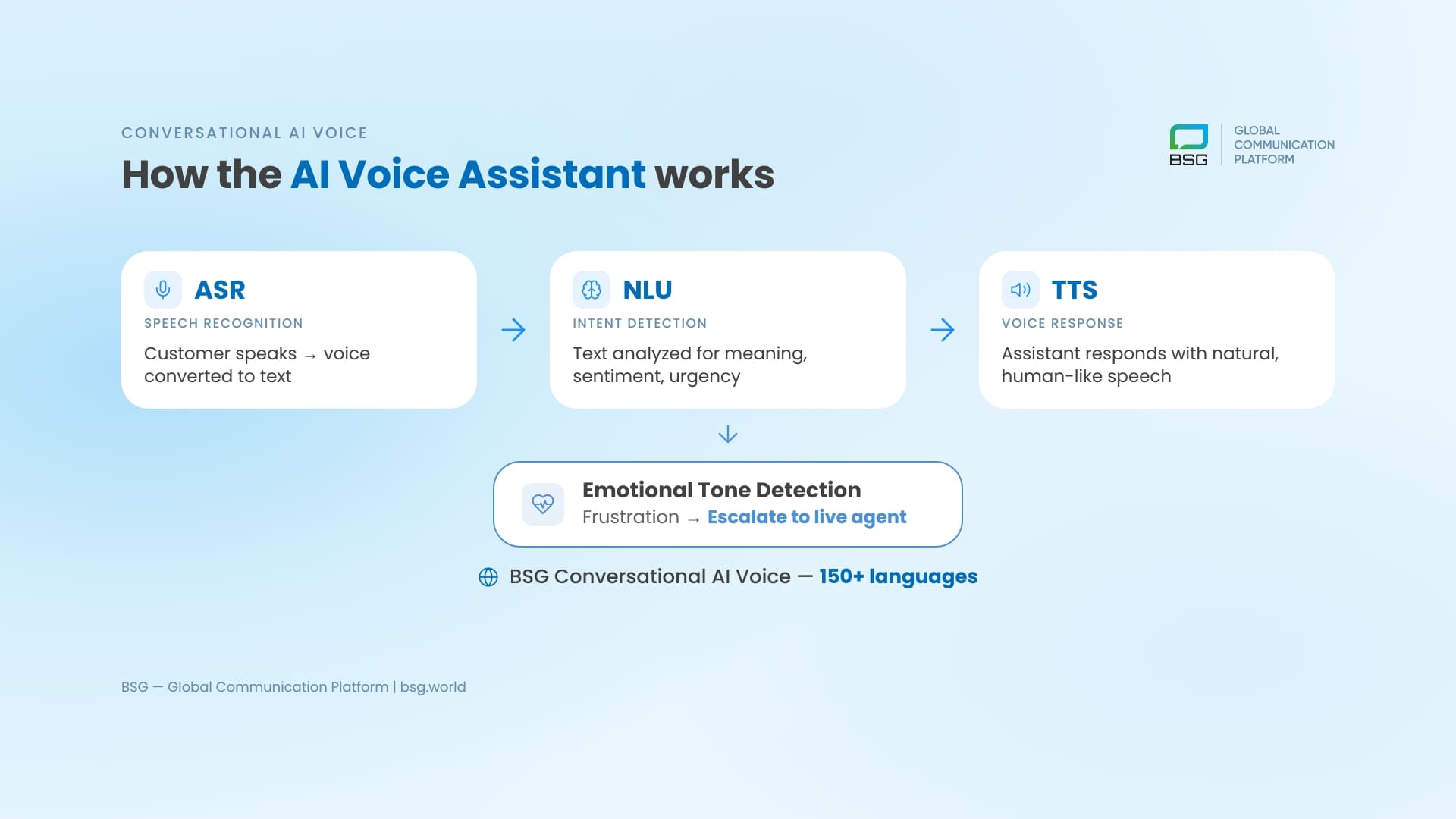
An AI voice assistant is not a menu-driven IVR. It is a real-time dialogue system built on three layers that work together to create natural, adaptive conversations. BSG's Conversational AI Voice combines all three into a single platform with 150+ language support and emotional tone detection.
ASR — Automatic Speech Recognition
Automatic Speech Recognition converts spoken language into text that the system can process. Modern ASR engines handle accents, background noise, and cross-language switching — critical for businesses operating across multiple markets. In a retention call, ASR accuracy determines whether the assistant correctly understands "I want to cancel" versus "I want to discuss my plan." The difference between those two intents changes the entire flow.
NLU — Natural Language Understanding
Natural Language Understanding takes the transcribed text and extracts meaning — intent, entities, sentiment, and urgency. This is where a retention-focused assistant separates from a generic one. A well-trained NLU model recognizes not just what the customer says, but why. "I am paying too much" maps to a pricing objection. "It does not do what I expected" maps to a feature-education opportunity. Each intent triggers a different retention script, dynamically.
TTS — Text-to-Speech Response
Once the assistant determines its response, TTS converts it to natural-sounding speech. The quality of TTS directly affects whether the customer stays on the line or hangs up. In our experience working with insurance and fintech clients, the shift from robotic TTS to neural voice synthesis increased average call duration by over 30% — customers simply stayed engaged longer when the voice sounded human. BSG's Conversational AI uses neural TTS across all supported languages, which means a retention call to a customer in the Philippines sounds as natural as one in Germany.
3 Retention Flows Powered by AI Voice
Retention is not a single action — it is a system. The three flows below cover the full lifecycle of churn management: catching at-risk customers before they leave, recovering those who already left, and measuring satisfaction to prevent future churn.
Churn Prevention — Proactive Call to At-Risk Customers
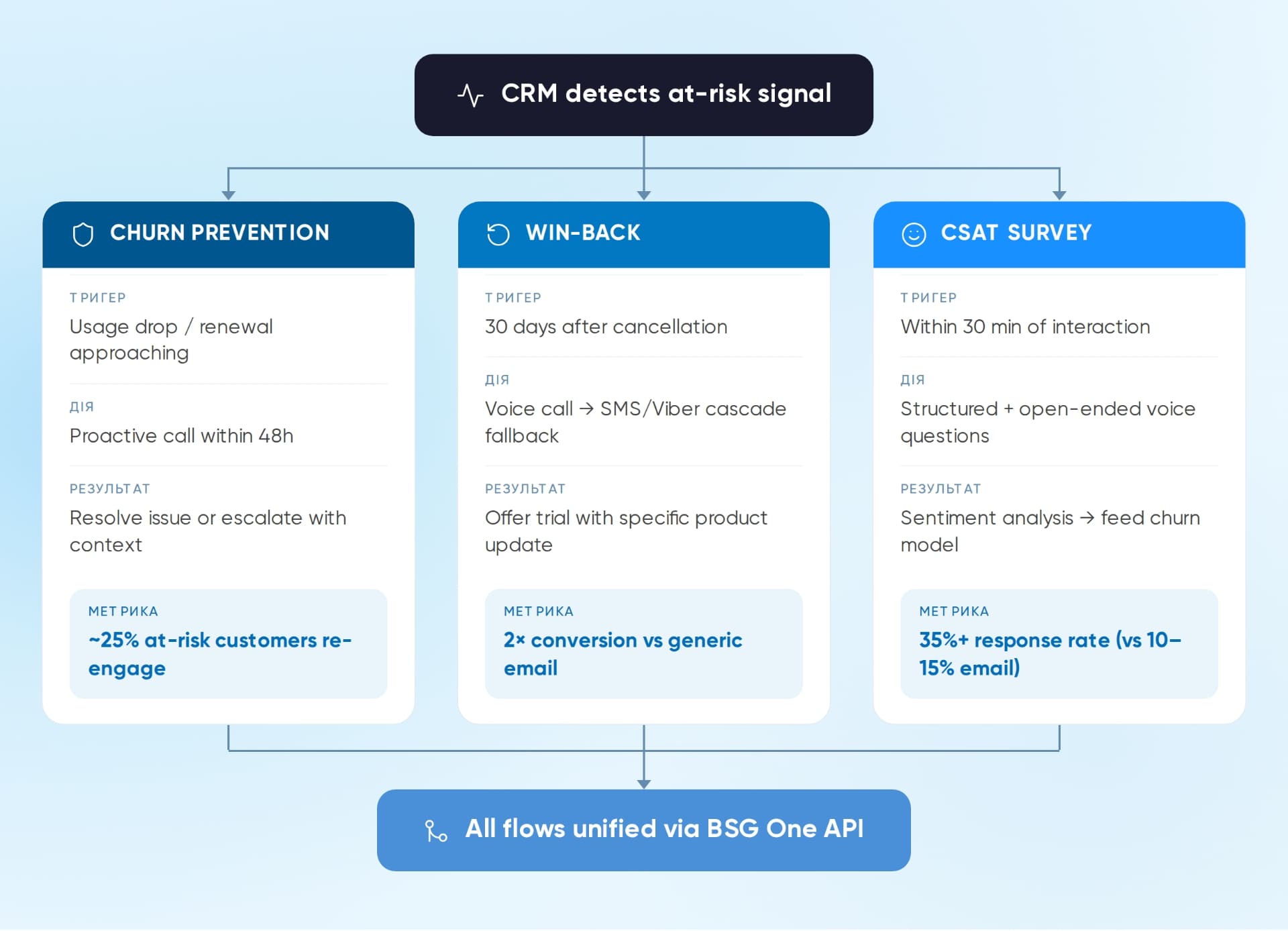
The trigger is behavioral: a customer's usage drops, a subscription renewal approaches without engagement, or a support ticket goes unresolved for too long. The CRM flags the account as at-risk, and the AI voice assistant initiates a proactive call.
Here is how the flow works in practice. The assistant calls the customer, identifies itself as the company's support assistant, and asks a direct question: "We noticed you have not used [feature] recently — is there anything we can help with?" If the customer expresses frustration, the assistant's NLU detects the sentiment and adapts — offering a discount, scheduling a call with a specialist, or walking through a feature the customer may have missed. If the customer's tone signals genuine intent to cancel, the assistant escalates to a live agent with full context already attached.
What our clients have found is that the timing of this call matters more than the script. A proactive call within 48 hours of a usage drop catches the customer while the frustration is still fixable. Wait two weeks, and the customer has already started evaluating alternatives. Research supports this: 70% of customers view businesses more positively when they receive proactive service notifications (Statista, 2024).
Without this flow: the customer churns silently. The CX team only sees it in the monthly report. With this flow: the assistant intervenes while the relationship is still salvageable, and the customer feels heard without waiting in a queue.
Win-Back — Re-engagement 30 Days After Churn
Not every churned customer is gone permanently. A customer who left because of a temporary billing issue, a missing feature that has since been added, or a competitor trial that disappointed them is a realistic win-back target. The challenge is reaching them through a channel they will actually respond to.
Email win-back campaigns typically see response rates below 5%. A voice call changes the dynamic. The assistant calls the former customer 30 days after cancellation — enough time for the initial frustration to fade, but not so long that they have forgotten the product. The script is straightforward: "We have made some changes since you left, including [specific update]. Would you be interested in a trial to see the difference?"
Based on what we observe across the campaigns we support, win-back voice calls that reference a specific product update convert at roughly double the rate of generic "we miss you" emails. The personalization is key: the assistant pulls the customer's usage history and cancellation reason from the CRM, and tailors the pitch accordingly.
For businesses using cascade routing, the win-back flow can layer voice with messaging: the assistant calls first, and if the customer does not answer, a follow-up SMS or Viber message delivers the same offer in text form. This multi-channel approach ensures the message reaches the customer regardless of channel preference.
Satisfaction Survey — Post-Interaction CSAT
CSAT surveys are most valuable when they capture the customer's sentiment immediately after an interaction — while the experience is fresh. Text-based surveys (email or in-app) often arrive hours later, when the emotional context has faded. Voice surveys, triggered within minutes of a support interaction or purchase, capture more honest and detailed feedback.
The AI voice assistant calls the customer, asks two or three structured questions ("On a scale of 1 to 5, how would you rate your experience?"), and then opens an unstructured follow-up: "Is there anything else you would like to share?" This open-ended question is where the real retention intelligence lives. The assistant's NLU analyzes the response for sentiment and specific complaints, tagging the interaction for follow-up if the score falls below a threshold.
We have worked with teams who tried post-purchase email surveys and found response rates around 10–15%. Switching to an AI voice survey within 30 minutes of the interaction raised that to over 35% — and the quality of feedback improved because customers spoke freely rather than typing short answers. The data feeds directly back into the churn prediction model, closing the loop: low CSAT scores trigger the churn prevention flow described above.
Results — What Voice Retention Can Deliver
Industry benchmarks and client-side observations point to consistent patterns when AI voice is added to retention workflows. AI-driven personalization lifts retention rates by 10–15% on average (Envive, 2025). Companies that implement omnichannel strategies — combining voice, messaging, and email — retain 89% of their customers, compared to 33% for single-channel approaches (Aberdeen Group, 2024).
The hypothesis in this article's title — that voice can retain 25% of otherwise-churning customers — aligns with what we see in practice. When a proactive voice call reaches a customer who has already mentally checked out, roughly one in four re-engages. The number varies by industry: fintech and insurance clients tend to see higher recovery because the switching cost is high and a well-timed call reminds the customer of that friction. eCommerce recovery rates are lower but still meaningful at scale.
For the businesses we work with in BFSI and insurance, the measurable impact goes beyond retention rate. Average customer lifetime value increases because retained customers tend to expand usage. Support costs decrease because the AI handles the first-line retention conversation. And the CSAT data from voice surveys gives the product team actionable feedback that text surveys rarely capture.
The critical factor is not the technology alone — it is the integration between voice, CRM, and messaging channels. An assistant that calls without context is just noise. An assistant that calls with the customer's usage history, open tickets, and billing status is a retention tool.
Integration with BSG One API
Running these three flows — churn prevention, win-back, and CSAT — requires a single integration point that connects voice, SMS, Viber, and email. BSG's One API provides exactly this: one API call triggers the voice assistant, and if the customer does not answer, the system automatically cascades to SMS or Viber with the same message context.
The technical setup is straightforward. Connect your CRM to BSG's API, define the behavioral triggers (usage drop, renewal date, low CSAT score), and the system handles the rest — call scheduling, language detection, escalation routing, and delivery reporting. In the campaigns we support, most teams go from API connection to first live retention call within two to three days.
One API also means your retention data is unified. Every voice call, SMS fallback, and Viber message is logged in one dashboard, so the CX team sees the full picture: which customers were reached, through which channel, what the outcome was, and whether follow-up is needed. This matters because retention is not a one-touch process — it is a sequence that may start with a voice call and end with an SMS confirmation, all tracked in one place.
Start Your AI Voice Retention Flow
If churn is costing your business more than acquisition, voice-based retention is worth testing. BSG's Conversational AI Voice deploys in days, supports 150+ languages, and integrates with your CRM through a single API. Our team can walk you through a live demo of the three flows described above — churn prevention, win-back, and CSAT — configured for your specific use case. Talk to BSG's team to set up a 15-minute demo and see how AI voice fits your retention strategy.
FAQ
How does an AI voice assistant reduce customer churn?
An AI voice assistant reduces churn by calling at-risk customers proactively — before they cancel. The assistant detects behavioral signals like usage drops or unresolved tickets, initiates a conversation, identifies the customer's specific concern through NLU, and either resolves it directly or escalates to a live agent with full context. This proactive approach catches churn signals that email and push notifications typically miss.
What retention rate improvement can I expect from AI voice?
Results vary by industry, but AI-driven personalization across channels lifts retention by 10–15% on average. Companies using omnichannel approaches (voice + messaging) retain up to 89% of customers versus 33% for single-channel strategies. For proactive retention calls specifically, roughly one in four at-risk customers re-engages after a well-timed voice interaction.
Can an AI voice assistant handle retention calls in multiple languages?
Yes. BSG's Conversational AI Voice supports 150+ languages with neural TTS, meaning the assistant sounds natural regardless of the language. The system detects the customer's language automatically during the call and switches accordingly — which is essential for businesses operating across multiple markets where retention calls need to feel local, not foreign.


Interested in a special offer?
Ready to reach further?
Let’s talk


Related articles
Mobile Number Portability: All You Should Know To stay in play in the liberalized telecom
![WhatsApp Business API: Complete Guide — Setup, Pricing, Use Cases [2026]](/assets/img/blog/whatsapp-business-api-setup-pricing-use-cases-guide_avatar.jpg)
WhatsApp Business API for 2026 — setup steps, the new per-message pricing model, and proven use cases by industry.
RCS vs SMS in 2026 — when to use each, how cascade routing works, and the real cost gap.