




SMS Quiet Hours in Europe: When You Can Send Promo SMS, by Country

A Black Friday campaign is queued for 21:45 in Paris. The creative is approved, the segment is clean, the budget is committed — and the send time falls outside the promotional window that French operators apply under their industry charter, which closes at 21:30. Add five more markets, three time zones and a weekend, and timing stops being a copywriting detail. It becomes a compliance task.
SMS quiet hours are the periods when promotional texts should not reach a recipient’s phone. The problem is that most country tables online are outdated or wrong. France rewrote its rules on 1 March 2026. Spain’s often-quoted 09:00–21:00 window applies to phone calls, not texts. Several large markets have no clock-time rule for SMS at all — only strict consent requirements.
This guide sorts out which SMS quiet hours are actually written down, who enforces them, and how to build a send schedule that holds up in every market you target. It is an information resource, not legal advice: rules change, so confirm business-critical decisions with your counsel.
What SMS Quiet Hours Are — and Who Actually Sets Them
SMS quiet hours come from three different sources, and the source matters more than the hours. A legal rule is written into national law and enforced by a regulator. An industry or operator rule is agreed by mobile operators and their partners and enforced through contracts, so non-compliant traffic can be filtered whatever the law says. A platform rule is set by a channel owner such as Meta and enforced inside its own app.
The EU baseline is the ePrivacy Directive. Its Article 13 requires prior consent for direct marketing by electronic mail, a definition EU law applies to SMS (EUR-Lex, 2009). It sets no time of day. That is why SMS marketing time restrictions across most of Europe come down to one legal question — do you hold valid opt-in consent? — and one commercial question: will the recipient tolerate the timing?
For a CRM team, the working rule is simple. Treat consent as the gate and timing as the guardrail. A perfectly timed message without consent is still unlawful, while a lawful promo landing at 23:40 is a complaint waiting to happen.
SMS Quiet Hours by Country: Europe Reference Table
The table covers SMS quiet hours and related rules we could verify against a law, a regulator or an operator code as of November 2026. Where a country has no clock-time rule for marketing SMS, we say so and cite the consent rule that does apply.
| Country | Promotional SMS window | Weekends & public holidays | Rule and type | Source |
|---|---|---|---|---|
| France | 08:00–21:30 local time, every day | Sundays and public holidays tolerated, not recommended | AF2M Business Messaging Charter 2026: industry code, binding on operators and aggregators by contract; covers SMS and RCS | AF2M; The Media Leader, 2026; MEF, 2026 |
| Spain | No clock-time rule for SMS | No SMS-specific rule; commercial phone calls barred on weekends and public holidays | Consumer law, Art. 96 TRLGDCU: commercial calls only 09:00–21:00 (applies to calls, not SMS) | BOE, RDL 1/2007 |
| Germany | No clock-time rule | No SMS-specific rule | UWG §7: prior express consent for advertising by electronic mail | UWG §7 |
| Italy | No clock-time rule | No SMS-specific rule | Privacy Code, Art. 130: consent for promotional SMS and MMS | Garante, 2013 |
| Netherlands | No clock-time rule | No SMS-specific rule | Telecommunications Act, Art. 11.7: unsolicited promotional SMS or app messages count as spam | ACM |
| Poland | No clock-time rule | No SMS-specific rule | Electronic Communications Law, Art. 398 (in force since 10 November 2024): prior consent for commercial information | Lege Artis, 2024 |
| United Kingdom | No clock-time rule | No SMS-specific rule | PECR: consent for marketing by electronic mail, including SMS | ICO guidance |
Two patterns stand out in European SMS quiet hours. France is the only market in this set where a promotional send window is enforced through the delivery chain. Everywhere else, regulators focus on consent, opt-out and sender identity — and they do enforce it. The UK’s ICO fined mobile operator EE £100,000 for sending more than 2.5 million direct marketing messages to customers without consent (ICO via Wired-Gov, 2019).
France: the one hard stop — and what changed on 1 March 2026
France matters because of volume and enforcement. Brands sent 15.26 billion Push SMS in France in 2025, up 7.51% year on year, according to AF2M’s SMS marketing barometer (The Media Leader, 2026). AF2M is not a government authority: it is an association of operators and service providers whose codes become contractually binding across operators, aggregators and platforms (MEF, 2026).
The 2026 edition of the Business Messaging Charter sets France’s SMS quiet hours: promotional SMS and RCS may go out only between 08:00 and 21:30. Sending Monday to Saturday is recommended; Sundays and public holidays are now tolerated but not recommended, and breaches can lead to non-compliant messages being stopped (The Media Leader, 2026). Many help pages still show “08:00–20:00, never on Sundays”. Those figures describe older practice or France’s separate rule for telemarketing calls.
That call rule is real and stricter: commercial phone canvassing is limited to Monday–Friday, 10:00–13:00 and 14:00–20:00, with weekends and public holidays excluded (Légifrance, 2022). If your team runs SMS and voice from one campaign calendar, configure the two windows separately.
At BSG, our default advice for France is to start large promotional batches early enough that retries and throttled sends finish well before 21:30, rather than scheduling right up to the edge. The same charter also tightens sender name rules, so check what each EU country requires for sender ID registration before your first French campaign.
Promotional vs Service Messages: Why Order Updates Are Not Time-Restricted
SMS quiet hours apply to promotion, not to information a customer is waiting for. A transactional SMS — an order confirmation, delivery update, one-time password or appointment reminder — serves an action the customer already took. The French charter states that delivery notifications, authentication and user-initiated exchanges fall outside its time restrictions (The Media Leader, 2026).
The legal logic is the same elsewhere. In the UK, the ICO says messages sent purely for administrative or customer service purposes do not count as direct marketing, provided they promote nothing (ICO guidance). The same guidance defines electronic mail broadly, covering SMS, in-app messages and direct messages on social media.
| Promotional SMS | Service (transactional) SMS | |
|---|---|---|
| Purpose | Sell or promote a product, offer or brand | Inform about an existing order, account or request |
| Marketing consent | Prior opt-in required (ePrivacy Art. 13 and national laws) | Not required while the message promotes nothing |
| Send window | France: 08:00–21:30; elsewhere a house policy | Not restricted by the French charter; send when the event happens |
| Examples | Flash sale, new collection, discount reminder | Order confirmation, shipping update, OTP, appointment reminder |
The trap is the hybrid message. “Your order has shipped — and here’s 15% off your next one” is no longer a pure service message. Once promotional content is added, marketing rules apply: consent, opt-out and, in France, the send window. In the EE case above, EE considered its texts to be service messages, but the ICO found they contained direct marketing (ICO via Wired-Gov, 2019). If your consent base needs work, start with our guide to SMS opt-in and why it matters.
WhatsApp Marketing Rules in Europe: No Clock, Tighter Gates
Meta sets the operational rules for WhatsApp, and none of them is a clock. Businesses must collect opt-in before messaging people, and the opt-in must make clear that the person agrees to receive messages from that business (Meta for Developers). Promotional content goes out as marketing message templates, which Meta categorises separately from utility and authentication messages.
Meta can also limit how many marketing template messages a person receives from businesses over a period of time, based on how they engage (Meta for Developers, 2026). That cap counts messages, not hours, so it will not stop a badly timed campaign. Your own schedule is the only brake.
National law still sits on top of Meta’s rules. The Dutch regulator ACM defines spam as an unsolicited promotional electronic message and names SMS and app messages alike (ACM). Poland’s Electronic Communications Law extends its consent rule to interpersonal communication services (Lege Artis, 2024).
At BSG, we recommend applying each country’s SMS quiet hours to WhatsApp promotions as well. It matters most in a message cascade fallback: if an RCS-to-SMS or Viber-to-SMS flow triggers its SMS step at 21:50 in Lyon, that fallback lands outside the French window even though the first message went out on time.
How to Set Up a Send Schedule That Respects SMS Quiet Hours
The best time to send promotional SMS is the window that satisfies the strictest rule in your target list and still matches when people read their messages. What we advise clients sending into several EU markets comes down to six steps.
- Classify every message. Tag each template as promotional or service in your CRM, and never let a discount line slip into a service template.
- Schedule in the recipient’s local time. Mainland Portugal and the Canary Islands run an hour behind Madrid; Finland, Greece and Romania run an hour ahead of Berlin. One “10:00 CET” send is three different local times.
- Set a window per country. Hard-code France at 08:00–21:30. For markets without a statutory rule, choose a conservative daytime window as house policy and document it.
- Load public holiday calendars. France tolerates Sunday and holiday promos but recommends against them; elsewhere, holiday sends are a judgement call your complaint rate will grade.
- Pace large batches. Throughput limits and retries stretch a send, so start early enough for the last message to clear before the window closes.
- Align fallback timing. When a rich-channel message falls back to SMS, the fallback must respect the same national window.
Scheduling in BSG Bulk SMS lets you set the date, time and frequency of a campaign, and the platform sends in each customer’s local time zone — the foundation for running one campaign across several national windows.
Picture the contrast. Without country rules, a pan-European flash sale goes out at 21:00 CET: Lisbon receives it at 20:00, Helsinki at 22:00, and the French segment runs into the 21:30 cut-off while it is still sending. With per-country windows and local-time scheduling, each segment lands in its own daytime slot, and the French batch completes inside its window.
Cross-border timing errors rarely come from not knowing the rules. They come from one UTC send time, a forgotten holiday or a fallback that fires too late. BSG schedules campaigns in each recipient’s local time zone and runs SMS fallback from one platform. If you are planning promotions across several EU markets, talk to our team and we will help you map country send windows before your next campaign.
Information current as of November 2026. This guide is not legal advice.
FAQ
What time can you send marketing SMS in France?
Under the AF2M Business Messaging Charter 2026, in force since 1 March 2026, promotional SMS and RCS may be sent between 08:00 and 21:30. Monday to Saturday is recommended, while Sundays and public holidays are tolerated but not recommended. Service messages such as delivery notifications and authentication codes are not covered by these restrictions.
Are there SMS quiet hours in Germany, Italy or the UK?
We found no statutory clock-time rule for marketing SMS in Germany, Italy or the UK. What these countries regulate strictly is consent: UWG §7 in Germany, Article 130 of the Privacy Code in Italy and PECR in the UK. A conservative daytime window is still sensible practice to protect response rates and avoid complaints.
Do SMS quiet hours apply to transactional SMS?
No. Quiet hours target promotional content, and the French charter excludes delivery notifications, authentication and user-initiated exchanges. If a transactional message includes an offer, it is treated as marketing and marketing rules apply.
Are there time restrictions on WhatsApp marketing messages in Europe?
Meta’s published WhatsApp rules cover opt-in, message templates and messaging limits; they do not define a send-time window. EU and UK consent laws still apply to promotional chat messages. Applying your SMS quiet hours to WhatsApp promotions is the safest default.


Interested in a special offer?
Ready to reach further?
Let’s talk


Related articles
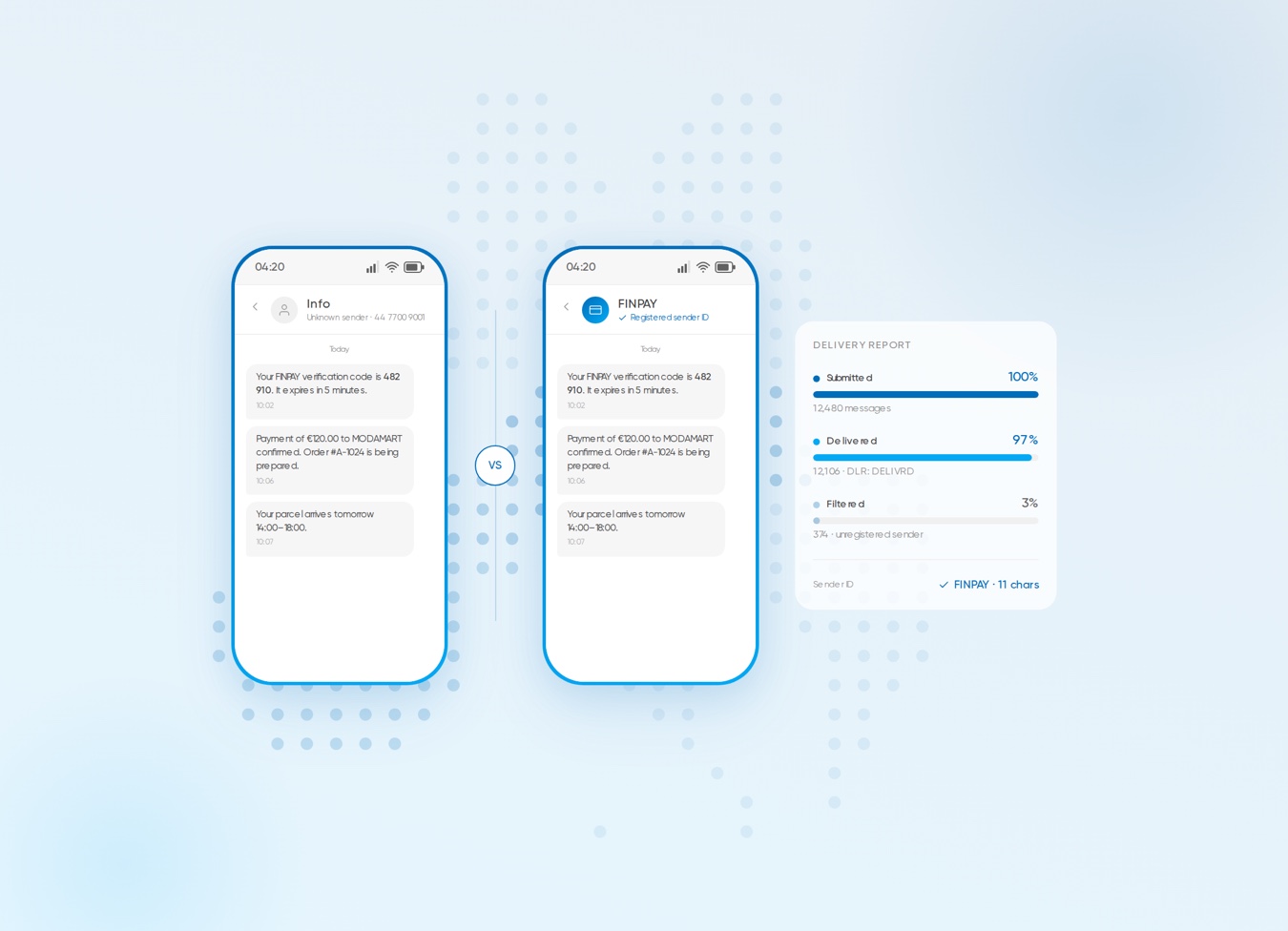
Why unregistered senders get filtered in the EU and UK, and what each country requires for sender ID registration.

Want to make sure your text message marketing campaigns are on the right side of law? It's all about understanding the rules! Stay informed about the SMS regulations in the US and Europe, and avoid any legal trouble.
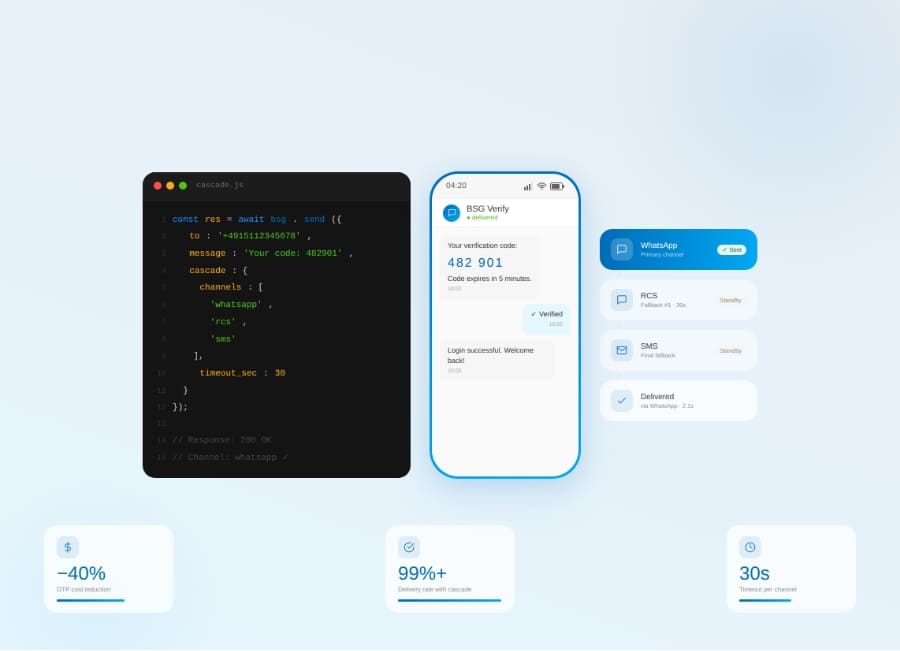
Server-side cascade routing across WhatsApp, RCS, and SMS — how it cuts OTP costs 20–40% with one API call.