




Choosing the Right Conversational AI for Business: Voice Bot or Chatbot?

Customer service is the primary strategic function of any developing business. The way your company interacts with customers not only determines the profitability of the project but has a direct connection with the loyalty of your customers. Therefore, high-quality conversational artificial intelligence is on top of the customer’s “hierarchy of needs.”
We can describe conversational AI as any type of AI that simulates human networking. In fact, nearly 80% of businesses use conversational AI, while interactions conducted by conversational agents increased by no less than 250% in the last four years.
Statistics show that chatbots and voice bots are no longer just an attractive feature for customer service but a real necessity. This article will come in handy if you are contemplating which type of digital assistance would become the winner for your business, and enclose the future of the industry.
Understanding Voice Bots and Chatbots
Both chatbots and voice chatbots are the products of machine learning, or to be more specific Natural Language Processing (NLP). The latter is referred to as the technology that can recognize the words, sentences, and overall context of your inquiries in customer support. Yet, there are still some critical preferences in both of their operating mechanism and usability.
The traditional chatbot refers to a software or computer program designed to imitate human conversation or engage in textual interactions. On the other hand, the voice bot takes this concept further by incorporating advanced features. A voice bot utilizes Natural Language Understanding (NLU) to detect and extract data from speech, along with an Interactive Voice Response (IVR) system that interacts with the user’s voice.
When it comes to improving customer communication , the matter of which customer AI is better becomes crucial. Decision-making here requires a deeper understanding of your business needs. So, let’s deepen the topic deeper.
Advantages and Limitations of Voice Bots
There is no surprise that voice bots seem to be rather a hands-on solution for customer engagement. Some advantages of voice bots include:
- The hands-free operation. This tool minimizes manual work, which makes it more applicable for users of all age groups, and suitable for more working conditions.
- Higher speed of processes. The numbers can prove: the average speaking speed is 173 wpm, while the typing speed equals no more than 70.
- Enhanced integration capabilities. Voice can now be integrated with a variety of communication channels, including websites, social media platforms, messaging apps, and phone systems.
The main downfall is the accuracy of conversational analytics. In times of machine learning, computers can also make mistakes as it is not just an interactive voice response but a system that requires voicebot training data. Just like with most of voice assistant platforms, it may take a solid time to create a bot that has equal enough knowledge base and complexity, otherwise, it may be a feature of limited functionality.
Real-World Examples of Successful Voice Bot Implementations
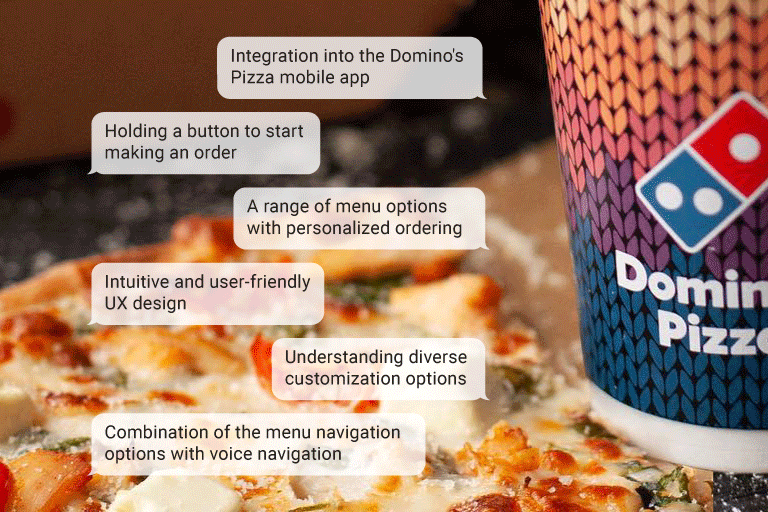
Let’s delve into one of the most remarkable instances of voice bots in 2023. Domino’s Pizza introduced a voice-enabled chatbot that allows customers to place orders using their voice. This innovative solution was seamlessly integrated into the Domino’s Pizza mobile app. Users can easily activate the voice bot by holding the button and speaking their order, as the app automatically initiates speech recognition and guides them through the ordering process. The menu offers a wide range of options, with the ability to personalize orders according to preferences.
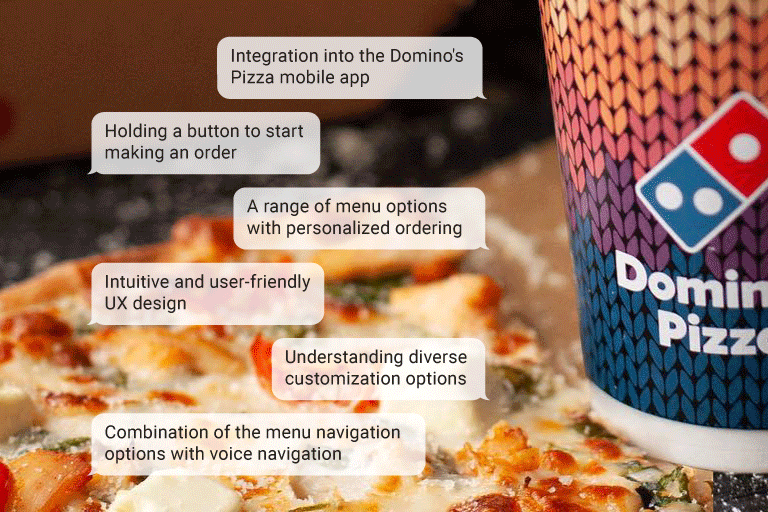
Even though the primary focus of the project was the bot’s ability to understand various customization options through weeks of training data, several other crucial factors contributed significantly to its success. One such factor was the chatbot UX design.
The Voice User Interface (VUI) was designed to be highly intuitive and user-friendly, using straightforward language to guide users throughout the entire process. Additionally, Domino’s clever integration of menu navigation options with voice commands further streamlined the ordering experience, making it even more convenient for customers.
Advantages and Limitations of Chatbots
In the right hands, the chatbot can streamline the company’s processes and beat up the voice bots in terms of customer experience. Some benefits make it increasingly captivating:
- Increased availability. Speaking aloud may not always be feasible or appropriate, in such situations text-based chatbots are a more versatile option to pick.
- Access to every device. While the voicebots work only with devices having an activated number, chatbots are accessible for every gadget with access to the Internet. This significantly expands the potential user pool.
- Facilitation of developing process. The chatbots are easier to create using variety of chatbot platforms as it does not require skills in complicated back-end technologies like NLU Engine or TTS.
Yet, chatbots are often loose in terms of conversational abilities as NLP algorithms struggle with understanding complex or ambiguous queries, detecting nuances, and providing proper sentiment analysis.
Real-World Examples of Successful Chatbot Implementations
One of the greatest examples of chatbot implementation for a business is Spotify. The musical streaming platform made a chatbot that offers a seamless experience for its users to explore, enjoy, and spread the magic of music. As soon as you dive in, you’ll be treated to personalized playlists that cater to your mood, current activities, or any specific music genre you desire.
One thing that makes this voicebox so special is the implementation of omnichannel communication within Messenger. It sets up the easily accessible social attachment of their audio streaming platform and shares the music with the user’s contacts. This serves as a quick and simple way to organically promote Spotify while also allowing consumers to fully enjoy the music service through a highly interactive and tailored experience.
Сhoosing the Right Conversational AI for Your Business
It is a tall order to recommend which type of AI is going to provide the best personal digital assistants in satisfying your business needs. The final decision is based not only on the desired user experience result but also company’s capabilities of building a certain type of AI assistance. However, the main factors to consider are presented below:
As you can see the decision relies on the issue you are trying to solve. Thus, one last piece of advice to avoid common pitfalls is to think about what your user needs and where would be the intersection of their need and your capabilities and look for the shortest way to deliver the results.
The Future of Conversational AI
The conversation about AI is only gaining momentum. According to recent research, by 2030, the global conversational AI market size will reach $32.6 billion . Artificial intelligence will be used in 95% of brand-customer interactions by 2025, making it easy to predict the increased competition in conversational AI development. The specialist expects some major future trends like multi-language support, hybrid voice chatbots, and advanced natural language processing. Predictions by AI experts, published via Medium online platform , indicate that the following trends will be predominant in the future:
- Maturation of enterprise strategy. All industries consider AI solutions as a priority rather than proofs-of-concept, leading to the formation of multidisciplinary teams and the adoption of best development practices.
- The increased importance of the design. The bot’s appearance will mostly be focused on empathy and personalization with an emphasis on ethical AI design and comprehending the non-verbal signals of customers.
- Rise of multichannel solution s. Companies seek multimodal and multichannel conversational to ensure a rich customer experience and allow seamless transitions between many channels and provide advanced use cases.
- Integration of new technologies . Machine learning will only go further. One small example may be a Large Language Model ot LLM for conducting the auto-generating conversation responses. Some businesses are also testing synthetic voices and avatars to make the conversation more interactive.
Any types of business are likely to adapt to the new demands of the customers and catch up with the trends to win the consumer’s loyalty.
Wrapping Up
The evidence is clear: AI holds the key to the future of delivering exceptional customer service. Both chatbots and voice bots offer unique advantages and disadvantages, depending on the specific needs of each business. Selecting the appropriate solution and finding a reliable partner to develop a high-quality AI system can greatly enhance the user experience while also saving significant costs for the company. It’s a strategic decision that can pave the way for improved customer satisfaction and operational efficiency in the long run.
If you intended to get the most out of voice bot or chatbot technology, consider contacting BSG — a global communication platform . We offer communication solutions to businesses worldwide and can help you utilize advanced technology in the most effective way possible.


Interested in a special offer?
Ready to reach further?
Let’s talk


Related articles

Cyber attacks have become an ever-present danger threatening to shut down digital activities. Cybercriminals’ activities

Imagine a future where you can start your day by accessing all the information you

Every year, shoppers and business owners look forward to the month of November because it’s