





The conversation usually starts in sprint planning. Someone needs password resets, delivery alerts or login codes, and a senior engineer says: "Sending an SMS is one HTTP call. We can build this ourselves in a couple of sprints." On day one, they are right. The first message goes out fast. The hard part shows up months later, when a route in one country starts dropping codes at night and nobody on the team knows which operator to call.
That gap between the first message and a production-grade messaging system is what the build vs buy messaging decision is really about. It is not a question of whether your developers are capable. It is a question of where their time creates the most value, and what you take on when you own the whole stack: carrier connectivity, routing, compliance and on-call included.
This guide compares the in-house vs CPaaS paths across the five dimensions that decide the outcome: time, money, support, compliance and scale. It is written for product leads, CTOs and engineers in the EU and UK, where regulation adds its own weight to the choice. If you need the basics first, start with what a CPaaS includes and how it works.
What "Building Messaging In-House" Actually Means
Building messaging in-house means your team owns the software, and often the connectivity, that turns an event in your product into a message on a customer's phone. Most teams underestimate the scope because "build" can describe three very different projects.
At the lightest level, you write a thin service that calls a provider's API. That is still buying: delivery is outsourced, and you keep only the business logic. At the middle level, you build your own messaging platform with queues, retries, templates, consent storage, reporting and a connection to one or more aggregators over SMPP, the protocol used to exchange A2P SMS traffic between businesses and carriers. At the heaviest level, you negotiate direct connections with mobile network operators, country by country.
Almost every build vs buy debate is really about the middle level. Teams rarely plan to become a telecom company. Yet a self-built platform drifts toward that role as soon as you add a second channel, a second country or a second provider for redundancy. Agree on which level you are evaluating before anyone estimates effort, or the estimates will describe different projects.
Time: The Build vs Buy Messaging Timeline Nobody Plans For
The first message ships in days. The production system takes far longer, because most of the work sits in edge cases that only appear under real traffic. Here is what a self-built SMS layer has to handle before it is safe for login codes or payment alerts, and it is where most build vs buy SMS estimates go wrong:
- Throughput control per connection, so traffic bursts are not throttled or rejected by the carrier.
- Message encoding: a single SMS holds 160 GSM-7 characters or 70 UCS-2 characters, and longer texts are split into segments (3GPP TS 23.038). One emoji can switch a whole message to UCS-2 and multiply the segment count you pay for.
- Delivery receipts (DLRs) that arrive late, out of order or in operator-specific formats.
- Retries and failover that never send the same one-time code twice.
- Sender ID rules that differ by country and, in some markets, require pre-registration.
- Opt-out handling, consent records and audit logs.
None of these is exotic. Each one is a ticket, a test suite and a failure mode. Together they turn a two-sprint estimate into a roadmap item that competes with your core product for quarters.
At BSG, we've seen that the most expensive part of a messaging build is not the first version but the second year. Carriers change interfaces, countries change sender rules, and the engineer who wrote the SMPP client moves to another team. Time-to-first-message is a poor proxy for time-to-reliable-messaging, so when you compare the two paths, estimate the second number.
Buying compresses this timeline because the integration work is mostly your own logic: calling an API, handling status webhooks and mapping message types to templates. Carrier connections, encoding, routing and receipt parsing are already running in production on the provider's side.
Money: What In-House Messaging Really Costs
The cost of in-house messaging is rarely the code. It is the people who maintain it, the contracts behind it and the losses that happen when nobody is watching the traffic.
In any CPaaS vs build comparison, start with a fact that changes many budgets: building does not remove per-message fees. Operators charge for message termination either way. When you build, you still buy delivery, from an aggregator or directly from operators, and direct agreements generally require volume, commercial relationships and technical certification that most product companies do not have. So the realistic comparison is not "provider price versus zero". It is provider price versus aggregator price plus the cost of your own platform.
A simple total cost of ownership model for the in-house path includes six lines:
- Engineering: the developers who build the platform, multiplied by their fully loaded cost and the months it takes.
- Maintenance: a share of an engineer's time every month for carrier changes, bugs and new requirements.
- On-call: someone has to own incidents outside business hours, every week of the year.
- Infrastructure: servers, queues, monitoring, logging and secure storage for consent and message data.
- Delivery fees and minimum commitments with aggregators or operators.
- Fraud losses, especially artificially inflated traffic (AIT), where bots trigger one-time-password requests to numbers controlled by fraudsters and you pay for every message.
Plug in your own salaries and volumes. If the in-house total comes out lower only because maintenance, on-call and fraud are set to zero, the model is not finished.
The buy path has its own cost. You pay a margin on each message, and you depend on the provider's pricing. What you get for that margin is routing work your team would otherwise do. In the OTP flows we support, cascade routing, which tries the most cost-effective channel first and falls back automatically, typically reduces verification costs by 20–40%. A self-built system can implement fallback too, but only across the routes and channels you have contracted and integrated yourself.
Support and Reliability: Who Gets Paged at Night?
Reliability is where the in-house vs CPaaS gap is widest, because messaging fails silently. An API returns "accepted", the message leaves your system, and somewhere between the aggregator and the handset it disappears. Your dashboards stay green while users stop receiving codes.
Detecting that requires monitoring delivery rate per country, operator and route, comparing it with a baseline and moving traffic when it drops. Fixing it requires relationships: someone who can open a ticket with the right operator and get an answer. An in-house team can build the monitoring. The relationships are much harder to build from scratch.
We've worked with teams who ran their own gateway on top of a single aggregator and found that the weak point was not their code but their dependency. When that one route degraded in one market, they had no alternative path ready and little visibility into why messages failed. Moving to multi-route delivery replaced manual investigation with automatic rerouting. Without redundancy, a carrier problem becomes your incident. With it, a carrier problem becomes a line in a report.
This is the layer BSG builds and operates. BSG Bulk SMS runs over 60+ direct connections to mobile network operators, on BSG's own SMSC software, with an SLA of 99.90–99.99%. That is the infrastructure a product team would otherwise have to assemble, certify and staff.
The trade-off cuts the other way too. When you buy, you depend on the provider's support quality. Ask how incidents are escalated, whether you get named contacts, and what the SLA actually covers: platform uptime, delivery performance or both.
Compliance in the EU and UK: In-House vs CPaaS Responsibilities
Compliance does not disappear when you buy, and it does not get easier when you build. What changes is who carries which part of the work.
In both cases, your company remains responsible for the lawful basis of each message. Under EU rules, marketing by electronic message, which includes SMS, generally requires prior consent (ePrivacy Directive 2002/58/EC, Art. 13), and the UK applies a similar rule through PECR (PECR, Regulation 22). Phone numbers and message content are personal data under GDPR, and the most serious infringements can lead to fines of up to €20 million or 4% of worldwide annual turnover, whichever is higher (GDPR, Art. 83).
When you build, you own the whole compliance surface: data residency, retention, encryption, access control, sender registration in each country, opt-out processing and audit trails. When you buy, the provider acts as your processor, so you need a data processing agreement and due diligence on where data is stored and who can access it. For EU financial entities, the Digital Operational Resilience Act adds formal requirements for managing ICT third-party risk (DORA, Regulation (EU) 2022/2554). Buying means documented vendor oversight. Building means documented resilience of your own stack.
For the businesses we work with in the EU, the deciding factor is often not the regulation itself but the evidence. Auditors ask for certifications, data flows and incident records. BSG works in line with GDPR, holds ISO and PCI DSS compliance and operates under 15+ national telecom licenses in the EU, which gives compliance teams documentation to point to instead of producing it from zero.
Scale: Where the Build vs Buy Messaging Math Flips
Scale is the one dimension where building can genuinely win. The real question is whose scale, and across how many countries.
Building tends to pay off when messaging is your product rather than a feature of it: aggregators, operators and large platforms that resell messaging to their own customers. It can also make sense when your volume is very high and concentrated in a few countries, when you already run a telecom or infrastructure team, or when regulation or contracts require a deployment you fully control.
Buying tends to win when messaging supports a product rather than being one, when you send to many countries, or when you need several channels such as SMS, RCS, Viber and voice with fallback between them. It also wins when time-to-market matters more than per-message margin. In-house, each new country or channel is a new integration project. With a CPaaS, it is usually a configuration change.
There is also a middle path. Some teams keep orchestration in-house, meaning their own logic for when to send what to whom, and buy delivery. Others want a branded messaging platform without writing one: renting a ready-made CPaaS platform gives aggregators and enterprises their own platform on infrastructure that already runs in production.
When to Build vs When to Buy: Decision Table
The table below summarises the in-house vs CPaaS decision in one view. Read each row as a question about your own situation, not about providers.
| Criterion | Build in-house when… | Buy a CPaaS when… |
|---|---|---|
| Role of messaging | Messaging is your core product or revenue line | Messaging supports your product: alerts, OTP, marketing |
| Time to market | You can wait for a multi-quarter platform project | You need production traffic this quarter |
| Team | Engineers can own telecom protocols and on-call long term | Engineers should stay focused on your core product |
| Geography | A few countries with stable, high volume | Many countries, or plans to expand |
| Channels | One channel is enough for the foreseeable future | SMS plus RCS, Viber or voice, with fallback between them |
| Cost structure | Volume is high enough to negotiate direct carrier terms | Per-message margin costs less than a team plus infrastructure |
| Compliance | You need full control of data and deployment | You prefer audited processes and existing certifications |
| Reliability | You can build multi-route monitoring and failover | You want redundancy and rerouting as part of the service |
If most of your answers land in the right-hand column, buying is the rational default. If they land on the left, build, but budget for the second year, not just the first release.
Making the Call for Your Team
The build vs buy messaging decision is easier when you test the buy path on real requirements rather than assumptions. BSG's API documentation shows what a production integration involves, from sending to status callbacks. If you would rather walk through your volumes, countries and compliance needs with people who run this infrastructure every day, talk to the BSG team. We will help you map which parts are worth building and which are worth buying.
FAQ
Is it cheaper to build your own SMS platform?
Usually not, unless messaging is your core business and your volume justifies direct carrier deals. Building does not remove per-message fees; it adds engineering, maintenance, on-call and fraud-prevention costs on top of them. In most build vs buy SMS decisions, the useful comparison is total cost of ownership, not per-message price.
When should a company use CPaaS instead of building in-house?
Use a CPaaS when messaging supports your product rather than being the product, when you send to several countries or channels, or when you need production-grade delivery quickly. In these cases, a provider's routing, redundancy and compliance work costs less than recreating it internally.
Can you start with a CPaaS and move in-house later?
Yes, and it is a common pattern. Keep your messaging logic behind an internal interface so the provider can be swapped, and avoid hard-coding provider-specific features into product code. That keeps the build option open without delaying your launch.
Does using a CPaaS make you GDPR compliant?
No. Your company stays responsible for consent and the lawful basis of each message, while the CPaaS acts as a processor. A good provider makes compliance easier with a data processing agreement, certifications and audit-ready records, but it does not replace your own obligations.


Interested in a special offer?
Ready to reach further?
Let’s talk


Related articles

Talking to customers these days is more than just emails or phone calls. Businesses need
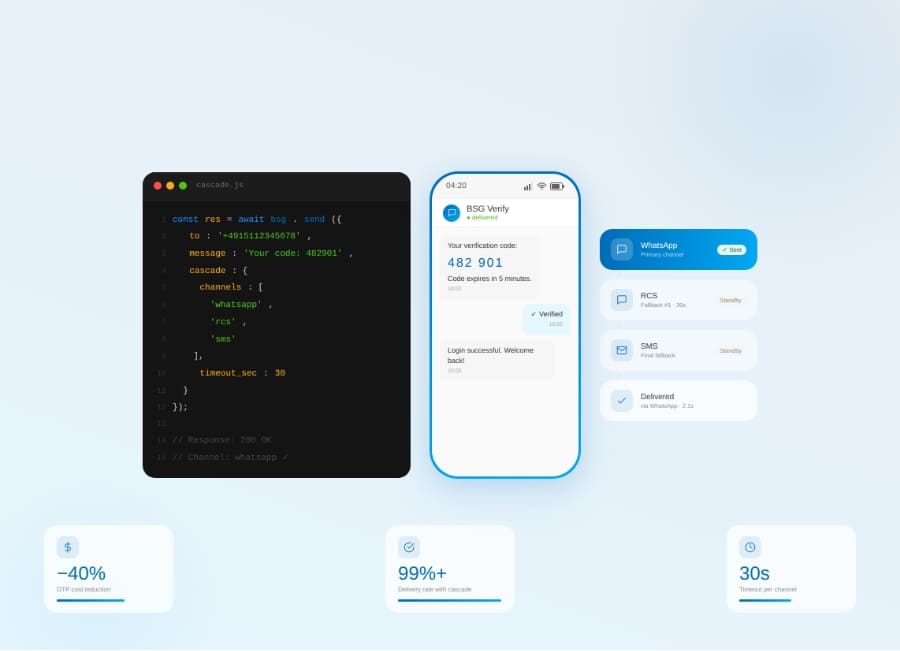
Server-side cascade routing across WhatsApp, RCS, and SMS — how it cuts OTP costs 20–40% with one API call.
Nurturing your brand on the web and on mobile heavily relies on your ability to