





A customer abandons a cart worth $120. Your email reminder lands six hours later — buried under 47 other messages. By then, the buyer has moved on, and that revenue is gone.
This is the gap WhatsApp for business closes. With open rates that consistently exceed 95% and response times measured in seconds rather than hours, WhatsApp has become the primary communication channel for businesses operating in mobile-first markets. More than 200 million companies already use the platform to send transactional alerts, recover lost sales, verify identities, and handle support requests — all inside the same app their customers use to talk with friends and family.
But the real question is not whether WhatsApp works. It is how it works differently across industries — and what happens when you apply it to your specific operational problems. Below are ten use cases drawn from real deployment patterns, each tied to a measurable business outcome.
Why WhatsApp for Business Communication
WhatsApp reaches over 3 billion monthly active users across 180+ countries (Meta, 2025). In markets like Brazil, India, Kenya, Nigeria, and the Philippines, it is not one of several messaging apps — it is the default. Customers in these regions check WhatsApp dozens of times per day, and they expect businesses to be there too.
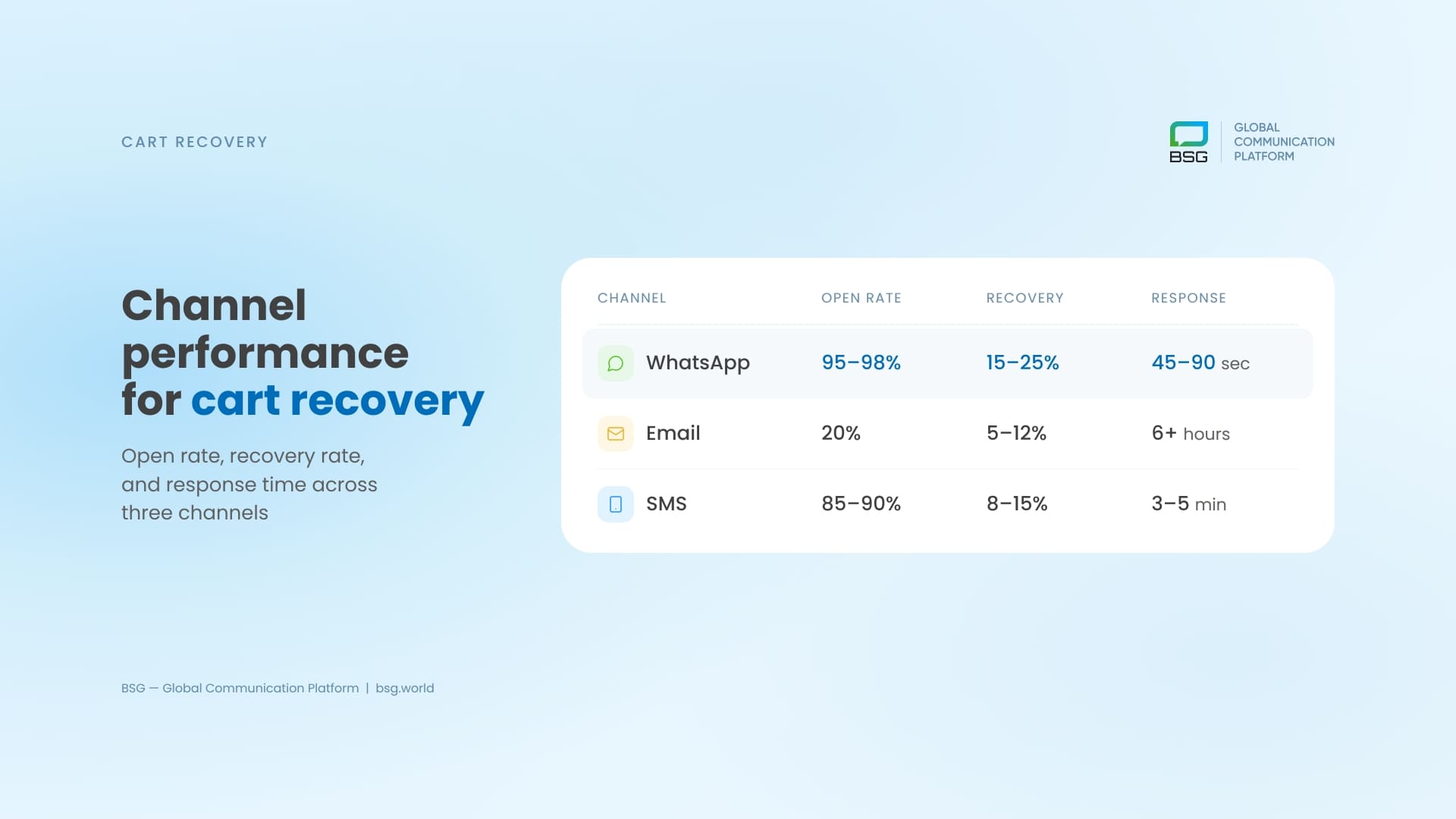
The performance gap between WhatsApp and traditional channels is significant. WhatsApp messages achieve open rates of 95–98%, compared to roughly 20% for email (Meta Business, 2025). Click-through rates on promotional WhatsApp content range from 15% to 60% depending on the campaign type, while email typically lands between 2% and 6%. Users respond to WhatsApp messages within 45–90 seconds on average — email responses take six hours or more.
At BSG, we've seen that the businesses getting the strongest results from WhatsApp are those who treat it as a primary channel from the start — not an afterthought bolted onto an existing email workflow. When WhatsApp is integrated into the core communication stack through a WhatsApp Business API, the impact on delivery, engagement, and conversion becomes measurable within weeks.
What makes WhatsApp particularly effective is the conversation model. Unlike SMS or email, WhatsApp supports rich media — images, documents, buttons, quick replies — inside a two-way conversation thread. Customers can ask follow-up questions, confirm details, or complete actions without leaving the chat. This reduces friction at every stage of the customer lifecycle, from acquisition to retention.
Use Case 1 — E-commerce: Cart Recovery & Order Updates
Cart abandonment averages 70.19% across eCommerce (Baymard Institute, 2025). That means seven out of ten shoppers who add items to a cart leave without completing the purchase. Most eCommerce teams rely on email to recover those carts, but email recovery rates sit at 5–12% in most markets.
WhatsApp changes this equation. A cart recovery message sent via WhatsApp within the first hour reaches the customer inside their most-used app, with a product image, a direct checkout link, and a suggested reply button. Recovery rates through WhatsApp reach 15–25%, roughly double what email achieves (ClickForest, 2025).
Beyond recovery, WhatsApp handles the full post-purchase communication flow: order confirmations, shipping updates, delivery notifications, and return instructions — all in one thread. The customer does not need to search through their inbox or check a separate tracking portal. In our experience working with eCommerce and retail clients, teams that move transactional messaging to WhatsApp see a measurable drop in "where is my order" support tickets within the first month.
The contrast is clear. Without WhatsApp: a customer abandons a cart, receives an email they never open, and the sale is lost. With WhatsApp: the customer gets a personalized reminder within minutes, taps a button to return to checkout, and completes the purchase.
Use Case 2 — Fintech: Transaction Alerts & KYC
Financial services live and die by trust. When a customer makes a payment, transfers funds, or logs in from a new device, they expect to be notified immediately — not minutes later, and certainly not by an email they might miss.
WhatsApp delivers transaction alerts in real time: payment confirmations, balance updates, suspicious activity warnings, and OTP codes for two-factor authentication. Because WhatsApp messages are encrypted and delivered directly to the customer's device, they carry an inherent trust signal that SMS in some markets does not.
KYC (Know Your Customer) workflows also benefit from WhatsApp's rich media capabilities. Instead of directing users to a web form — where drop-off rates are notoriously high — fintech companies send a WhatsApp message asking customers to photograph their ID document and submit it directly in the chat. The document is uploaded, verified, and confirmed within minutes. Based on what we observe across the campaigns we support, fintech clients who shift KYC prompts from email to WhatsApp see completion rates improve by 20–30%, particularly in markets where customers are more comfortable sharing documents through a familiar app than through an unfamiliar website.
Use Case 3 — iGaming: Promo & Re-engagement
Player retention is the core challenge in iGaming. Acquiring a new player costs five to ten times more than keeping an existing one active, yet most re-engagement campaigns rely on email and push notifications — channels that players routinely ignore.
WhatsApp gives iGaming operators a direct line to players with high visibility. Promotional messages — bonus offers, free spins, tournament invitations — arrive in a format that supports images, countdown timers, and action buttons. Because WhatsApp open rates far exceed push and email, campaign engagement rises sharply.
Re-engagement is where the channel proves its value. When a player goes inactive for 7, 14, or 30 days, an automated WhatsApp message with a personalized offer brings them back into the platform at a rate that email cannot match. For the businesses we work with in the gaming sector, WhatsApp re-engagement campaigns consistently generate higher return-to-play rates than any other single channel.
Compliance matters here. WhatsApp requires opt-in consent, which means every message goes to a player who agreed to receive it. This is a structural advantage in regulated markets where unsolicited messaging triggers fines.
Use Case 4 — Logistics: Real-Time Delivery Tracking
A missed delivery costs money — for the logistics provider, for the shipper, and for the customer. The traditional approach is to send an SMS with a tracking link or an email with a delivery window. Both have the same problem: they arrive in channels the customer may not check in time.
WhatsApp changes the delivery notification model. A logistics company sends a WhatsApp message with the delivery window, driver details, and a map link — all in a rich-format message. The customer can reply to confirm availability, reschedule, or provide access instructions. This two-way exchange happens in real time, reducing failed deliveries and the cost of return trips.
In our experience working with logistics clients, shifting delivery notifications from SMS to WhatsApp reduces "unable to deliver" rates measurably. The key factor is not the notification itself — SMS can do that. The key factor is the two-way response: the customer confirms or reschedules before the driver arrives, not after.
For last-mile operations in markets like Kenya and the Philippines, where address systems are inconsistent, WhatsApp location sharing becomes a practical tool. Customers share their live GPS coordinates, eliminating the ambiguity of text-based addresses.
Use Case 5 — Healthcare: Appointment Reminders
No-show rates in healthcare average 15–30% depending on the specialty and market. Each missed appointment costs the provider revenue and blocks a slot that another patient could have used.
WhatsApp appointment reminders solve this with a simple mechanism: send a reminder 24–48 hours before the appointment, include a confirm/reschedule button, and allow the patient to respond with a single tap. This is not fundamentally different from SMS reminders — but the open and engagement rates are. When a patient receives a WhatsApp message, they see it within minutes. When they receive an SMS, they may see it — or they may not, depending on their phone settings and message volume.
What our clients have found is that WhatsApp reminders with interactive buttons reduce no-show rates more effectively than one-way SMS reminders. The confirm/reschedule mechanism gives the provider real-time visibility into which slots will actually be filled, enabling same-day rebooking of cancellations.
Beyond appointments, healthcare providers use WhatsApp to send lab results, prescription refill reminders, and post-visit care instructions — all within a secure, encrypted thread.
Use Case 6 — Travel: Booking Confirmations & Check-in
Travel is a high-anxiety purchase. Between booking and arrival, customers have a constant need for information: confirmation details, itinerary changes, gate updates, check-in instructions, and local recommendations. Email handles some of this, but the volume of travel-related emails means critical messages often get lost.
WhatsApp consolidates the entire travel communication flow into one thread. Booking confirmation arrives immediately after purchase. Flight or hotel changes trigger an automated update. Check-in reminders arrive 24 hours before departure with a link to complete the process. Boarding passes can be sent directly in the chat.
The advantage is not just delivery — it is accessibility. A traveler standing in a foreign airport can pull up their WhatsApp thread and find every document they need without searching through emails. Two-way support is built in: questions about baggage, upgrades, or transfers are handled conversationally, not through a call center queue.
Use Case 7 — Education: Course Notifications
Online education platforms face a persistent engagement problem: students enroll but do not complete. Completion rates for MOOCs and self-paced courses range from 5% to 15% in most studies. Email reminders — the standard tool — are part of the problem, not the solution, because students do not open them consistently.
WhatsApp course notifications keep students engaged with deadline reminders, assignment submissions, grade updates, and peer discussion invitations delivered directly to their phone. The interactive format allows students to confirm attendance, submit responses, or ask questions without navigating back to the learning platform.
We've worked with teams who tried email-only course notifications and found WhatsApp worked better for engagement. The mechanism is straightforward: students see WhatsApp messages immediately because the app is already open. Email notifications compete with every other message in an overcrowded inbox.
Use Case 8 — Retail: Personal Shopping Assistant (Chatbot)
The in-store shopping assistant has always been retail's strongest sales tool. A knowledgeable person who asks what you need, suggests options, and guides you to a decision converts browsers into buyers. WhatsApp chatbots replicate this experience digitally.
A retail WhatsApp chatbot handles product discovery, size/color recommendations, stock checks, and purchase confirmations — all within a conversational flow. The customer types or taps what they want, and the chatbot responds with product images, pricing, and a direct link to buy. If the query exceeds the chatbot's scope, the conversation transfers to a live agent without the customer starting over.
This works particularly well in markets where customers are more comfortable messaging than browsing a website. In the Philippines, for example, many retail purchases begin with a WhatsApp or Viber message asking "do you have this in stock?" A chatbot that answers instantly, with images and pricing, converts that inquiry into a sale before the customer moves on to a competitor.
At BSG, we've seen that retailers combining WhatsApp chatbots with AI-powered conversational tools close the gap between online inquiry and purchase faster than any web-only checkout flow.
Use Case 9 — Insurance: Claims Status Updates
Filing an insurance claim is already stressful. Waiting days for a status update — or, worse, having to call a hotline and navigate a phone menu — compounds that stress into frustration. Insurance companies that move claims communication to WhatsApp reduce both.
A claims status update via WhatsApp arrives the moment the claim status changes: received, under review, approved, payment scheduled. The customer sees each update in a running thread, creating a transparent record of the process. If they have questions, they reply in the same thread — no phone queue, no email chain.
For the businesses we work with in insurance, WhatsApp claims communication measurably reduces inbound calls to support centers. The reason is simple: customers do not call when they already know the status. Every proactive update eliminates a reactive inquiry.
Policy renewal reminders, premium payment confirmations, and document submission requests all fit naturally into the same WhatsApp thread, creating a single communication hub for the entire customer-insurer relationship.
Use Case 10 — SaaS: Onboarding & Feature Announcements
SaaS companies lose users in the first 14 days. If a new signup does not reach the activation milestone — the moment they experience the product's core value — they churn. Email onboarding sequences are the standard approach, but open rates for onboarding emails decline with each subsequent message. By email four or five, most users have stopped reading.
WhatsApp onboarding cuts through this decay. A welcome message arrives immediately after signup, with a direct link to the first setup step. Follow-up messages guide the user through activation, configuration, and first use — with quick-reply buttons for common questions and a path to live support if needed.
Feature announcements also perform better on WhatsApp. When a SaaS product ships a new capability, a WhatsApp broadcast to active users generates immediate awareness and trial. Unlike in-app notifications — which require the user to open the product — WhatsApp reaches users wherever they are.
Based on what we observe across the campaigns we support, SaaS companies using WhatsApp for onboarding see activation rates improve within the first cohort. The mechanism is not complicated: users see and act on WhatsApp messages faster than email, and faster activation means lower churn.
How to Start — BSG WhatsApp API Integration
Getting started with WhatsApp for business requires a Business Solution Provider (BSP) that connects your systems to the WhatsApp Business API. BSG provides this connection through a unified API that integrates WhatsApp alongside SMS, Viber, RCS, and voice — so you do not need separate integrations for each channel.
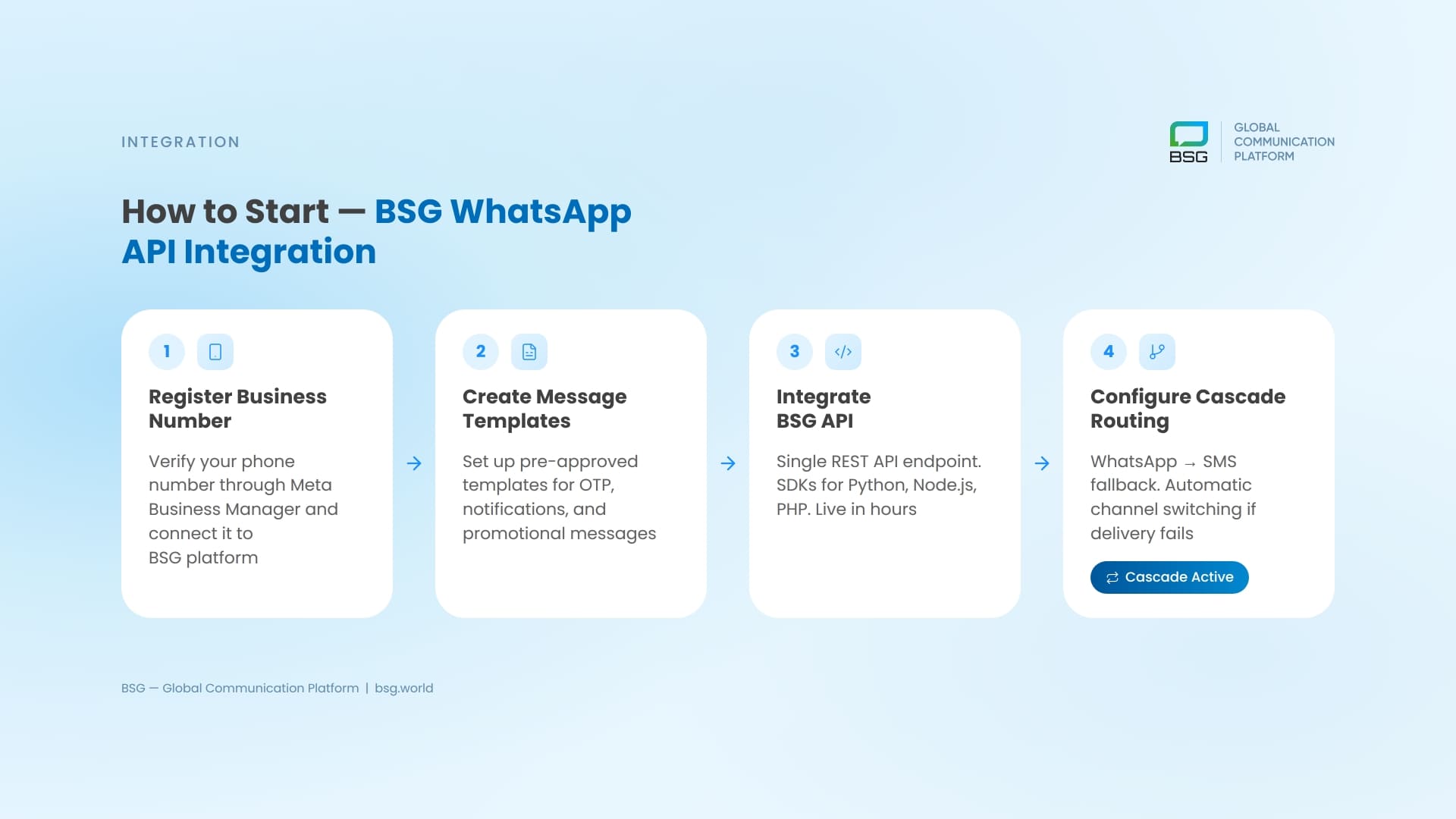
The setup process follows a practical sequence. First, register your business phone number and verify your Meta Business account. Second, create message templates for your core use cases — templates need Meta approval before sending. Third, integrate BSG's API with your CRM, eCommerce platform, or custom application. Fourth, configure cascade routing so that if WhatsApp delivery fails, the message falls back to SMS or another channel automatically.
The cascade fallback is critical in markets with variable connectivity. At BSG, we've seen that teams who configure SMS fallback for WhatsApp delivery failures reduce lost messages by a measurable margin — especially in regions where internet access is inconsistent. Without fallback, a failed WhatsApp delivery means a customer never receives the message. With fallback, they receive it via SMS seconds later.
BSG's API supports all WhatsApp message types: text, media, templates, interactive buttons, and list messages. The developer documentation at docs.bsg.dev covers authentication, webhook configuration, message sending, and delivery status tracking.
Ready to Apply WhatsApp to Your Use Case?
If any of these use cases match what your team is working on, BSG can help you move from planning to live deployment. We provide WhatsApp Business API access integrated with SMS, Viber, and voice fallback — all through a single API. Our team has deployed WhatsApp across eCommerce, fintech, logistics, healthcare, gaming, insurance, and SaaS — and we can help you configure the right setup for your market and volume. Reach out to BSG's team for a consultation and we will walk through your specific requirements.
FAQ
What is the WhatsApp Business API and how does it differ from the WhatsApp Business App?
The WhatsApp Business App is a free, standalone application designed for small businesses handling low message volumes manually. The WhatsApp Business API is a programmatic interface for medium and large businesses that need to send messages at scale, integrate with CRM and eCommerce systems, and automate workflows. The API requires a Business Solution Provider like BSG and supports template-based messaging, chatbot integration, and cascade routing to fallback channels.
How much does WhatsApp Business API cost?
WhatsApp Business API pricing is conversation-based. Meta charges per 24-hour conversation window, with rates varying by country and conversation category (marketing, utility, authentication, or service). BSG provides transparent per-conversation pricing with no hidden platform fees. Contact BSG's team for pricing specific to your market and volume.
Can WhatsApp replace SMS and email for business communication?
WhatsApp supplements rather than fully replaces SMS and email. In mobile-first markets where WhatsApp is dominant — Africa, Southeast Asia, Latin America, parts of Europe — it functions as the primary channel. In markets with lower WhatsApp penetration, SMS remains essential. The strongest approach is omnichannel: send via WhatsApp first, with automatic SMS fallback for undelivered messages. This is how BSG's cascade routing works — ensuring every message reaches the customer regardless of channel availability.
What industries benefit most from WhatsApp for business?
Every industry with customer-facing communication benefits, but the highest impact is seen in eCommerce (cart recovery, order updates), fintech (transaction alerts, KYC verification), healthcare (appointment reminders), logistics (delivery tracking), and iGaming (re-engagement campaigns). The common thread is a need for real-time, high-open-rate communication on a channel the customer already uses daily.


Interested in a special offer?
Ready to reach further?
Let’s talk


Related articles
To prevent those useless spending, before sending anything, it makes good sense to review and clean your contact list. Here it’s time to discover what is HLR in mobile communication.
Marketing is a nuanced endeavor that requires diverse strategies to attract and retain customers. The
In today’s digital marketing, a time when you send your content is critical for the