
BSG utilizes HTTP cookies (and similar or complementary technologies) to 1) make this website safe, functional, and accessible (through the use of mandatory cookies) and 2) understand how you use our website (through the use of optional cookies) in order to improve your experience and to provide you with personalized content.

The information in the cookie text files may be related to your personal preferences or your device and is intended to make the site operate according to your expectations. The information contained in cookies does not usually identify your identity directly but is helpful in providing you with a more personalized user experience.

In accordance with the requirements of the General Data Protection Regulation (GDPR) privacy and security law that governs how the personal data of individuals in the EU may be processed and transferred, we provide you the possibility to prohibit the use of certain types of cookies when you use our website.

Read our Cookie Notice and the Privacy Policy for detailed information on how BGS collects and uses cookies. Please note that prohibiting the use of certain types of cookies may affect your interaction with the website and limit the accessibility of services we offer you. Choose the appropriate category below to learn more and to disable cookies.

Accept All cookies*
*Recommended for comfortable use of the site
Accept only necessary cookies
Accept only selected cookies
Necessary cookies
Social media
Analytics
Marketing

Wholesale SMS

What is wholesale SMS?

Wholesale SMS is the exchange of A2P message traffic between carriers, aggregators and messaging platforms at volume-based rates, delivered over carrier interconnections rather than a self-serve dashboard.

How does wholesale SMS work?

Wholesale SMS is how business messages travel between networks at scale. An aggregator or platform collects A2P traffic from its clients — one-time codes, alerts, notifications — and buys termination from a wholesale provider that delivers it to the destination mobile operators. Instead of paying per campaign, the buyer pays per message at a rate tied to volume and route.

The price on a rate card is only half the picture. What decides the real cost is route quality: whether traffic goes over direct operator connections or through a chain of resellers and grey routes, whether delivery reports reflect what actually reached the handset, and how the route handles ported numbers. A cheap route that loses messages costs more per delivered message than a slightly pricier direct one.

Example

An aggregator sending OTP traffic to a new country runs a short test on two routes before committing volume. The test shows one route returning delivery reports that don't match handset delivery, so the traffic goes to the direct route instead.


Interested in a special offer?

Ready to reach further?
Let’s talk

I agree to BSG privacy policy
Submit

Useful Materials

World map with a flight route linking Muscat, Rome, Lisbon and Buenos Aires over a conference networking hall
Telecom Events November 2026: Where to Meet BSG in Four Cities

Where to meet BSG in November 2026: GCCM Muscat, SiGMA World Rome, Web Summit Lisbon and LAWC Buenos Aires.

Interview with BSG Director for the Americas: Wholesale Voice Solutions and Telecom Insights

The telecommunications industry continuously evolves to meet user needs. For BSG, staying at the forefront
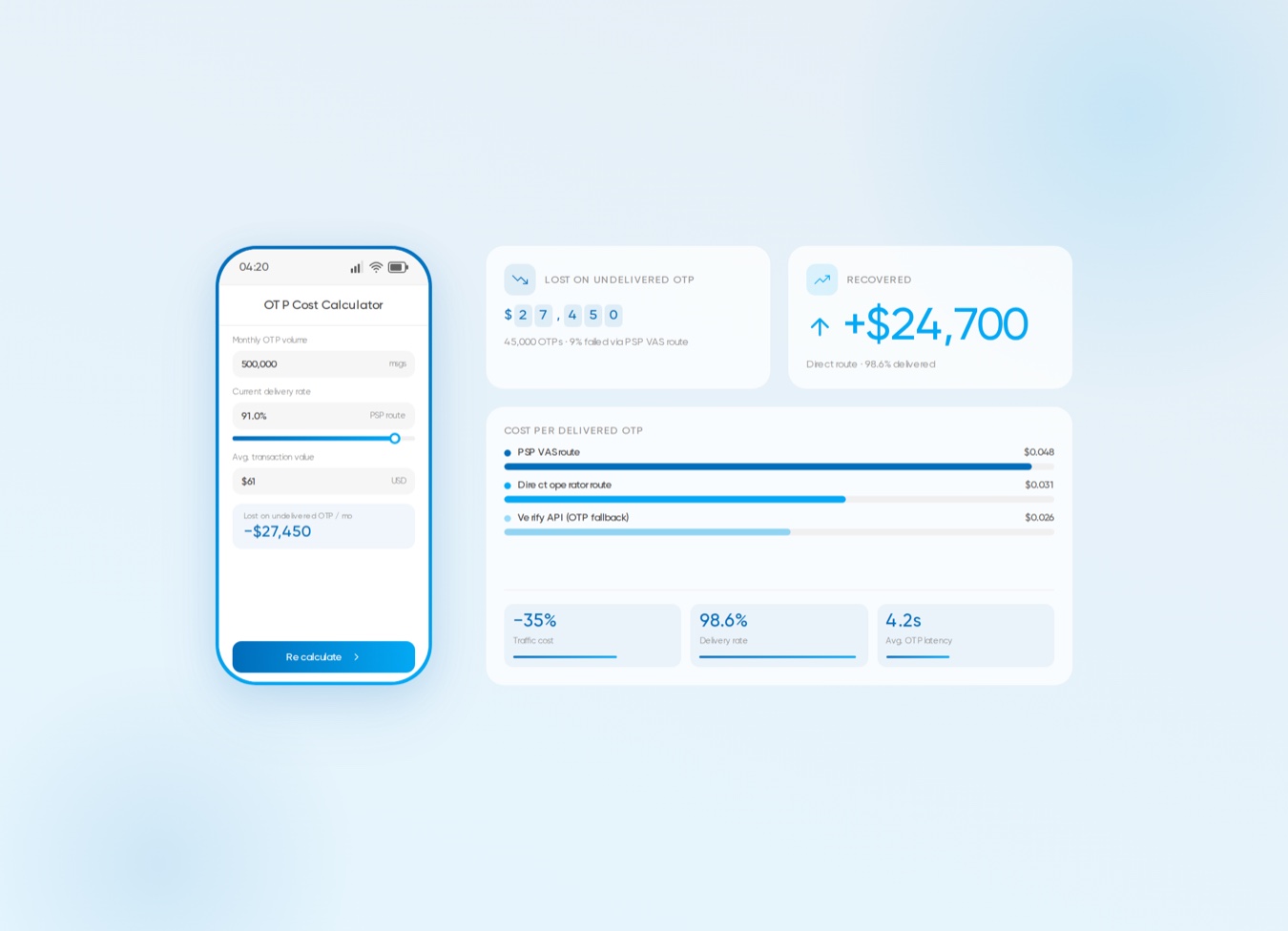
Cost per Delivered OTP: Why a Cheap SMS Vendor Costs PSPs More

You pay per SMS sent, but only delivered OTPs work. A worked example shows why the cheapest vendor costs more.