




Bulk SMS Marketing in 2026: Why Campaigns Now Run on WhatsApp API + SMS Cascade

A UK retailer sends 100,000 promotional messages ahead of a weekend sale. Around 8,000 go to numbers that no longer exist. Thousands more land as plain text on handsets where WhatsApp threads, push notifications, and rich media compete for the same attention. The report says “delivered”. Revenue still comes in under forecast. That gap is where most bulk SMS marketing budgets leak in 2026.
Bulk SMS marketing still earns its place — no other channel matches its reach or handset coverage. What has changed is how the highest-performing campaigns are built. Teams across the UK and EU now start on the WhatsApp Business API and fall back to SMS only where WhatsApp cannot deliver. And before anything is sent, they verify the list.
This guide covers the five steps that separate profitable campaigns from expensive ones, then explains why the WhatsApp API + SMS cascade has become the default architecture for large sends.
What Is Bulk SMS Marketing (and Why 2026 Is Not 2010)
Bulk SMS marketing means sending promotional or service text messages to a large group of opted-in contacts at once. Technically it is a form of A2P SMS — application-to-person messaging, where a platform rather than a person initiates the send. A typical example: a retailer pushes a sale announcement with a short link to 50,000 subscribers in one campaign.
The mechanics of a bulk text message have barely changed since 2010. Everything around them has. Nearly every recipient in the UK and EU now carries WhatsApp on the same handset — the app passed 3 billion monthly active users in 2025 (Backlinko, 2026). Carrier rates for A2P traffic on most European routes have climbed year after year, so each wasted message costs more than it used to. Regulators have sharpened their teeth, particularly in the UK. And customers reply to marketing messages, expecting a conversation — something a one-way blast cannot hold.
None of this makes SMS obsolete. It makes SMS the wrong first channel for many audiences, and the right fallback. Keep that framing in mind through the five steps below.
Step 1 — Verify Your List Before You Send (the 5–10% Waste Rule)
Based on what we observe across the campaigns we support at BSG, 5–10% of numbers in a typical marketing database are invalid, inactive, or long abandoned — and the older the list, the worse the ratio. On a 200,000-contact send, that is up to 20,000 messages billed and never read.
Verification removes this waste before the first message leaves the platform. An HLR lookup queries the carrier's Home Location Register to confirm whether a number is live and which network it currently belongs to. BSG Number Verifier runs this check across an entire database in one pass and flags dead, ported, and unreachable numbers so you can suppress them before the campaign starts.
Skip this step and three things happen. You pay full price for messages that can never arrive. Your delivery statistics get polluted, so every later optimisation decision rests on bad data. And repeated sends to dead ranges can hurt sender reputation on some routes. Run verification first and the budget shrinks by exactly the size of your dead-number problem — while every downstream metric becomes trustworthy.
Make it step one of every sms marketing campaign, not a quarterly clean-up. Verify, suppress, then segment what remains.
Step 2 — Write SMS Copy That Gets Clicks
One SMS gives you 160 characters in GSM-7 encoding; go longer and you pay for a second segment. Treat the limit as a discipline. A promotional sms that converts usually contains five elements: who you are, what the offer is, who it applies to, when it ends, and a single call to action with a short trackable link.
Send from a registered alphanumeric sender ID so the message reads as your brand, not an anonymous long number — recipients in the UK and EU delete unbranded promotions on sight. If you need working starting points, BSG maintains a library of promotional SMS templates organised by industry and occasion.
Timing decides a surprising share of the outcome. What our clients have found is that late-morning and early-evening weekday sends consistently beat weekend blasts for retail offers in the UK, while payday-adjacent timing lifts response on higher-ticket promotions. Test against your own audience — but do not send at 8 a.m. on a Sunday and then blame the channel.
Step 3 — Segmentation That Matters
Sending one message to everyone is the most expensive way to run mass sms marketing, even though it looks like the cheapest. A flat blast trains most recipients to ignore you and pushes the least engaged ones to opt out — and every opt-out is reach you never get back.
The minimum viable model has three cuts. Recency: customers who bought in the last 90 days respond to different offers than lapsed ones. Value: top spenders deserve early access, not a generic 10% code. Behaviour: people who clicked one of your last three campaigns warrant a stronger offer and a shorter deadline than those who ignored them all.
In our experience working with eCommerce clients in the UK and EU, three segments with adjusted offers reliably beat a single blast on revenue per message — before any channel change is made. Segmentation is also where the cascade pays off later: WhatsApp-active segments can receive rich interactive messages, while the fallback path keeps everyone else covered.
Step 4 — Compliance: GDPR, PECR, and Opt-Out Mechanics
If you market to UK numbers, PECR — the Privacy and Electronic Communications Regulations — is your operative law. It requires prior consent for promotional texts, with a narrow “soft opt-in” exception for existing customers who were offered a chance to refuse. The stakes changed in February 2026: the Data (Use and Access) Act 2025 raised the maximum PECR fine from £500,000 to £17.5 million or 4% of global annual turnover, whichever is higher (Mayer Brown, 2025). The ICO already treats unsolicited marketing as a priority area, having issued 49 monetary penalties totalling £4.63 million for such breaches since March 2022 (ConsentTrail, 2026).
In the EU, GDPR governs the personal data behind your list, with penalties reaching €20 million or 4% of global turnover (GDPR.eu). In practice both regimes ask the same question: can you prove, per contact, when and how opt-in was given?
The operational checklist is short. Store consent records with a timestamp, the source, and the exact wording shown. Include a free, working opt-out in every promotional message — “Reply STOP” remains the standard. Process opt-outs immediately and sync the suppression list across every channel you use, including WhatsApp. And never send marketing to a purchased list: UK regulators fine that pattern more consistently than any other.
Step 5 — Measure: Delivery Rate, CTR, Conversion
Three numbers tell you whether a campaign worked. Delivery rate comes from carrier delivery reports (DLR) and shows what share of messages reached a handset. Click-through rate (CTR) — clicks on your link divided by delivered messages — shows whether the copy and offer landed. Conversion, tracked through discount codes or UTM-tagged links, connects the send to revenue.
Read them as a diagnostic chain. Delivery below roughly 95% after list verification points to a routing or sender-ID problem, not a list problem. Healthy delivery with falling CTR means the copy, the offer, or the frequency is off. Strong clicks with weak conversion says the message wrote a promise the landing page did not keep.
The metric to retire is “messages sent”. Teams that report cost per delivered message and revenue per segment make sharper decisions within two or three campaigns than teams that celebrate volume.
Why WhatsApp API + SMS Cascade Beats Plain Bulk SMS
Once the five fundamentals are in place, the biggest remaining lever is architecture. The WhatsApp Business API sends approved template messages with images, buttons, and product cards — and every recipient can reply, turning a broadcast into a sales or support conversation. SMS cannot match that format, but it reaches every mobile handset without any app installed. The point is not to pick one channel. It is to sequence them.
| Criterion | Plain bulk SMS | WhatsApp API + SMS cascade |
|---|---|---|
| Message format | 160-character text plus link | Images, buttons, product cards; SMS text as fallback |
| Conversation | One-way | Two-way on WhatsApp; replies feed sales and support |
| Delivery visibility | Carrier DLR only | App-level delivered/read status, plus DLR on the fallback |
| Cost at volume | Every contact billed at SMS rate; rich content needs 2–3 segments | One WhatsApp message replaces multiple segments; SMS paid only for the fallback share |
| Reach | Any mobile handset | WhatsApp base first, full SMS reach preserved via fallback |
| Failure mode | Undelivered = lost contact | Undelivered on WhatsApp = automatic SMS retry |
Cost is the part that surprises finance teams. Based on what we observe across European routes, a single WhatsApp marketing message carrying an image and two buttons frequently costs less than the two or three concatenated SMS segments needed to approximate the same content — and the fallback share, typically the minority of a verified list, is the only traffic billed at SMS rates. At volume, the cascade usually lands cheaper per delivered message than the SMS-only campaign it replaces, while giving customers a reply button that plain text never had.
How the WhatsApp→SMS Cascade Works in a Campaign
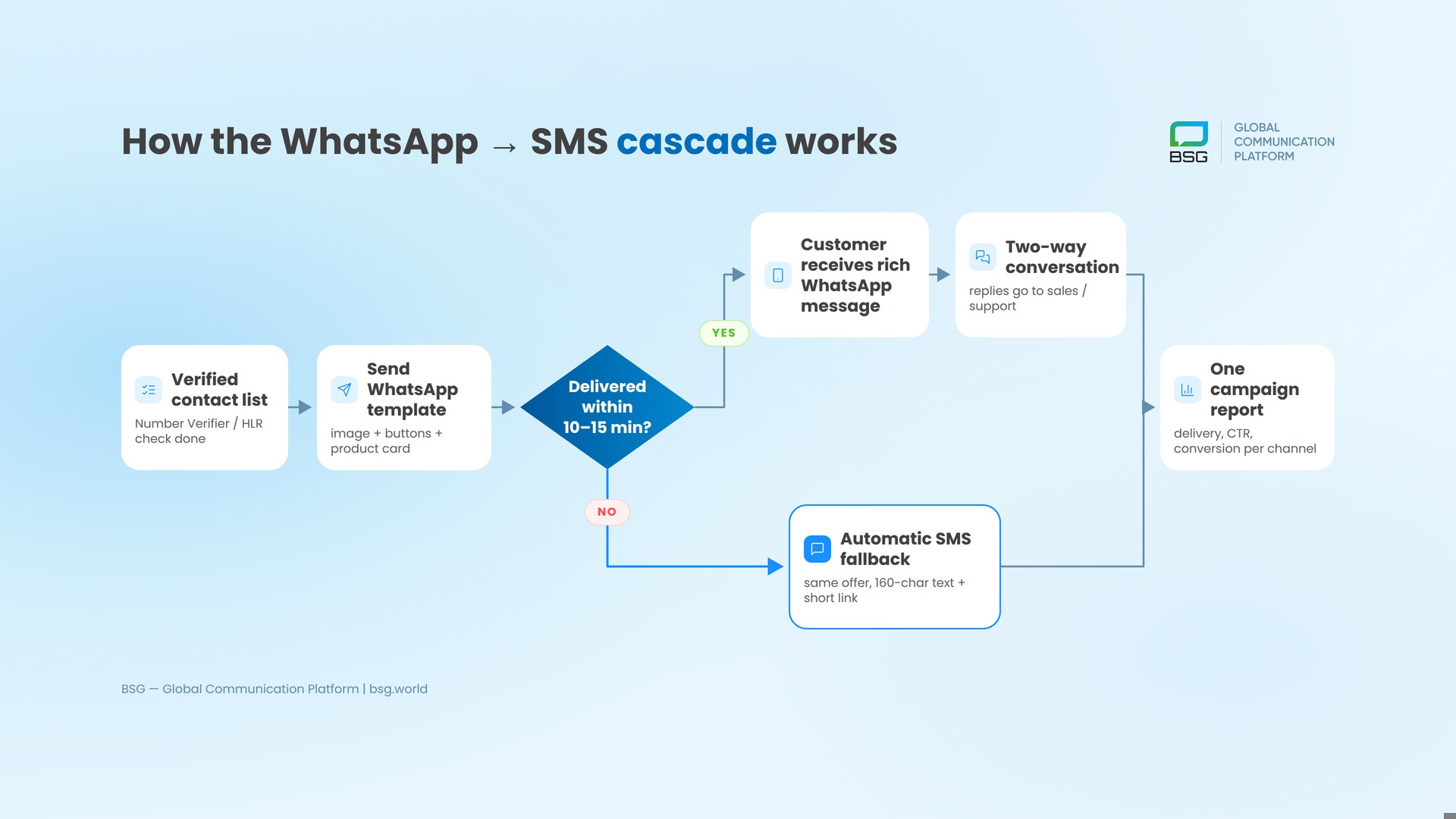
The flow is simpler than it sounds. The platform sends your approved WhatsApp template to every contact in the segment, then watches delivery status for a window you define — ten to fifteen minutes is common for promotions. Any contact whose message is not confirmed as delivered, because they lack WhatsApp, block business messages, or are unreachable, automatically receives the SMS version of the same offer. One campaign, one report, both channels. The routing mechanics are covered in detail in our guide to message cascade fallback.
At BSG, we've seen how this plays out for a UK fashion retailer that moved its weekly promotion from SMS-only sends to a WhatsApp-first cascade. Roughly seven contacts in ten were reached on WhatsApp with a richer message at a lower per-contact price; the SMS fallback caught most of the remainder, keeping total reach above the level of the old SMS-only campaign — while the blended cost per delivered message went down, not up. The retailer also gained something the old setup could not offer at any price: customers replying “is this available in a size 12?” and a team able to answer in the same thread.
The cascade only works on a clean list, which is why this guide started with verification. Sending a cascade to unverified numbers wastes two channels instead of one.
Run Your Next Campaign as a Cascade
If your next sms marketing campaign is going to more than a few thousand contacts, follow the sequence in this guide: verify, segment, comply, then send WhatsApp-first with SMS fallback. BSG runs all of it on one platform — WhatsApp Business API, SMS routes across the UK and EU backed by 15+ telecom licences, and Number Verifier for the list check that should come first. Talk to our team about your list size and target markets, and we will map the cascade setup and the expected cost per delivered message for your case.
FAQ
Is bulk SMS marketing still effective in 2026?
Yes, but rarely as the only channel. SMS keeps unmatched reach across the UK and EU because it needs no app, and it remains the standard fallback layer. The strongest results now come from WhatsApp-first campaigns that use bulk SMS to cover contacts WhatsApp cannot reach.
What is a WhatsApp-to-SMS cascade?
A cascade is a delivery sequence in which a campaign message is first sent through the WhatsApp Business API, and any contact without a confirmed delivery within a set window automatically receives the SMS version instead. You reach the full list through one campaign while paying SMS rates only for the fallback share.
Do I need consent to send promotional SMS in the UK?
Yes. PECR requires prior consent for marketing texts, with a limited soft opt-in exception for existing customers. Since February 2026, the maximum fine has risen to £17.5 million or 4% of global turnover, so consent records and working opt-outs are mandatory operational hygiene.
How does list verification affect campaign cost?
Verification identifies invalid and inactive numbers — typically 5–10% of a marketing database — before you send, so they are suppressed rather than billed. On any list above a few thousand contacts the saving usually exceeds the cost of the check, and every reported metric becomes more accurate.


Interested in a special offer?
Ready to reach further?
Let’s talk


Related articles
According to statistics, the Black Friday and Cyber Monday (BFCM) season generated $222.1 billion in
In today’s fast-paced cybersecurity landscape, large enterprises confront a constant barrage of threats to their
SIM swaps jumped 1,055% in a year. Voice OTP takes your riskiest codes off the SMS rail.