




RCS vs SMS: Which Messaging Channel Should Your Business Use in 2026?

A marketing manager launches a flash-sale campaign. Half the audience sees a plain 160-character text. The other half gets a branded card with product images, a carousel, and a one-tap "Buy Now" button — all inside the native messaging app. Same audience, same offer, radically different engagement. That gap between SMS and RCS is no longer theoretical — it is measurable, and in 2026 it is reshaping how businesses plan their messaging spend.
But the choice is not as simple as "RCS is newer, so switch." SMS still carries strengths that RCS cannot replicate everywhere, and the smartest teams are not picking one channel over the other. They are combining both. This article breaks down the real differences between RCS and SMS, maps each channel to the use cases where it performs best, and explains why cascade routing — sending RCS first with automatic SMS fallback — is becoming the default strategy for high-performing campaigns.
Quick Comparison — RCS vs SMS at a Glance
Before diving into specifics, here is a side-by-side overview of the core differences.
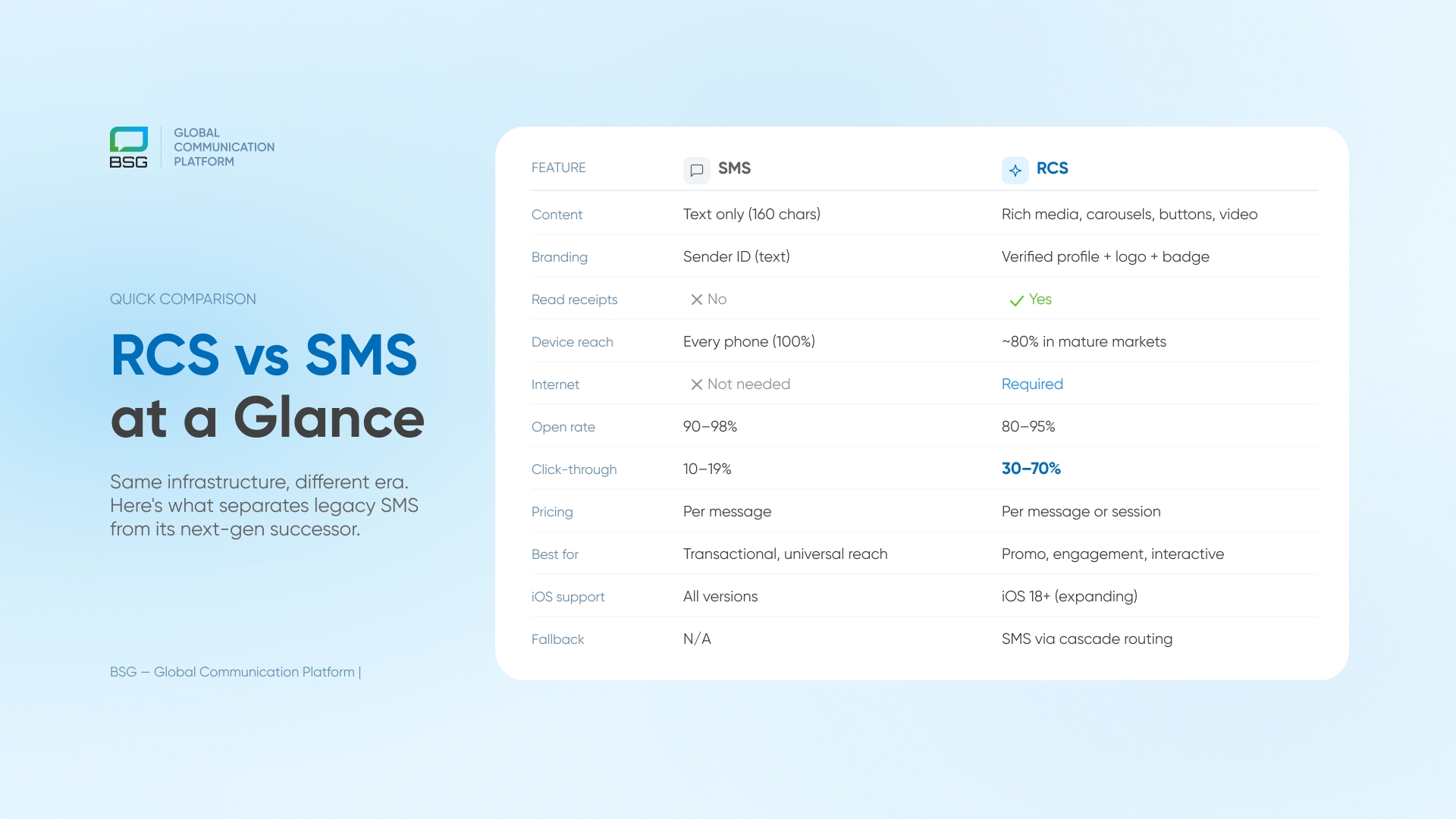
The chart above captures the structural gap: RCS adds rich media, verified branding, and interactive elements to the native messaging inbox, while SMS delivers universal reach with zero dependencies on data connectivity or device compatibility.
At BSG, we see both channels coexisting in nearly every client deployment — the question is not which one to use, but which one to send first.
When SMS Is Still the Right Choice
SMS has been the backbone of business messaging for over two decades, and its position is not accidental. The channel reaches every phone in existence — feature phones, smartphones, devices without data plans, and handsets in areas with unreliable connectivity. No app download, no internet connection, no device compatibility check.
For transactional messages that must arrive regardless of conditions — OTP codes, delivery confirmations, appointment reminders, payment alerts — SMS remains the most reliable path. Open rates consistently sit between 90% and 98%, with the majority of messages read within three minutes of delivery (Validity, 2025). That kind of immediacy matters when a customer is waiting for a login code or a shipping update.
SMS also wins on simplicity and cost predictability. Pricing follows a straightforward per-message model, and there is no brand verification process or content approval workflow to navigate before sending. For businesses running high-volume transactional flows across dozens of countries, this operational simplicity is a real advantage.
In our experience working with logistics and fintech clients across Africa and Southeast Asia, SMS outperforms every other channel in markets where mobile data coverage is inconsistent. A delivery notification that arrives via SMS at 2G signal strength is infinitely more valuable than a rich card that never loads.
Where SMS falls short is engagement depth. You cannot embed images, add action buttons, or show a branded sender profile inside a standard text message. For promotional campaigns that need to drive clicks and conversions, this is a measurable limitation — SMS click-through rates average around 10–19%, and there is no read-receipt signal to confirm the message was opened.
When RCS Makes a Measurable Difference
RCS messaging brings capabilities that SMS structurally cannot deliver. Rich media — images, video, carousels — renders directly inside the default messaging app. Buttons for "Buy Now," "Book a Demo," or "Track Order" reduce friction by letting the customer act without leaving the conversation. Verified sender profiles display your brand name, logo, and a verification badge, which builds trust in an inbox increasingly crowded with spam.
The engagement numbers reflect this. Early adopters report click-through rates three to seven times higher than equivalent SMS campaigns (Sinch, 2025). RCS open rates land between 80% and 95%, and because the protocol includes read receipts, businesses finally get visibility into whether a message was actually seen — not just delivered.
RCS traffic is growing fast. Business messaging volume reached 70 billion messages globally in 2025 and is projected to exceed 200 billion by 2027 (Juniper Research, 2026). Apple added RCS support starting with iOS 18 in late 2024, and as of May 2026, iOS 26.5 has introduced end-to-end encryption for RCS conversations — a milestone that removes one of the last security objections.
For promotional campaigns, product launches, cart recovery, and interactive customer service, RCS delivers a measurably richer experience. Based on what we observe across the campaigns we support, e-commerce teams running RCS-first promotional flows see notably higher tap-through rates and shorter conversion paths compared to SMS-only sends — particularly in markets where smartphone penetration and data connectivity are high.
The caveat: RCS does not yet reach every device in every market. Coverage sits at roughly 80% of smartphone users in mature markets like the US and France, but drops significantly in parts of South Asia and East Africa. Android coverage is near-universal among major carriers, and iOS support is expanding but still rolling out by carrier. If your message must reach 100% of recipients regardless of device or network, RCS alone cannot guarantee that.
RCS + SMS Together — The Cascade Approach
The binary framing — "should I use RCS or SMS?" — misses the point. The most effective strategy combines both: send RCS first for the richer experience, and automatically fall back to SMS when RCS is unavailable on the recipient's device or network.
This is cascade routing, and it eliminates the reach-versus-richness tradeoff entirely.
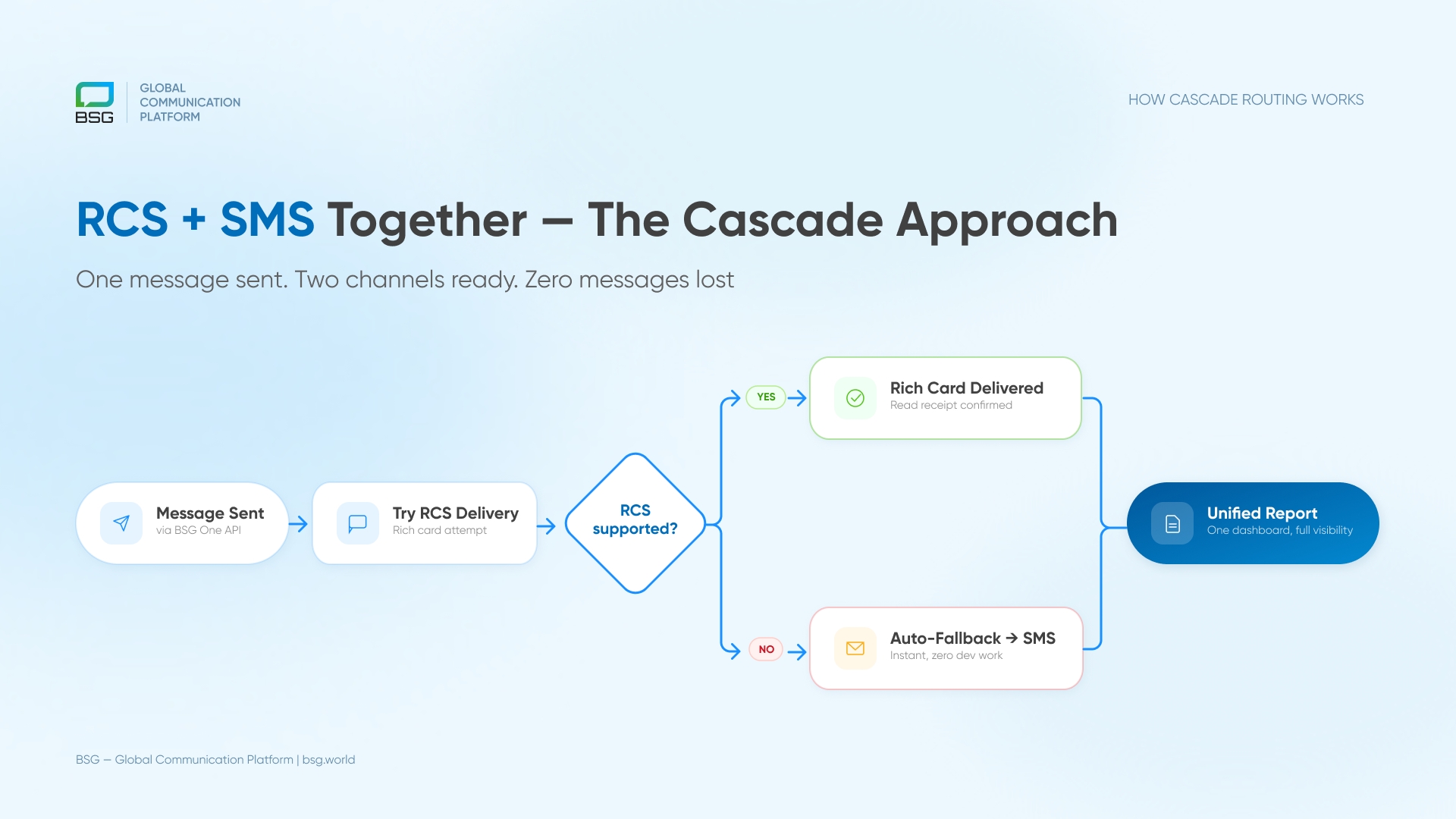
How BSG One API Handles Fallback
BSG's One API allows businesses to configure cascade logic in a single API call. The system attempts RCS delivery first. If the recipient's device does not support RCS, or if delivery fails within a defined timeout window, the message automatically downgrades to SMS — with a pre-configured text version of the same content.
From the business side, this means one integration point, one message template (with RCS-rich and SMS-plain variants), and one delivery report that shows which channel actually reached each recipient. No separate campaign setup, no manual segmentation by device type.
What our clients have found is that cascade routing consistently delivers the best of both channels: promotional messages land as branded rich cards on compatible devices, while the SMS fallback ensures every recipient is reached. In the campaigns we support, teams using RCS-to-SMS cascade see delivery rates above 97% across mixed-device audiences — compared to RCS-only sends that typically reach 70–82% of the same list.
Cost Comparison: RCS-First vs SMS-Only
RCS pricing differs structurally from SMS. While SMS follows a flat per-message model, RCS uses tiered pricing based on message type — basic (text-only), single (rich content), or conversational (session-based, covering multiple messages within a 24-hour window). Exact rates vary by carrier and region.
On a per-message basis, RCS often costs more than SMS. But cost-per-conversion — the metric that actually matters — tells a different story. When a rich card with a product image and a one-tap button generates three to seven times higher click-through than a plain text link, the cost gap narrows or inverts entirely.
For transactional use cases (OTPs, alerts, confirmations), SMS remains the more cost-efficient choice — the message is short, delivery must be universal, and rich media adds no value. For promotional and engagement-driven campaigns, RCS-first with SMS fallback tends to deliver stronger ROI because fewer messages are needed to drive the same number of conversions.
Real-World Example — E-commerce Flash Sale Campaign
Consider a mid-sized online retailer running a 48-hour flash sale across a database of 200,000 opted-in customers.
Scenario A — SMS-only: The team sends a 160-character message with a shortened URL. Open rate sits at approximately 95%. Click-through rate: around 11%. Conversion from click: 3.5%. Total orders driven: roughly 730.
Scenario B — RCS-first with SMS fallback: The team sends an RCS rich card showing the top three discounted products in a carousel, with "Shop Now" buttons linking directly to product pages. On devices that do not support RCS, a plain SMS with a short URL is delivered automatically. RCS reach: approximately 78% of the list. Click-through rate on RCS: around 35%. SMS fallback reaches the remaining 22%. Combined conversion: approximately 1,600 orders — more than double the SMS-only approach, from the same list, with the same offer.
At BSG, we have seen this pattern repeat across multiple verticals. The RCS layer captures high-intent engagement from the majority of recipients, while SMS ensures no one is left out. The economics work because the RCS uplift in click-through more than compensates for the higher per-message cost.
How to Get Started with Both via BSG
BSG provides RCS messaging and Bulk SMS through a single platform and API. Here is what the setup path looks like:
For SMS, the process is straightforward: register a sender ID, connect via API or web cabinet, and start sending. BSG operates direct-to-MNO connections in 60+ markets, which means 0-hop delivery — fewer intermediaries, faster delivery, higher completion rates.
For RCS, the process includes brand verification through Google's RCS Business Messaging program, agent setup (your branded sender profile), and content template approval. BSG handles the technical onboarding and carrier coordination.
For cascade routing, both channels are configured within BSG's One API — one integration, one message flow, automatic fallback logic. The API documentation is available at the BSG Developer Portal.
If you are already running SMS campaigns and want to test RCS on a subset of your audience before scaling, BSG supports phased rollouts — start with a single market or campaign type, measure the difference, and expand based on results.
Ready to Compare the Cost of RCS vs SMS for Your Use Case?
The right channel mix depends on your audience, your markets, and the type of messages you send. BSG's team can help you model the cost and delivery impact of RCS-first cascade routing versus SMS-only — using your actual volumes and geographies. Talk to our team to get a tailored comparison and test both channels through a single integration.
FAQ
What is the main difference between RCS and SMS for business messaging?
SMS delivers plain text to every phone, regardless of device type or internet connection. RCS adds rich media, interactive buttons, verified sender branding, and read receipts — but requires a compatible device and data connectivity. For businesses, the practical difference is engagement: RCS drives significantly higher click-through and conversion rates on promotional messages, while SMS remains the most reliable channel for transactional alerts.
Can I send RCS messages to iPhones?
Yes. Apple added RCS support starting with iOS 18 in late 2024. As of May 2026, iOS 26.5 includes end-to-end encryption for RCS conversations. However, carrier support varies by market — not all operators have enabled RCS for Business on iOS yet. Using cascade routing ensures your message reaches iPhone users via SMS if RCS is not available on their carrier.
Is RCS more expensive than SMS?
RCS per-message pricing is generally higher than SMS, and pricing structures vary by carrier and message type. However, RCS campaigns typically generate three to seven times higher click-through rates than SMS, which often results in a lower cost per conversion. For transactional messages, SMS remains more cost-efficient. For promotional campaigns, RCS-first with SMS fallback tends to deliver better overall ROI.
How does cascade routing work?
Cascade routing sends your message via RCS first. If the recipient's device does not support RCS, or if delivery fails within a set timeout, the system automatically falls back to SMS. BSG's One API handles this logic in a single API call — one integration, one message, automatic channel selection per recipient.


Interested in a special offer?
Ready to reach further?
Let’s talk


Related articles
Why would hackers target small businesses? Usually, startups are not as financially developed compared to
The theft and use of personal data have become an absolute disaster. Hackers use the
Mapping the benchmarks is a proven way to be successful in any industry, and the