




What Is CPaaS? The Complete Business Guide to Communications Platform as a Service

Most companies don't set out to build a messaging stack. It happens by accident. One team adds an SMS gateway for order confirmations. Another wires up a WhatsApp provider for support. Marketing buys a separate email tool, the security team bolts on a verification vendor, and within two years the business runs five contracts, five integrations, and still can't answer one question: did the customer actually receive the message?
This is the problem CPaaS was built to solve. So what is CPaaS? Communications Platform as a Service (CPaaS) is a cloud platform that lets a business add messaging, voice, and verification directly into its own applications through APIs, without owning telecom infrastructure, signing carrier contracts, or running a single server. Instead of stitching point tools together, your developers call one set of APIs and reach customers on SMS, WhatsApp, RCS, Viber, voice, and email.
For a CTO, the appeal is structural, not cosmetic. CPaaS turns communication from a procurement problem into a few lines of code. Carrier routes, number management, delivery logic, and failover sit with the provider. Your team ships product features instead of maintaining telecom plumbing.
CPaaS Definition: What It Means and Why It Matters
The cpaas meaning is easiest to grasp by what it removes. Traditionally, sending a verified code to a customer in Lagos or a booking confirmation to a shopper in Manila meant integrating with mobile operators, managing message formats, and handling the dozens of failure modes that occur between your server and a handset. A CPaaS provider hides all of that behind a single API call.
Here is the definition for the record: CPaaS is a cloud-based model that delivers real-time communication, including SMS, voice, video, chat apps, and authentication, as programmable APIs that developers embed in existing software. There is no app for your customers to install and no separate dashboard they ever see. The communication happens inside your product.
The market shows how fast this model became the default. The global CPaaS market was valued at about $19.1 billion in 2024 and is projected to reach $86.26 billion by 2030, a 28.7% compound annual growth rate (Grand View Research, 2024). Adoption is already mainstream: 38.4% of organizations were using CPaaS by early 2024, with a further share planning to start within the year (Metrigy, 2024).
At BSG, we've seen why that curve is so steep. The businesses that move first aren't chasing a trend, they're lowering the cost of every channel they will add later. Once the API integration exists, turning on RCS or a voice bot is a configuration change, not a new project.
How CPaaS Works: Architecture Overview
A CPaaS platform sits between your application and the global telecom network. Understanding the layers explains why the choice of provider matters far more than the API documentation suggests.
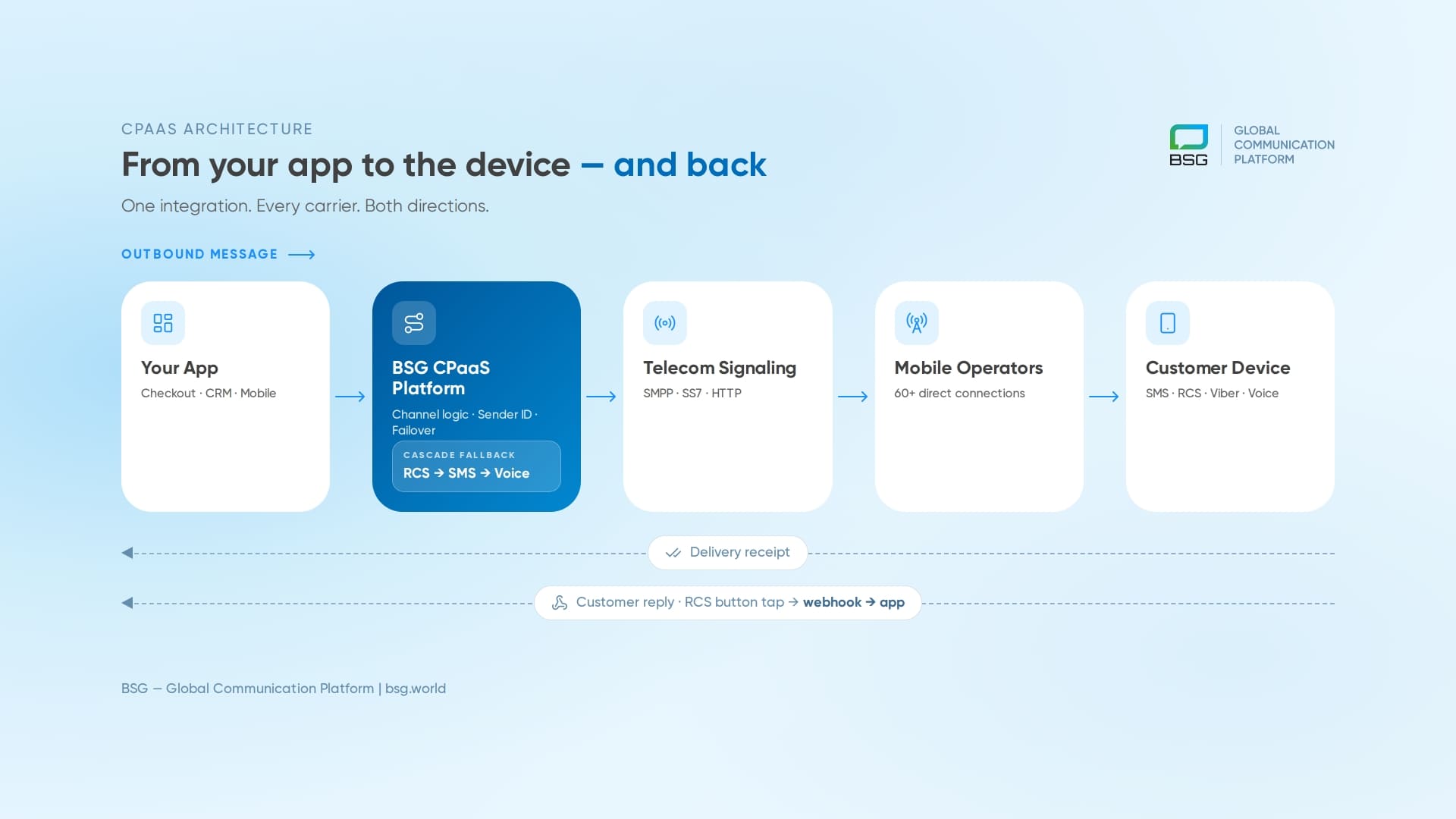
At the top is your application, whether a checkout page, a CRM, or a mobile app. It makes a request: send this message to this number. The platform receives the request, applies business logic such as which channel, which sender ID, and what to do on failure, then routes the message toward the right carrier. For SMS and voice, that routing passes through telecom signaling systems to the mobile network operators (MNOs) that deliver to the subscriber's device. A delivery receipt travels back up the same path.
The routing layer is what separates a strong provider from a weak one. An aggregator that buys access through several intermediaries adds a hop at each step: more latency, more points of failure, higher cost per message. A provider with direct operator connections removes those hops, and the difference shows up in delivery rate and speed, not in the demo.
Communication also flows the other way. When a customer replies to an SMS or taps a button in an RCS message, the platform captures that inbound event and pushes it to your application through a webhook, so your software can react in real time. This two-way path is what turns a one-off broadcast into a conversation, and it is the same mechanism a chatbot or a support workflow uses to respond without a human reading every message.
Based on what we observe across the traffic we route, the routing layer is where delivery is won or lost. BSG runs its own SMSC and SS7 software with 60+ direct-to-operator connections, so a message takes the shortest path to the handset instead of crossing resold routes. When a channel does fail, cascade routing retries the message on a fallback, such as SMS after RCS or voice after SMS, rather than letting it disappear.
CPaaS vs UCaaS vs CCaaS: Key Differences
The three communication as-a-service models get confused constantly, yet they solve different problems for different users. The short version: CPaaS is for developers building communication into a product, UCaaS is for employees talking to each other, and CCaaS is for agents talking to customers.
CPaaS vs UCaaS is the comparison most teams actually need. UCaaS (Unified Communications as a Service) bundles internal collaboration, including video meetings, team chat, and business phone, into one cloud suite; it is the set of tools your staff opens to do their jobs. CPaaS gives you the building blocks to put communication inside the software your customers use. CCaaS (Contact Center as a Service) is a ready-made contact center, with call queues, agent desktops, and IVR, for support operations.
| Dimension | CPaaS | UCaaS | CCaaS |
|---|---|---|---|
| Primary user | Developers / product teams | Internal employees | Support agents |
| What it delivers | Communication APIs inside your app | Collaboration suite: chat, video, phone | Cloud contact center: queues, IVR, agent desk |
| Customer-facing | Yes, inside your product | No, internal use | Yes, via support agents |
| Typical channels | SMS, WhatsApp, RCS, voice, email, OTP | Video, team chat, business phone | Voice, chat, email routing |
| Buying team | Engineering / CTO | IT / operations | Customer support / CX |
| Example use | OTP at checkout, order alerts | Company video meetings | Inbound support call routing |
The line blurs in practice, because many CCaaS and UCaaS products are built on CPaaS APIs underneath. For most product and engineering teams the decision is still simple: if you need communication features inside your own application and you want to control the experience, CPaaS is the layer you want.
Core CPaaS Capabilities
A modern CPaaS platform is defined by the channels and services it exposes through one integration. These are the building blocks most businesses combine, and each maps to a concrete job.
SMS & MMS API
SMS is still the backbone of business messaging because it reaches every handset, with or without a data connection. Through an A2P SMS API, businesses send one-time passwords, order updates, and alerts that have to arrive in seconds. BSG's Bulk SMS API handles both high-volume campaigns and transactional traffic over direct operator routes. Programmable messaging remains the single largest source of CPaaS revenue, ahead of voice and email (Metrigy, 2024), proof that basic SMS is far from finished.
WhatsApp Business API
The WhatsApp Business API brings rich, two-way conversations to the app customers already open every day in Latin America, Africa, the Middle East, and much of Asia. Businesses send templated notifications, run support threads, and recover abandoned carts inside the chat, all under a verified business profile that signals the message is legitimate.
RCS Business Messaging
RCS Business Messaging, short for Rich Communication Services, is the successor to SMS: it supports images, carousels, buttons, and read receipts natively on Android, with no app to download. Adoption accelerated after Apple added native RCS support in iOS 18 in 2024 (Mordor Intelligence, 2026), which removed the last big barrier on iPhone. For promotions and interactive order tracking, RCS delivers app-like experiences over a plain messaging channel.
Voice & AI Voice
Voice APIs automate calls, including reminders, confirmations, and surveys, at a scale no call center can match manually. The newer layer is AI voice: assistants that hold a natural conversation instead of reading an IVR menu. BSG's Conversational AI Voice handles inbound and outbound calls in 150+ languages and detects emotional tone, so a frustrated caller is escalated to a human instead of looping through prompts. In a typical deployment the bot absorbs the repetitive first line of contact, such as order status and appointment confirmations, freeing agents for the cases that genuinely need judgment.
OTP & Verification
OTP delivery is where reliability turns into revenue. A one-time password that arrives late is an abandoned signup or a failed payment, not a minor glitch. CPaaS verification sends codes over SMS, voice, email, or messaging apps and falls back across channels when the first attempt doesn't land.
In our experience working with fintech and gaming clients in low-connectivity markets, adding channel fallback to verification is the single change that moves completion rates the most. A code that fails on SMS still arrives by voice seconds later, so the customer never hits the dead end that would otherwise cost a conversion.
Chatbots & Conversational AI
Conversational AI ties the channels together. Chatbots resolve common requests, qualify leads, and hand off to a live agent with the full context of the conversation. This is the point where messaging stops being one-directional and starts doing work: answering, routing, and converting without a person on every thread. The practical payoff is volume: a bot that settles routine questions on its own keeps the easy traffic off the support queue, so the agents who remain spend their time on the conversations that genuinely need a person.
Why Businesses Choose CPaaS in 2026
The shift toward CPaaS isn't about novelty. It comes down to three practical advantages that compound over time.
API-first approach
Because every capability is an API, communication becomes part of the development workflow instead of a separate purchasing cycle. A new channel is a new endpoint, not a new vendor contract. That speed is why market analysts tie CPaaS growth directly to broader cloud adoption and digital transformation budgets.
Pay-per-use model
CPaaS bills for what you actually send, whether per message, per minute, or per verification, with no upfront infrastructure to buy. A startup and an enterprise call the same APIs and pay in proportion to volume, which is why the model scales cleanly from a first test OTP to millions of messages a month. A retailer that triples its OTP volume during a flash sale pays for that spike and nothing more once it passes, with no idle capacity left on the books.
Multi-channel from one provider
Consolidating channels under one provider removes the integration tax of running separate vendors. What our clients have found is that the bigger gain isn't only the lower bill, it is having one delivery view across SMS, WhatsApp, and voice, so a drop in delivery is visible and fixable instead of buried in five dashboards.
BSG as an AI CPaaS: One API, Cascade Routing, AI Voice
BSG is infrastructure-first. It operates its own networks, routes, and platforms rather than reselling another vendor's. With 60+ direct operator connections, 15+ telecom licenses in the EU, and an SLA between 99.90% and 99.99%, the foundation is built for volume: more than 70 million transactions a month across over 40,000 businesses. Owning the stack also means delivery data is first-hand rather than relayed through a reseller, which matters when you need to explain a failed campaign to a finance team.
Three things define BSG as an AI CPaaS. First, One API: a single integration that exposes SMS, WhatsApp, Viber, RCS, email, and voice, so adding a channel doesn't start a new project, and developers can begin in the BSG Developer Portal. Second, cascade routing, which turns multi-channel from a slogan into a delivery mechanism by retrying failed messages on fallback channels. Third, AI Voice, an in-house assistant rather than a white-labeled bot, running in production since 2023 across 150+ languages.
We've worked with teams who integrated each vendor separately and then rebuilt the same delivery logic for every channel. The ones who started on One API shipped their second and third channels far faster, because the hard part, carrier routing and failover, was already solved once.
How to Get Started with CPaaS
Adopting CPaaS is less about technology than about sequencing. A practical path looks like this:
- Map the use cases first.: List the communications that actually move metrics, such as login OTP, order confirmations, cart recovery, and support replies, before you evaluate a single tool.
- Judge the provider on infrastructure, not the dashboard.: Ask how many operator connections are direct, what the SLA guarantees, and whether failover is built in. Resold routes look cheaper until delivery quietly drops.
- Check compliance early.: Confirm GDPR, ISO, and PCI DSS coverage and the regional rules that apply, such as NDPR in Nigeria and POPIA in South Africa, before you send at scale.
- Test in a sandbox.: Send real messages to real numbers in your target markets and measure delivery and latency, not the polished demo.
- Start with one channel, then expand.: With an API-first provider, the second channel is a configuration change, which is the entire point of the model.
Start Building on CPaaS
If you're working out how communication should sit inside your product, the fastest way to learn is to send a real message. Try BSG's AI CPaaS in a free BSG sandbox, test SMS, voice, and verification against your own use cases, or talk to our team if you'd rather map your channels first. We've built the routing and the One API so your team can ship communication features, not maintain telecom plumbing.
FAQ
What is CPaaS in simple terms?
CPaaS (Communications Platform as a Service) is a cloud service that lets a business add messaging, voice, and verification to its own apps through APIs, without building telecom infrastructure. In practice, your software can send an SMS, start a WhatsApp chat, or place a call with a few lines of code.
What is the difference between CPaaS and UCaaS?
CPaaS provides communication APIs that developers embed inside a product for customer-facing messaging and calls. UCaaS is a finished collaboration suite, with video, chat, and phone, that employees use internally. Put simply, CPaaS is building blocks and UCaaS is a ready-made tool.
How much does CPaaS cost?
CPaaS uses a pay-per-use model: you pay per message, per minute, or per verification rather than a fixed license, with no upfront infrastructure cost. Prices vary by channel and by destination country, because carrier rates differ from market to market.
Is CPaaS secure and compliant?
A serious CPaaS provider operates under recognized standards such as GDPR, ISO, and PCI DSS and offers verification and fraud controls at the platform level. Always confirm both the provider's certifications and the regional data rules that apply to the markets you message.


Interested in a special offer?
Ready to reach further?
Let’s talk


Related articles
For the most successful activity, each company must communicate with its customers, as this is
Companies deciding to employ SMS marketing strategy want to create effective texting lists. For this
In light of businesses looking for fresh and catchy ways to communicate with clients, the