




One Communication API for SMS, WhatsApp, Viber & RCS — Why It Beats Five

A messaging stack rarely starts as a mess. You add SMS for one-time passwords. A customer asks for WhatsApp. Marketing wants RCS on Android. Six months later your codebase carries five separate integrations — each with its own SDK, auth scheme, and delivery webhook — and the engineer who built the first three has moved on.
This is the point where most technical leaders start looking for a single communication API: one programmable interface that sends and receives messages across every channel through one integration, instead of five that quietly drift out of sync. The appeal is not elegance. It is the maintenance bill, the on-call burden, and the time it takes to ship the next channel without touching the last four.
At BSG, we have seen that the cost of running five channel APIs rarely shows up in the first quarter. It shows up later — the day a provider changes a webhook format and three unrelated features break at once. This article breaks down what a unified messaging api actually does, where the fallback logic lives, and how the developer experience changes when you collapse five endpoints into one.
The Problem — Managing Five APIs for Five Channels
Running one channel is simple. Running five means maintaining five of everything, and the "everything" is where the hidden cost lives.
Each provider does the basics differently. A2P SMS runs over SMPP or HTTP with carrier-specific quirks. WhatsApp routes through Meta's Cloud API with template approval and 24-hour session windows. RCS depends on Google's RCS Business Messaging rails and a verified sender profile. Viber has its own onboarding and rate model. That is five auth schemes, five payload formats, and five sets of error codes that mean subtly different things.
The breakage is not theoretical. When delivery receipts arrive in five different webhook shapes, your analytics layer needs five parsers — and each parser is a place where a silent failure can hide. We have worked with teams who found that a month of "delivered" WhatsApp messages were never actually read, because the DLR mapping for one channel had drifted after a provider update no one was tracking.
Then there is the part nobody budgets for: orchestration. If WhatsApp fails, something has to decide what happens next. With separate APIs, that decision lives in your application code — a tangle of retry timers, status polling, and per-channel fallback rules that every new engineer has to relearn. Multiply that by every market where a different channel dominates, and a "simple messaging feature" becomes a permanent maintenance surface that grows with the business instead of shrinking.
The surface keeps widening in ways that are easy to underestimate. Each channel enforces its own rate limits, its own template and sender-ID rules, and its own compliance steps before a single message goes out. A change on any one of them — a new WhatsApp policy, an RCS profile re-verification, a carrier filtering update — lands as an unplanned task on a team that was supposed to be building product. None of this work moves the business forward. It only keeps five connections from breaking.
What Is a Communication API and How It Works
A communication API, also called a CPaaS API, is a single programmable interface that lets your application send and receive messages across multiple channels — SMS, WhatsApp, Viber, RCS, email, and voice — through one integration, one authentication step, and one response format.
The shift is architectural, not cosmetic. Instead of teaching your code to speak five dialects, you teach it one, and the platform translates to each carrier or channel provider behind the endpoint. That single design decision is what removes most of the maintenance surface described above.
Single endpoint, multiple channels
You send one request to one URL. The channel becomes a parameter, not a separate integration. Adding Viber to an application that already sends SMS turns into a config change — a value in the channel array — rather than a new SDK, new credentials, and a new webhook listener. For any omnichannel messaging api strategy, this is the difference between launching a channel in an afternoon and scheduling it for next quarter.
Built-in cascade logic (WhatsApp to RCS to SMS)
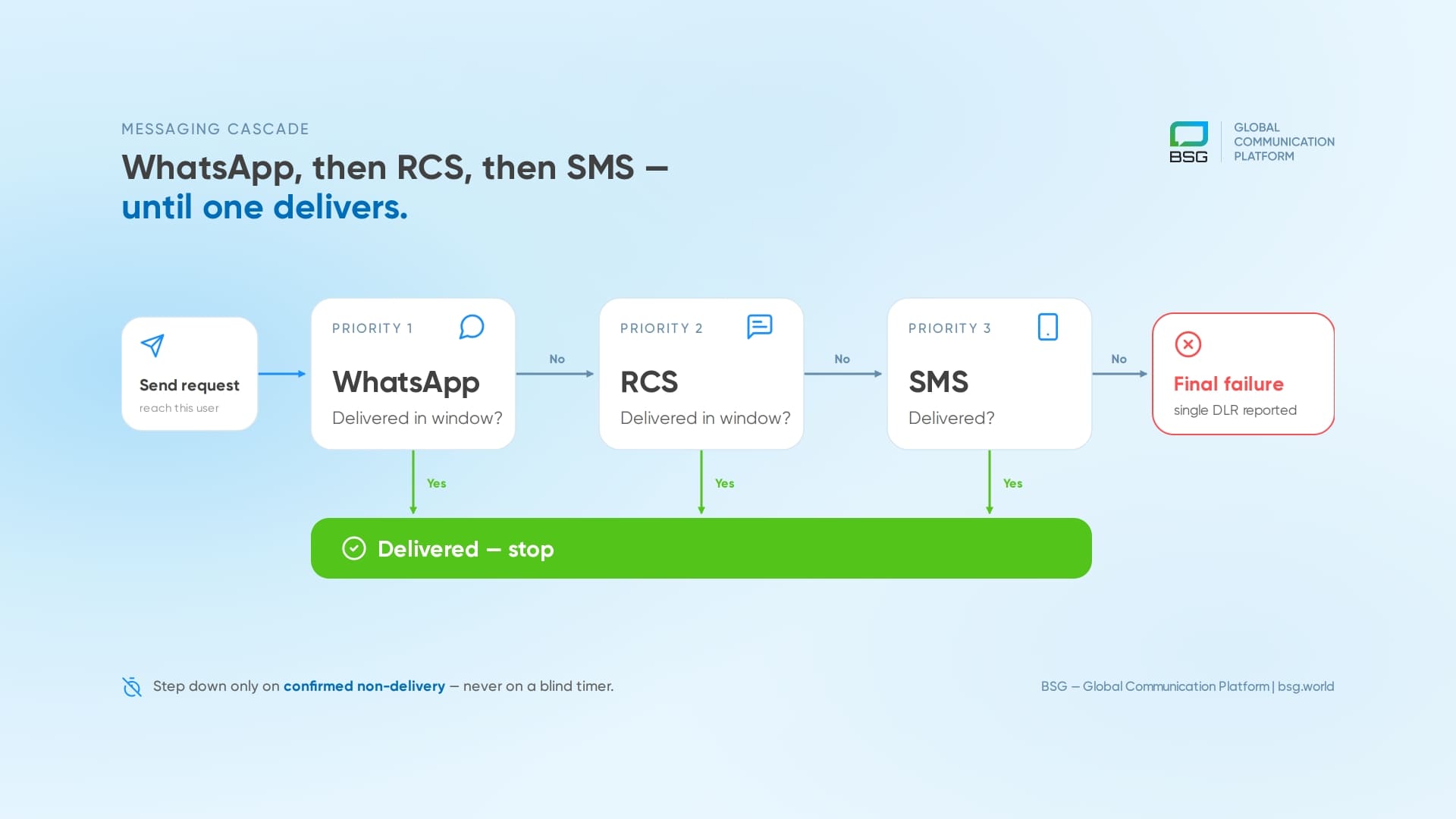
This is where a one api messaging approach earns its place. You define a priority order — try WhatsApp first, fall back to RCS, then SMS — and the platform executes the sequence. Your code states the intent, "reach this user," and the communication api handles the order of attempts. The cascade routing lives in infrastructure that is tested across millions of messages, not in a retry loop someone wrote the night before a launch.
Unified analytics and delivery reports
One webhook format. One schema for delivery status, whether the message landed via RCS or SMS. Instead of stitching five dashboards together to answer "did this campaign reach people," you query one source. That single view is also what makes honest channel comparison possible — you can finally see which channel actually performs, per market, and price accordingly.
Communication API vs Separate Integrations — Side by Side
The trade-off becomes clear when you line up the work. A separate-integration approach front-loads speed for the first channel and then pays interest on every channel after it.
| Criteria | One API (BSG) | Five Separate APIs |
|---|---|---|
| Integrations to build & maintain | One | Five |
| Authentication | One credential / API key | Five auth schemes |
| Webhook / delivery format | One unified format | Five different formats |
| Fallback between channels | Built-in cascade (configured) | Custom code you maintain |
| Delivery analytics | Unified, one source | Five separate dashboards |
| Adding a new channel | Configuration flag | New integration project |
| Vendor relationships | One | Five |
| Billing | One invoice | Five reconciliations |
| Time to first message | Minutes (Postman) | Days per channel |
With five separate APIs, you build and maintain five integrations, manage five authentication schemes, and parse five webhook formats. Fallback is custom code you own forever. Delivery analytics live in five places, and adding a sixth channel means starting the whole cycle again. With a single communication api, you build one integration, authenticate once, and parse one response format. Fallback is a configured cascade rather than code you maintain. Analytics are unified, and adding a channel is a configuration flag rather than a project with its own timeline.
The maintenance math is the part engineering leaders feel most. One vendor relationship instead of five. One status page to watch instead of five. One invoice to reconcile instead of five billing exports that never quite agree. In our experience working with SMB engineering teams, the first integration is rarely the bottleneck — the real cost is keeping five of them alive while shipping everything else the business is waiting on.
The reason you cannot simply pick one channel and ignore the rest is reach. WhatsApp passed two billion users years ago (Meta). RCS crossed 1.1 billion active users in 2024 and is forecast to keep climbing (Juniper Research, 2024). SMS still reaches essentially every handset on earth. Different customers live on different channels, so the real question was never "which one" — it was "how do I run all of them without owning five integrations."
How BSG One API Handles Message Cascade
Cascade is easy to describe and hard to operate. The logic that decides which channel to try, when to give up, and what "delivered" actually means has to run reliably at volume — which is precisely the part you do not want living inside your own application.
Priority logic
You set the order per use case. A marketing message might run WhatsApp to RCS to SMS to favor rich media. A one-time password might run SMS to Viber to favor speed and universal reach. Our message cascade logic applies your priority and only moves down the chain when a channel genuinely fails to deliver — not on a blind timer that fires whether the message landed or not.
Fallback timing
Timing is where naive fallback wastes money. Move too fast and you pay for two channels when the first would have arrived. Move too slow and a time-sensitive code expires before the next attempt. The cascade uses per-channel delivery confirmation windows: it waits for a real delivery signal within a defined window before stepping down, so you are not double-charged for a message that was about to succeed.
Cost optimization (cheapest delivered channel)
The goal is not the cheapest channel. It is the cheapest channel that actually delivers. At BSG, we have seen that routing through 0-hop direct carrier connections changes the math: when the primary channel lands reliably, the cascade rarely needs to step down, so the blended cost stays close to the cheapest tier instead of stacking paid retries. One logistics client we worked with cut duplicate sends sharply after moving fallback off their own servers and onto the cascade. Their old setup fired an SMS backup on a fixed timer whenever a WhatsApp notification was not confirmed fast enough, which meant they often paid for both — even when the WhatsApp message had, in fact, been delivered a second later. With confirmation-based timing, the same delivery-update notifications reached customers, with far fewer paid attempts behind them.
Developer Experience — A Quick Start in 15 Minutes
The clearest test of a communication api is how quickly a developer who has never seen it can send a message. With a unified messaging api, the answer should be measured in minutes, not in a sprint.
Authentication
One credential. You generate an API key once and use it for every channel — SMS, WhatsApp, Viber, RCS — instead of registering separately with each provider and tracking four token lifecycles. Channel-specific onboarding, such as a WhatsApp sender or an RCS profile, still happens, but it happens once inside one account rather than across five portals.
Send your first message
A single POST request sends a message and names the channel. To add fallback, you list channels in priority order inside the same request — no extra integration, no second SDK. The same request shape sends an SMS, a WhatsApp template, or an RCS card. Only the payload changes. Full request and response examples, including the cascade parameters, live in the BSG developer portal.
Postman collection
The fastest way to feel the difference is to send a message before you write any code. A ready Postman collection lets a developer fire a live message in a few minutes — the practical proof that one integration has replaced five. Teams who have shipped multi-channel the hard way notice what is missing here: the four other integrations they would normally be starting this week. It also helps to map where each channel fits before you build, which is exactly what a use-case breakdown by industry is for. That planning step is cheap when adding a channel is a flag, and expensive when it is another integration.
Start Here
If you are weighing whether to add another channel integration or replace the ones you already maintain, the fastest way to judge a communication api is to send a message through it. BSG One API puts SMS, WhatsApp, Viber, and RCS behind a single endpoint with cascade built in, so you can open a sandbox and send a test message in about five minutes. And if you would rather map your channels and fallback logic with someone who has run this at volume first, our team is glad to walk through it with you.
FAQ
What is a communication API?
A communication API is a single programmable interface that lets an application send and receive messages across multiple channels — SMS, WhatsApp, Viber, RCS, email, and voice — through one integration and one authentication step. Instead of connecting to each channel provider separately, you connect once and choose the channel as a parameter in the request.
Is one communication API actually cheaper than separate integrations?
The integration cost is usually similar; the savings arrive afterward. One vendor, one webhook format, and built-in fallback remove the ongoing maintenance, orchestration code, and billing reconciliation that five separate APIs demand. A well-tuned cascade also avoids paying for two channels when the first would have delivered on its own.
What is message cascade in an omnichannel messaging api?
Message cascade is automatic fallback across channels in a set priority order — for example, WhatsApp first, then RCS, then SMS. If the primary channel fails to confirm delivery within a defined window, the API retries on the next channel, so a single request can still reach the user on whichever channel works.
How long does it take to integrate a unified messaging api?
With one endpoint, one credential, and one response format, a developer can send a first live message in minutes using a Postman collection. A basic production integration usually takes hours, rather than the days that each separate channel integration would consume on its own.


Interested in a special offer?
Ready to reach further?
Let’s talk


Related articles
Companies deciding to employ SMS marketing strategy want to create effective texting lists. For this

Security is the backbone of any enterprise requiring customers to input personal information. Weak infrastructure,

In the world of millions of intricately intertwined Internet of Things (IoT) devices, technological development