




Communication API
What is a communication API?
A communication API is a single programmable interface for sending and receiving messages across multiple channels — SMS, WhatsApp, Viber, RCS, email and voice — through one integration. Also called a CPaaS API, it is the programmable layer a business connects to in order to reach customers across messaging and voice channels without building a separate integration for each one.
For the practical side of this, check out BSG's One Communication API for SMS, WhatsApp, Viber & RCS — Why It Beats Five.
How does a communication API work?
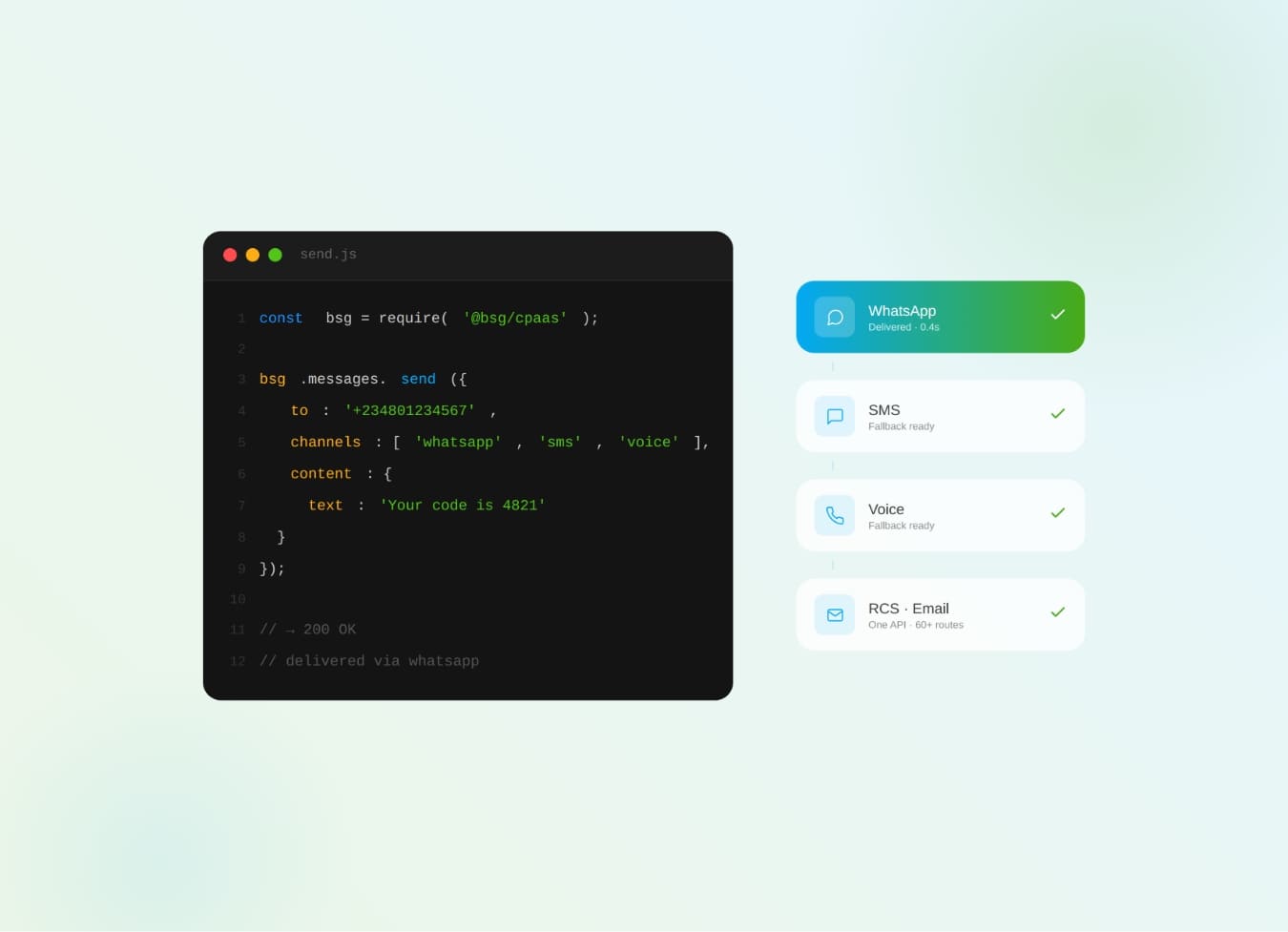
Instead of connecting individually to SMS carriers, the WhatsApp Business API, Viber, RCS and email, a developer authenticates once and selects the channel as a parameter in the request. The provider handles translation to each underlying channel, plus delivery reporting in a single unified format. Stronger communication APIs also include cascade logic, so a single request can fall back from one channel to another automatically when the first does not confirm delivery.
Why use a communication API instead of separate APIs?
The practical value is lower maintenance and faster channel rollout: adding a channel becomes a configuration change rather than a new project. For engineering teams, the trade-off is clear — one endpoint, one credential and one set of delivery reports replace five of each. A common example: a fintech sends a one-time password via SMS, and if delivery is not confirmed in time, the same request retries on Viber, all through one API call.


Interested in a special offer?
Ready to reach further?
Let’s talk


Related Terms
Explore BSG Solutions
Useful Materials
![WhatsApp Business API: Complete Guide — Setup, Pricing, Use Cases [2026]](/assets/img/blog/whatsapp-business-api-setup-pricing-use-cases-guide_avatar.jpg)
WhatsApp Business API for 2026 — setup steps, the new per-message pricing model, and proven use cases by industry.
What is CPaaS? The cloud API layer that adds SMS, WhatsApp, voice & OTP to your apps — how it works and why it beats a multi-vendor stack.
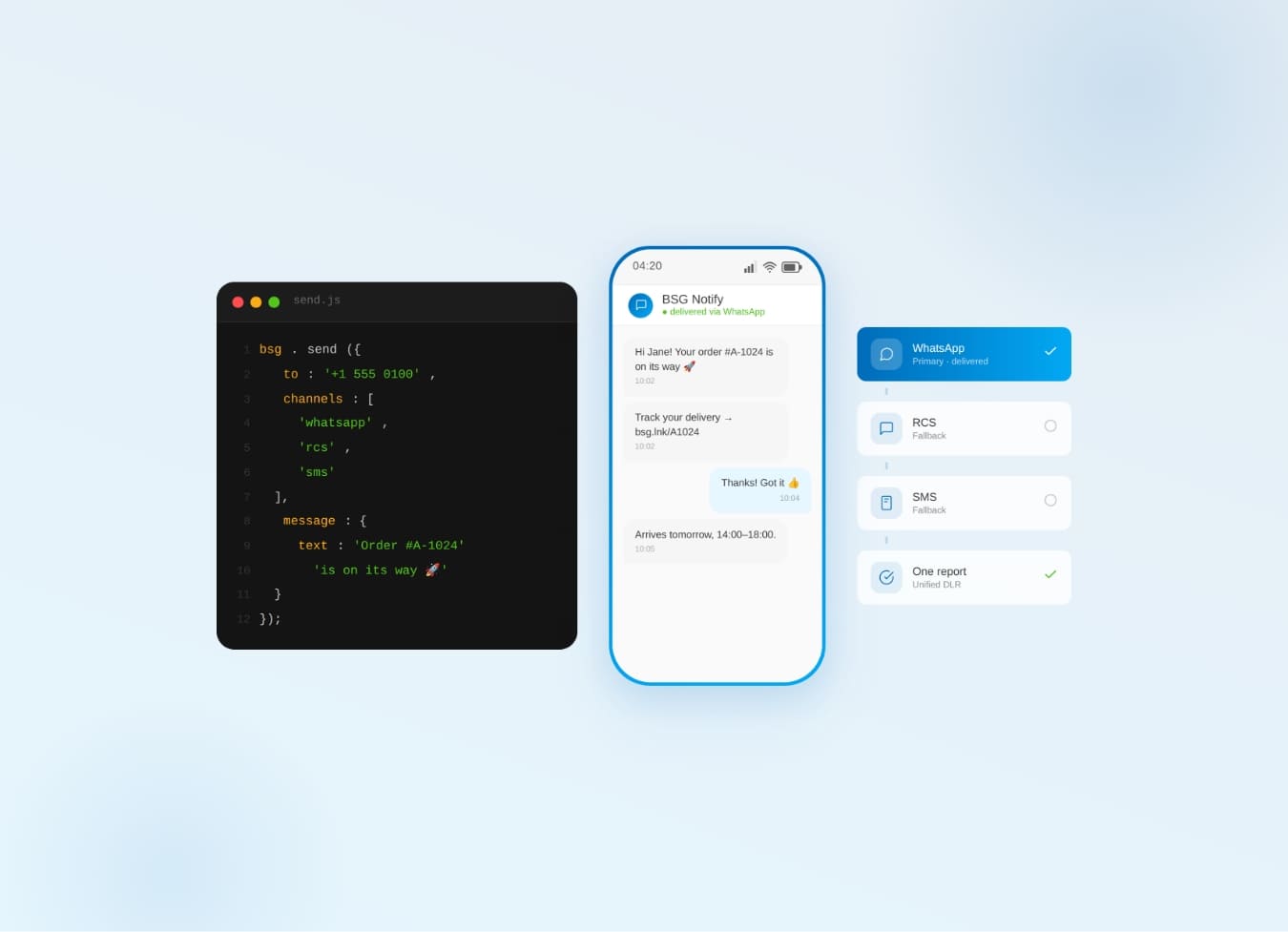
Why one communication API for SMS, WhatsApp, Viber & RCS beats five separate integrations — cascade fallback, unified reports.