





The finance team opens the monthly invoice and the WhatsApp line has doubled. Same audience, same campaigns, a bigger number. Nothing was misconfigured. The cost model changed underneath them.
If you are budgeting around WhatsApp API pricing in 2026, the single most important fact is this: Meta retired the old conversation-based model and now charges per delivered message. That one change breaks every spreadsheet built on the old assumptions, including the "first 1,000 conversations free" line that finance teams leaned on for two years. That allowance is gone, and so is the idea that one 24-hour window covers unlimited template sends.
This guide breaks down how the new model works, what a message actually costs by region, where provider markup hides, and five tactics that cut the bill without cutting reach. We operate the routing behind this kind of messaging, so the tradeoffs here come from running campaigns, not from a rate card alone. If WhatsApp is already core to your customer journey, our WhatsApp for business use cases by industry shows where it earns its rate.
How WhatsApp API Pricing Works in 2026 (Per-Message Model)
Since 1 July 2025, the WhatsApp Business API bills on a per-message pricing basis: every template message you send is its own line item, priced by the recipient's country and message category (Meta Developer Documentation, 2026). The old conversation-based pricing — one flat fee per 24-hour window — has been retired.
For low-volume senders, the difference is small. For anyone sending at scale, it is the gap between a predictable flat cost and a bill that grows with every individual send. The mechanics below decide which side of that gap you land on.
The Four Message Categories — Marketing, Utility, Authentication, Service
Every template you send carries a category, and the category sets the rate. There are four, and the spread between them is wide.
- Marketing: promotions, broadcasts, abandoned-cart nudges, re-engagement. The most expensive category, charged on every delivery.
- Utility: order confirmations, shipping updates, payment reminders. Priced far lower than marketing, and free when sent inside an open service window.
- Authentication: one-time passwords and verification codes. Cheap in most markets, but some carry a separate, higher Authentication-International rate.
- Service: customer-initiated support replies. Free within the 24-hour customer service window.
The practical consequence: a retailer sending an order confirmation pays a utility rate, while the same retailer sending a flash-sale broadcast pays a marketing rate several times higher. Miscategorize the template and you either get it blocked or pay the wrong rate.
Who Pays, and When
You pay for business-initiated template messages. The rate follows the recipient's phone number country code, not your company's location (Meta Developer Documentation, 2026). A business in Berlin messaging a customer in Lagos pays Nigeria's rate, not Germany's.
In our experience, the teams that get burned are the ones that budget a single blended global rate. The bill is set market by market, so the planning has to be too — a campaign that looks cheap on an average is rarely cheap once you split it by destination.
What's Still Free — Service Windows and Free Entry Points
The free first-1,000-conversations tier is gone, but free messaging still exists. It just works differently now, and most teams underuse it.
- Service window: when a customer messages you, a 24-hour window opens. Inside it you can send free-form replies and even utility templates at no charge, and each new inbound message resets the clock (Meta Developer Documentation, 2026).
- Free entry points: a customer who taps a Click-to-WhatsApp ad opens a 72-hour free window, long enough to qualify a lead or close a support thread without a paid template (Meta Developer Documentation, 2026).
Across the deployments we support, the single biggest avoidable cost is sending a paid template to a customer who messaged ten minutes ago. The reply was free. The template was not. Mapping which conversations already sit inside a free window is the fastest audit a finance team can run.
WhatsApp API Price by Region
Marketing rates swing more than 10x between markets, so where your customers are matters as much as how many messages you send. The table shows approximate marketing rates per delivered message for 2026. Meta updates these on a fixed quarterly calendar — 1 January, 1 April, 1 July, 1 October — so treat them as a planning baseline, not a contract (Meta Developer Documentation, 2026).
| Recipient market | Marketing (per message) | Notes |
|---|---|---|
| India | ~$0.011 | Utility dropped to ~$0.0014 — among the cheapest globally |
| Rest of Africa (incl. Kenya) | ~$0.0225 | Lowest-cost African tier |
| North America (US / Canada) | ~$0.025 | US marketing routed via the MM Lite API |
| Mexico | ~$0.031 | Mid-tier Latin America |
| United Kingdom | ~$0.048 | Standard Western Europe band |
| UAE | ~$0.050 | Authentication-International premium applies |
| Brazil | ~$0.063 | High-volume Latin American market |
| Germany | ~$0.124 | Among the most expensive markets |
Utility and authentication messages cost far less than marketing — typically under $0.01 per message in most markets — and both carry volume tiers that lower the rate further as monthly volume grows (Meta Developer Documentation, 2026). Nine markets, including Nigeria, South Africa, the UAE, India and Indonesia, apply a separate Authentication-International rate for cross-border one-time passwords, which can run several times the domestic rate (Meta Developer Documentation, 2026).
For the emerging-market clients we work with, that one detail — domestic versus international authentication rate — often moves the OTP budget more than message volume does. Kenya sits in the low-cost Rest of Africa tier, while Nigeria and South Africa carry the international premium when codes are sent from a foreign account. The fix is structural, not promotional: register the sending account in-country and the domestic rate applies.
BSP Markup — What Providers Charge on Top of Meta
Meta's rate is only half the invoice. You reach the API through a Business Solution Provider (BSP), and every BSP adds its own layer (Meta Developer Documentation, 2026). That layer is where pricing usually turns opaque.
The markup shows up in several shapes: a flat per-message fee on top of Meta's rate; a percentage markup, commonly somewhere in the 15-25% range; monthly fees per phone number; minimum spend commitments; and an FX margin when the provider bills in a currency different from Meta's USD rate card. Each is defensible on its own. Stacked and undisclosed, they can take the real cost to two or three times the headline Meta rate.
Transparent Pricing vs Hidden Fees
The pattern we see most often is a low advertised per-message rate paired with fees that only surface on the invoice. A team compares two providers on the marketing rate alone, picks the cheaper headline, then discovers a per-number monthly charge, a platform subscription, and an FX spread that erase the saving. The provider with the slightly higher per-message rate and no add-ons was cheaper the whole time.
At BSG we price the markup as a single visible line: the Meta pass-through plus a stated margin, without per-number surcharges or hidden currency spreads. The point is not that transparency is a feature — it is that a number you cannot see is a number you cannot plan around, and a WhatsApp budget that cannot be planned is the original problem.
Five Ways to Reduce WhatsApp API Costs
The per-message model rewards design. Teams that architect flows around free windows and the right channel mix routinely run well below teams that push everything through paid marketing templates. A message cascade that cuts cost and lifts delivery is one lever; here are the five that move the bill most.
1. Maximize Free Service Windows
Route as much as the rules allow into the 24-hour service window. When a customer initiates, answer with free-form messages and utility templates inside the window instead of firing paid templates afterward. Design support and post-purchase flows so customers keep replying, because each reply resets the free clock.
2. Batch and Consolidate Notifications
Because Meta now bills per message, three separate updates cost three times one combined update. Where the customer experience allows, consolidate "order confirmed," "packed," and "shipped" into fewer, well-timed templates. This is the exact reverse of the old model, where extra messages inside a window were free — a habit that now quietly inflates the invoice.
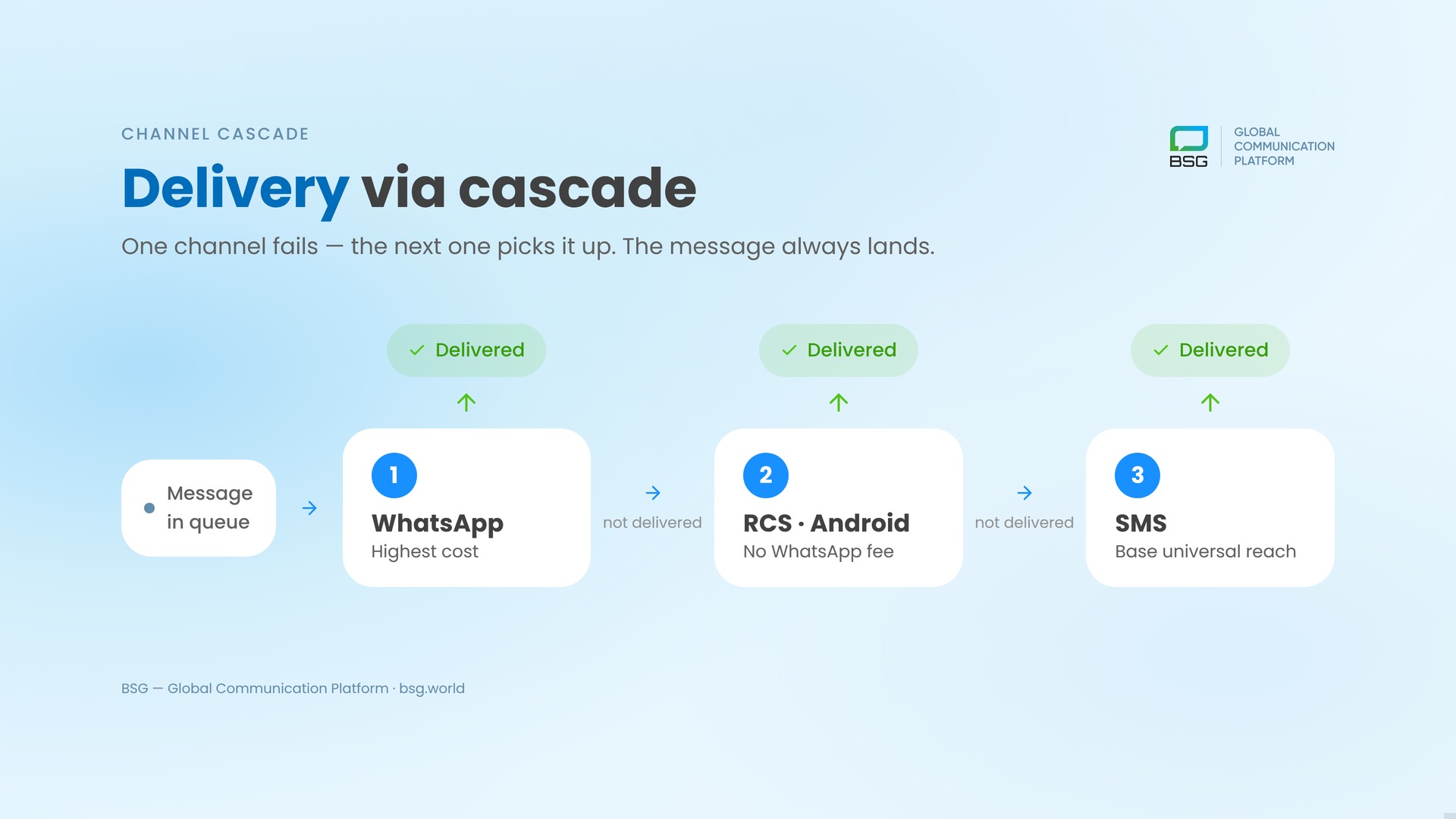
3. Cascade WhatsApp to RCS to SMS for Non-Critical Messages
For messages that do not require WhatsApp specifically, a cascade routing setup sends through the cheapest channel that will reach the customer and falls back only when needed. On Android, RCS messaging can carry rich content without a per-message WhatsApp fee; where neither lands, Bulk SMS is the universal floor.
In the campaigns we support, moving non-critical notifications off WhatsApp into a RCS-then-SMS cascade is the fastest single cut we see, and it does not touch reach on the messages that genuinely need WhatsApp. The skill is deciding which messages are non-critical, not building the routing.
4. Optimize Templates to Cut Rejections and Re-sends
You pay for delivered messages, but rejected templates and re-sends after failures still cost budget and time. A marketing template miscategorized as utility gets blocked or rebilled at the wrong rate. Write to the category rules, keep variables clean, and get templates approved before campaign day rather than during it.
5. Monitor Spend with a Real-Time Analytics Dashboard
You cannot optimize what you cannot see split by category and market. Track cost per message by category, by recipient market, and by template, so the expensive segments are obvious before the quarter closes. A dashboard that breaks spend down this way turns a quarterly billing surprise into a weekly adjustment.
How to Calculate Your WhatsApp API Costs
You can estimate a monthly bill with one formula, applied per market and per category:
Monthly cost = Σ (messages per category per market × Meta rate for that category and market) + BSP markup − messages that fall inside free service windows and entry points.
A worked example makes the category effect obvious. Take a mid-size retailer with this monthly mix:
| Item | Volume | Rate | Cost |
|---|---|---|---|
| Marketing broadcasts to Brazil | 40,000 | ~$0.063 | ~$2,520 |
| Utility order updates to India | 60,000 | ~$0.0014 | ~$84 |
| Service replies inside 24h window | 25,000 | Free | $0 |
| Meta pass-through subtotal | ~$2,604 | ||
| Transparent BSP margin (illustrative 20%) | ~$521 | ||
| Estimated monthly total | ~$3,125 |
Notice the shape of it: 60,000 utility messages cost less than 1,400 of the Brazil marketing messages. The category mix and the destination markets, not the raw volume, drive the bill. A public rate card cannot do this math for you, because it does not know your split — which is exactly where a tailored model earns its place.
Size Your Real WhatsApp Cost
If you are building a WhatsApp budget for 2026, the cost depends on your exact market mix, your category split, and how much traffic you can move into free windows — none of which a public rate card can estimate. We can model your real cost across markets and show where a transparent pass-through saves against a marked-up rate. Talk to the BSG team and we will calculate WhatsApp API pricing for your business, market by market.
FAQ
Is the WhatsApp API still free for the first 1,000 conversations a month?
No. Meta retired the 1,000-free-conversations allowance when it moved to per-message pricing on 1 July 2025 (Meta Developer Documentation, 2026). Free messaging now comes from the 24-hour customer service window and 72-hour free entry points from Click-to-WhatsApp ads, not a monthly conversation quota.
How much does a WhatsApp marketing message cost in 2026?
It depends on the recipient's country. Marketing rates range from roughly $0.011 per message in India to about $0.124 in Germany, with most markets falling in between (Meta Developer Documentation, 2026). Utility and authentication messages cost far less, often under $0.01.
Do I pay per message or per conversation now?
Per message. Since 1 July 2025, every delivered template message is billed individually, replacing the old per-conversation model where one 24-hour window covered unlimited sends (Meta Developer Documentation, 2026).
What is the difference between utility and marketing message pricing?
Marketing messages — promotions and broadcasts — carry the highest rate. Utility messages — order updates, reminders, confirmations — are priced far lower and are free when sent inside an open service window. Choosing the correct template category is one of the simplest ways to control cost.


Interested in a special offer?
Ready to reach further?
Let’s talk


Related articles

The start of the school year: when parents trade in their summer margaritas for the

Businesses in different countries and cities are going through the coronavirus pandemic variously. Across all
SMS marketing is indispensable in today’s retail landscape for its direct and immediate communication. With