




Student Engagement on WhatsApp & SMS: A 5-Node Flow That Cuts Drop-Off

A learner pays for your course on Monday, watches lesson one on Tuesday and misses Thursday's session because of a work deadline. Nobody contacts them, and a few weeks later the subscription quietly lapses. For online schools and EdTech companies, this is where revenue leaks: not through refunds, but through renewals and second courses that never happen.
Student engagement on WhatsApp and SMS fixes this only when it is built as a conversation, not a broadcast. This playbook lays out the student path as five nodes — enrollment, first lesson, missed lesson, deadline and certificate — behind a consent gate. Each node follows one logic: a trigger fires, a message goes out, the flow branches on what the learner does, and the channel fits the moment.
Why Learners Drop Off After the First Lessons
Drop-off starts at the very beginning of a course. In an analysis of 12.67 million course registrations across Harvard and MIT courses on edX, 52% of registrants never entered the courseware at all, and attrition stayed high through the first two weeks (Reich & Ruipérez-Valiente, Science, 2019). Paying did not solve it: among learners on the paid certificate track, 46.02% completed their course in 2017–18, per the same dataset.
Your own cohort numbers will differ from open courses, but the pattern points to the start of the course: the gap between purchase and the first lesson, and the first weeks of study. There is also experimental evidence that timely text outreach changes outcomes. In a randomized trial with 2,483 students in two large online courses at Georgia State University, learners who got 2–3 personalised texts a week from a course chatbot (reminders, notes on missing work, the option to reply) were 4 percentage points more likely to earn an A or B than the control group, where 61% did (Meyer et al., EdWorkingPaper 22-564, 2026). That is the core of student retention messaging: messages tied to what the learner did or didn't do.
How to Read the Flow: Trigger, Message, Branch, Channel
Every node has four parts. The trigger is a behavioral trigger — an event your LMS or CRM records, such as "enrolled" or "no login for 3–5 days". The message is one text with one action. The branch decides the next step based on whether the learner acted. The channel fits the job: WhatsApp for buttons and replies, a course reminder SMS for time-critical notices or as a fallback.
| Node | Trigger | Message | Branch | Channel |
|---|---|---|---|---|
| 0. Consent gate | Checkout | Service and marketing opt-in | Marketing consent: yes / no | Web form |
| 1. Enrollment | Course purchased | Welcome + lesson link | Lesson 1 started within 24 h? | |
| 2. First lesson | No lesson opened after 24 h | "Lesson 1 takes about 15 minutes" | Started → track; silent → node 3 | |
| 3. Missed lesson | No login for 3–5 days | "You stopped at lesson 3" + button | Delivered? Back within 48 h? | WhatsApp → SMS fallback |
| 4. Deadline | Assignment due tomorrow | Due-date reminder | Submitted → close; missed → tutor | SMS |
| 5. Certificate | Course completed | Certificate | Marketing consent → next-course offer |
Timings are starting points to tune per course. Node 3 loops: a learner can stall at lesson 3, return and stall again at lesson 6, so it fires on every gap, with a weekly cap.
Student Engagement on WhatsApp, Node by Node
These online course reminders are written as WhatsApp message templates — the pre-approved formats Meta requires for business-initiated messages — plus two SMS versions. Variables in double braces come from your LMS.
Node 1: Enrollment
Trigger: payment is completed and the course is assigned in the LMS.
Message (WhatsApp):
Hi {{first_name}}, welcome to {{course_name}}! Your first lesson is ready whenever you are. Reply HELP if you can't log in. [Start lesson 1]
Branch: lesson 1 started within 24 hours → normal progress tracking; not started → node 2; HELP reply → support conversation.
Channel: WhatsApp, because a reply here is useful.
Node 2: First Lesson
Trigger: 24 hours after enrollment, no lesson has been opened.
Message (WhatsApp):
Hi {{first_name}}, lesson 1 of {{course_name}} takes about {{lesson_length}} minutes. Ready to start today? [Start now]
Branch: a tap or lesson start closes the node; silence hands the learner to node 3 instead of a second nudge that week.
Channel: WhatsApp, for the one-tap button.
Node 3: Missed Lesson
Trigger: no login for 3–5 days during an active course.
Message (WhatsApp):
Hi {{first_name}}, you stopped at lesson {{lesson_number}}: "{{lesson_title}}". Pick up exactly where you left off. [Continue lesson {{lesson_number}}]
Fallback (SMS):
{{school_name}}: you stopped at lesson {{lesson_number}} of {{course_name}}. Continue here: {{short_link}}
Live-cohort variant (WhatsApp): if your course runs scheduled live sessions, trigger node 3 on a missed session instead:
Hi {{first_name}}, we missed you today! Here's what we covered and your homework: {{recording_link}}. Next lesson is {{next_date}} at {{time}}. See you there?
Branch: WhatsApp not delivered → SMS. Back within 48 hours → close; question in reply → tutor; no response → wait for the next gap.
Channel: WhatsApp first, SMS fallback.
Node 4: Deadline
Trigger: an assignment is due within 24 hours, not yet submitted.
Message (SMS):
{{school_name}}: your {{assignment_name}} for {{course_name}} is due tomorrow at {{time}}. Submit here: {{short_link}}
Branch: submission closes the node. A missed deadline flags the learner for a tutor check-in.
Channel: course reminder SMS — short, time-critical, no button needed.
Node 5: Certificate
Trigger: the final assessment is passed.
Message (WhatsApp):
Congratulations, {{first_name}}! You've completed {{course_name}}. Your certificate is ready. [Download certificate]
Branch: only learners with marketing consent get the follow-up offer.
Offer (WhatsApp, marketing):
{{first_name}}, ready for the next step after {{course_name}}? {{next_course}} starts on {{start_date}}. [See the programme] Reply STOP to stop receiving offers.
Channel: WhatsApp, as two separate messages, because Meta treats any template that mixes utility and promotional content as marketing (Meta for Developers, 2026).
WhatsApp vs Course Reminder SMS: Channel Rules Inside the Flow
WhatsApp wins wherever the learner needs to act inside the message. Meta defines a utility template as non-promotional and specific to the user's order, account or service, and it can recategorise a template as marketing after review (Meta for Developers, 2026). Nodes 1–3 and the certificate fit that definition when they reference the learner's own course and carry no offer. That is why WhatsApp for education works best as a service channel first, and why student engagement on WhatsApp should rest on utility templates.
The customer service window is what turns a node into a conversation. When a learner messages you, a 24-hour window opens in which you can reply with free-form messages; once it closes, only pre-approved templates can be sent (Meta for Developers, 2026). A learner who answers node 3 with "I'm stuck" gets a tutor's reply inside it. Replies are common when they are invited: in the Georgia State trial, 54% and 43% of messaged students in the two courses wrote back to the chatbot at least once (Meyer et al., 2026).
eLearning SMS earns its place in node 4 and as the node 3 fallback: it reaches any mobile phone without an app, which matters for learners who don't use WhatsApp or can't install apps on a work device.
The fallback itself is cascade routing: the message goes to BSG WhatsApp Business API first and switches to SMS if it isn't delivered. With BSG, this rule lives on our side, not in your LMS: one request, one delivery report, whichever channel delivered — the approach behind our one communication API for SMS, WhatsApp, Viber and RCS.
Node 0: The Consent Gate
Consent decides whether the flow may run at all, so it sits before node 1. Meta requires businesses to obtain opt-in before messaging people on WhatsApp, and the opt-in must clearly state the business name (Meta for Developers, 2025). Where you rely on consent, GDPR requires it to be demonstrable, as easy to withdraw as to give, and not a condition for a service that doesn't need it (GDPR, Art. 7). In practice: never make course access depend on accepting promotional messages.
In the UK, PECR bars marketing texts to individuals without specific consent, apart from a limited "soft opt-in" exception for existing customers (ICO, 2026). Nodes 1–4 and the certificate are service messages; the offer is marketing. So the gate collects two permissions:
- Service consent: "Send me lesson reminders, deadlines and my certificate from {{school_name}} via WhatsApp or SMS."
- Marketing consent (optional, unticked by default): "Send me offers about new courses from {{school_name}} via WhatsApp or SMS."
- Consent record: store the timestamp, wording shown, channel and source page.
Every promotional message carries an opt-out route, such as STOP, honoured on both channels. On single versus double opt-in, see what SMS opt-in means and why it matters. Rules differ by market, so confirm final wording with your DPO.
What to Measure at Each Node
Give every node one behavioural metric and compare against a small hold-out group. Watch opt-outs too: in the Georgia State trial, only 3–4% of students opted out over a semester of 2–3 messages a week (Meyer et al., 2026), a useful benchmark for your own frequency.
| Node | Metric | How to calculate |
|---|---|---|
| 1–2 | First-lesson activation | Enrolled learners who start lesson 1 within 7 days ÷ all enrolled learners |
| 3 | Lesson return rate | Learners who open a lesson within 48 hours of a missed-lesson message ÷ learners who received it |
| 4 | On-time submission rate | Assignments submitted before the deadline ÷ assignments due |
| 5 | Next-course conversion | Certificate holders who buy the next course within 30 days ÷ all certificate holders |
| Whole flow | Course completion rate | Learners who finish the course ÷ learners who started it |
| Every node | Opt-out rate | Opt-outs ÷ messages delivered |
Read the metrics as a chain: if lesson return rate is healthy but completion is flat, the problem sits later in the course, not in your WhatsApp student engagement flow. Delivery status is the first filter: every message through BSG returns a delivery report, separating "ignored" from "never arrived".
Build Your Student Retention Flow
If you are planning student engagement on WhatsApp and SMS for an online school, EdTech platform or corporate academy, start with the consent gate and nodes 1–3, which cover the first weeks of a course, where the data above shows the steepest drop-off. BSG connects WhatsApp and SMS behind one API with cascade fallback and delivery reports, so your LMS sends one request per node. See how this works in BSG messaging for online schools and EdTech, or talk to our team about mapping your own course flow.
FAQ
Can online schools send course reminders on WhatsApp without consent?
No. Meta requires opt-in before a business messages people on WhatsApp, and the opt-in must name the business. In the EU and UK, promotional messages are also restricted by ePrivacy rules and PECR, so collect separate permissions for service and marketing messages.
Is a lesson reminder a utility or a marketing template on WhatsApp?
A lesson reminder can qualify as a utility template when it refers to the learner's own purchased course and contains no promotional content. Adding a discount, an upsell or a new-course offer makes it a marketing template under Meta's rules.
When should I use SMS instead of WhatsApp for students?
Use SMS for short, time-critical notices such as assignment deadlines, and as a fallback when a WhatsApp message isn't delivered. Choose WhatsApp for education messages where the learner needs buttons, files or a two-way conversation with a tutor.
What should I measure in student retention messaging?
Track first-lesson activation, lesson return rate, on-time submissions, course completion and next-course conversion, each against a hold-out group that received no messages.
Interested in a special offer?
Ready to reach further?
Let’s talk


Related articles
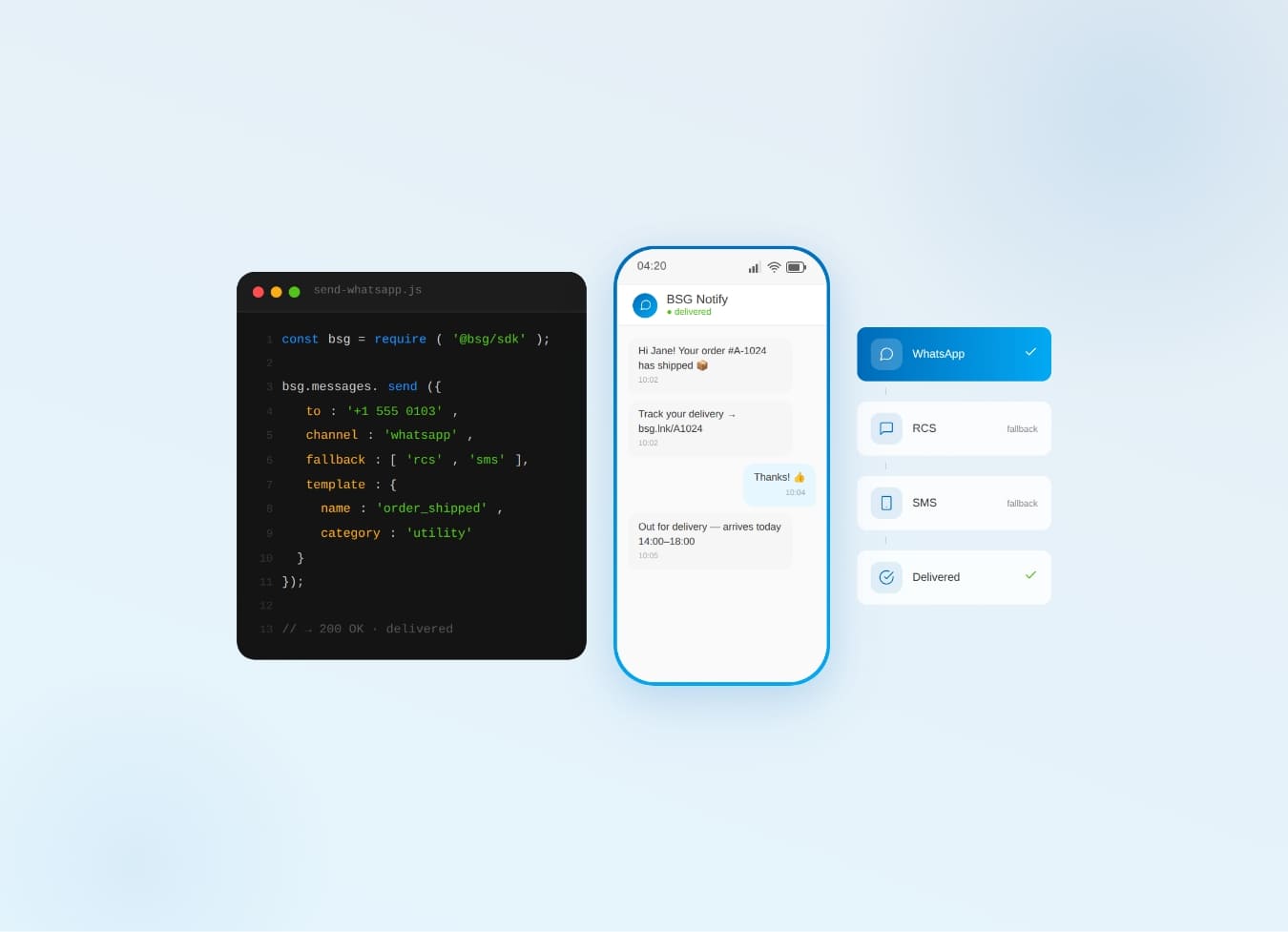
WhatsApp Business API for 2026 — setup steps, the new per-message pricing model, and proven use cases by industry.
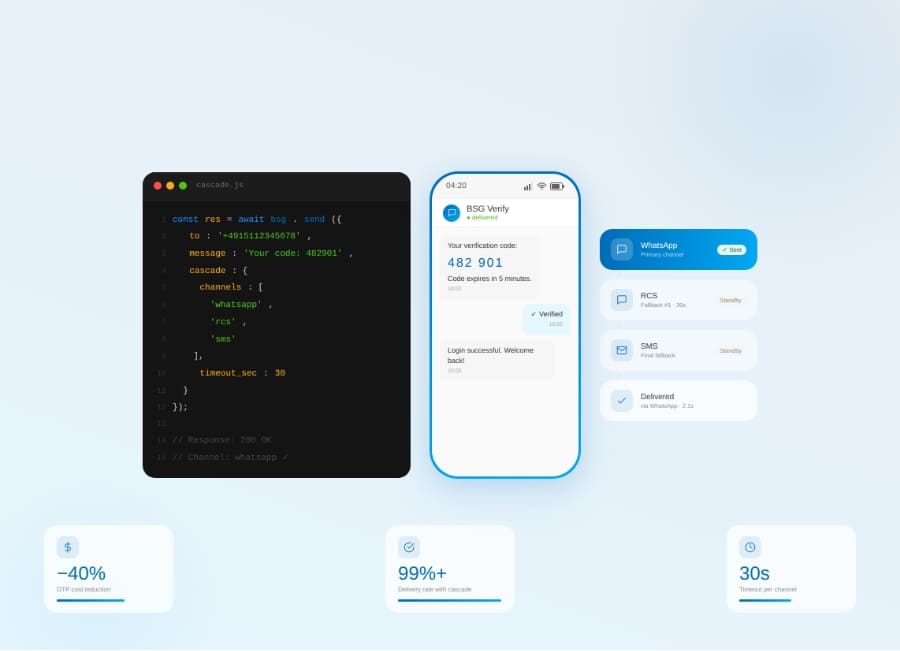
Server-side cascade routing across WhatsApp, RCS, and SMS — how it cuts OTP costs 20–40% with one API call.
10 real-world WhatsApp Business API use cases — cart recovery, KYC, delivery tracking, claims, onboarding, and more.